Ephrin-B1 (EFL-3) (ELK ligand) (ELK-L) (EPH-related receptor tyrosine kinase ligand 2) (LERK-2) [Cleaved into: Ephrin-B1 C-terminal fragment (Ephrin-B1 CTF); Ephrin-B1 intracellular domain (Ephrin-B1 ICD)]
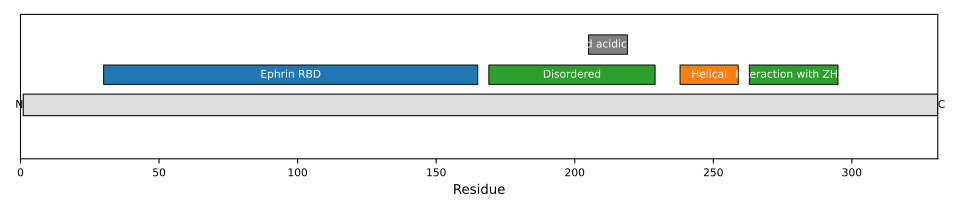
1_MARPG 6_ QRWLG 11_ KWLVA 16_ MVVWA 21_ LCRLA 26_ TPLAK 31_ NLEPV 36_ SWSSL 41_ NPKFL 46_ SGKGL 51_ VIYPK 56_ IGDKL 61_ DIICP 66_ RAEAG 71_ RPYEY 76_ YKLYL 81_ VRPEQ 86_ AAACS 91_ TVLDP 96_ NVLVT 101_ CNRPE 106_ QEIRF 111_ TIKFQ 116_ EFSPN 121_ YMGLE 126_ FKKHH 131_ DYYIT 136_ STSNG 141_ SLEGL 146_ ENREG 151_ GVCRT 156_ RTMKI 161_ IMKVG 166_ QDPNA 171_ VTPEQ 176_ LTTSR 181_ PSKEA 186_ DNTVK 191_ MATQA 196_ PGSRG 201_ SLGDS 206_ DGKHE 211_ TVNQE 216_ EKSGP 221_ GASGG 226_ SSGDP 231_ DGFFN 236_ SKVAL 241_ FAAVG 246_ AGCVI 251_ FLLII 256_ IFLTV 261_ LLLKL 266_ RKRHR 271_ KHTQQ 276_ RAAAL 281_ SLSTL 286_ ASPKG 291_ GSGTA 296_ GTEPS 301_ DIIIP 306_ LRTTE 311_ NNYCP 316_ HYEKV 321_ SGDYG 326_ HPVYI 331_ VQEMP 336_ PQSPA 341_NIYYK
1: Cell surface transmembrane ligand for Eph receptors, a family of receptor tyrosine kinases which are crucial for migration, repulsion and adhesion during neuronal, vascular and epithelial development (PubMed:7973638, PubMed:8070404). Binding to Eph receptors residing on adjacent cells leads to contact-dependent bidirectional signaling into neighboring cells (PubMed:7973638, PubMed:8070404). Shows high affinity for the receptor tyrosine kinase EPHB1/ELK (PubMed:7973638, PubMed:8070404). Can also bind EPHB2 and EPHB3 (PubMed:8070404). Binds to, and induces collapse of, commissural axons/growth cones in vitro (By similarity). May play a role in constraining the orientation of longitudinally projecting axons (By similarity)