Heat shock factor protein 1 (HSF 1) (Heat shock transcription factor 1) (HSTF 1)
1_MDLPV 6_ GPGAA 11_ GPSNV 16_ PAFLT 21_ KLWTL 26_ VSDPD 31_ TDALI 36_ CWSPS 41_ GNSFH 46_ VFDQG 51_ QFAKE 56_ VLPKY 61_ FKHNN 66_ MASFV 71_ RQLNM 76_ YGFRK 81_ VVHIE 86_ QGGLV 91_ KPERD 96_ DTEFQ 101_ HPCFL 106_ RGQEQ 111_ LLENI 116_ KRKVT 121_ SVSTL 126_ KSEDI 131_ KIRQD 136_ SVTKL 141_ LTDVQ 146_ LMKGK 151_ QECMD 156_ SKLLA 161_ MKHEN 166_ EALWR 171_ EVASL 176_ RQKHA 181_ QQQKV 186_ VNKLI 191_ QFLIS 196_ LVQSN 201_ RILGV 206_ KRKIP 211_ LMLND 216_ SGSAH 221_ SMPKY 226_ SRQFS 231_ LEHVH 236_ GSGPY 241_ SAPSP 246_ AYSSS 251_ SLYAP 256_ DAVAS 261_ SGPII 266_ SDITE 271_ LAPAS 276_ PMASP 281_ GGSID 286_ ERPLS 291_ SSPLV 296_ RVKEE 301_ PPSPP 306_ QSPRV 311_ EEASP 316_ GRPSS 321_ VDTLL 326_ SPTAL 331_ IDSIL 336_ RESEP 341_ APASV 346_ TALTD 351_ ARGHT 356_ DTEGR 361_ PPSPP 366_ PTSTP 371_ EKCLS 376_ VACLD 381_ KNELS 386_ DHLDA 391_ MDSNL 396_ DNLQT 401_ MLSSH 406_ GFSVD 411_ TSALL 416_ DLFSP 421_ SVTVP 426_ DMSLP 431_ DLDSS 436_ LASIQ 441_ ELLSP 446_ QEPPR 451_ PPEAE 456_ NSSPD 461_ SGKQL 466_ VHYTA 471_ QPLFL 476_ LDPGS 481_ VDTGS 486_ NDLPV 491_ LFELG 496_ EGSYF 501_ SEGDG 506_ FAEDP 511_ TISLL 516_ TGSEP 521_PKAKD
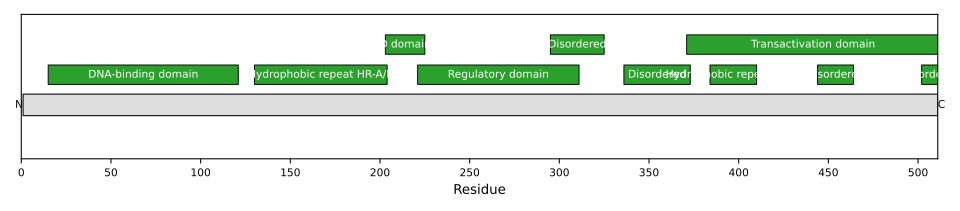
1: Functions as a stress-inducible and DNA-binding transcription factor that plays a central role in the transcriptional activation of the heat shock response (HSR), leading to the expression of a large class of molecular chaperones, heat shock proteins (HSPs), that protect cells from cellular insult damage (PubMed:11447121, PubMed:12659875, PubMed:12917326, PubMed:15016915, PubMed:18451878, PubMed:1871105, PubMed:1986252, PubMed:25963659, PubMed:26754925, PubMed:7623826, PubMed:7760831, PubMed:8940068, PubMed:8946918, PubMed:9121459, PubMed:9341107, PubMed:9499401, PubMed:9535852, PubMed:9727490). In unstressed cells, is present in a HSP90-containing multichaperone complex that maintains it in a non-DNA-binding inactivated monomeric form (PubMed:11583998, PubMed:16278218, PubMed:9727490). Upon exposure to heat and other stress stimuli, undergoes homotrimerization and activates HSP gene transcription through binding to site-specific heat shock elements (HSEs) present in the promoter regions of HSP genes (PubMed:10359787, PubMed:11583998, PubMed:12659875, PubMed:16278218, PubMed:1871105, PubMed:1986252, PubMed:25963659, PubMed:26754925, PubMed:7623826, PubMed:7935471, PubMed:8455624, PubMed:8940068, PubMed:9499401, PubMed:9727490). Upon heat shock stress, forms a chromatin-associated complex with TTC5/STRAP and p300/EP300 to stimulate HSR transcription, therefore increasing cell survival (PubMed:18451878). Activation is reversible, and during the attenuation and recovery phase period of the HSR, returns to its unactivated form (PubMed:11583998, PubMed:16278218). Binds to inverted 5'-NGAAN-3' pentamer DNA sequences (PubMed:1986252, PubMed:26727489). Binds to chromatin at heat shock gene promoters (PubMed:25963659). Activates transcription of transcription factor FOXR1 which in turn activates transcription of the heat shock chaperones HSPA1A and HSPA6 and the antioxidant NADPH-dependent reductase DHRS2 (PubMed:34723967). Also serves several other functions independently of its transcriptional activity. Involved in the repression of Ras-induced transcriptional activation of the c-fos gene in heat-stressed cells (PubMed:9341107). Positively regulates pre-mRNA 3'-end processing and polyadenylation of HSP70 mRNA upon heat-stressed cells in a symplekin (SYMPK)-dependent manner (PubMed:14707147). Plays a role in nuclear export of stress-induced HSP70 mRNA (PubMed:17897941). Plays a role in the regulation of mitotic progression (PubMed:18794143). Also plays a role as a negative regulator of non-homologous end joining (NHEJ) repair activity in a DNA damage-dependent manner (PubMed:26359349). Involved in stress-induced cancer cell proliferation in a IER5-dependent manner (PubMed:26754925)
2: (Microbial infection) Plays a role in latent human immunodeficiency virus (HIV-1) transcriptional reactivation. Binds to the HIV-1 long terminal repeat promoter (LTR) to reactivate viral transcription by recruiting cellular transcriptional elongation factors, such as CDK9, CCNT1 and EP300