Nuclear factor NF-kappa-B p100 subunit (DNA-binding factor KBF2) (H2TF1) (Lymphocyte translocation chromosome 10 protein) (Nuclear factor of kappa light polypeptide gene enhancer in B-cells 2) (Oncogene Lyt-10) (Lyt10) [Cleaved into: Nuclear factor NF-kappa-B p52 subunit]
1_MESCY 6_ NPGLD 11_ GIIEY 16_ DDFKL 21_ NSSIV 26_ EPKEP 31_ APETA 36_ DGPYL 41_ VIVEQ 46_ PKQRG 51_ FRFRY 56_ GCEGP 61_ SHGGL 66_ PGASS 71_ EKGRK 76_ TYPTV 81_ KICNY 86_ EGPAK 91_ IEVDL 96_ VTHSD 101_ PPRAH 106_ AHSLV 111_ GKQCS 116_ ELGIC 121_ AVSVG 126_ PKDMT 131_ AQFNN 136_ LGVLH 141_ VTKKN 146_ MMGTM 151_ IQKLQ 156_ RQRLR 161_ SRPQG 166_ LTEAE 171_ QRELE 176_ QEAKE 181_ LKKVM 186_ DLSIV 191_ RLRFS 196_ AFLRA 201_ SDGSF 206_ SLPLK 211_ PVISQ 216_ PIHDS 221_ KSPGA 226_ SNLKI 231_ SRMDK 236_ TAGSV 241_ RGGDE 246_ VYLLC 251_ DKVQK 256_ DDIEV 261_ RFYED 266_ DENGW 271_ QAFGD 276_ FSPTD 281_ VHKQY 286_ AIVFR 291_ TPPYH 296_ KMKIE 301_ RPVTV 306_ FLQLK 311_ RKRGG 316_ DVSDS 321_ KQFTY 326_ YPLVE 331_ DKEEV 336_ QRKRR 341_ KALPT 346_ FSQPF 351_ GGGSH 356_ MGGGS 361_ GGAAG 366_ GYGGA 371_ GGGGS 376_ LGFFP 381_ SSLAY 386_ SPYQS 391_ GAGPM 396_ GCYPG 401_ GGGGA 406_ QMAAT 411_ VPSRD 416_ SGEEA 421_ AEPSA 426_ PSRTP 431_ QCEPQ 436_ APEML 441_ QRARE 446_ YNARL 451_ FGLAQ 456_ RSARA 461_ LLDYG 466_ VTADA 471_ RALLA 476_ GQRHL 481_ LTAQD 486_ ENGDT 491_ PLHLA 496_ IIHGQ 501_ TSVIE 506_ QIVYV 511_ IHHAQ 516_ DLGVV 521_ NLTNH 526_ LHQTP 531_ LHLAV 536_ ITGQT 541_ SVVSF 546_ LLRVG 551_ ADPAL 556_ LDRHG 561_ DSAMH 566_ LALRA 571_ GAGAP 576_ ELLRA 581_ LLQSG 586_ APAVP 591_ QLLHM 596_ PDFEG 601_ LYPVH 606_ LAVRA 611_ RSPEC 616_ LDLLV 621_ DSGAE 626_ VEATE 631_ RQGGR 636_ TALHL 641_ ATEME 646_ ELGLV 651_ THLVT 656_ KLRAN 661_ VNART 666_ FAGNT 671_ PLHLA 676_ AGLGY 681_ PTLTR 686_ LLLKA 691_ GADIH 696_ AENEE 701_ PLCPL 706_ PSPPT 711_ SDSDS 716_ DSEGP 721_ EKDTR 726_ SSFRG 731_ HTPLD 736_ LTCST 741_ KVKTL 746_ LLNAA 751_ QNTME 756_ PPLTP 761_ PSPAG 766_ PGLSL 771_ GDTAL 776_ QNLEQ 781_ LLDGP 786_ EAQGS 791_ WAELA 796_ ERLGL 801_ RSLVD 806_ TYRQT 811_ TSPSG 816_ SLLRS 821_ YELAG 826_ GDLAG 831_ LLEAL 836_ SDMGL 841_ EEGVR 846_ LLRGP 851_ ETRDK 856_ LPSTA 861_ EVKED 866_ SAYGS 871_ QSVEQ 876_ EAEKL 881_ GPPPE 886_ PPGGL 891_CHGHP
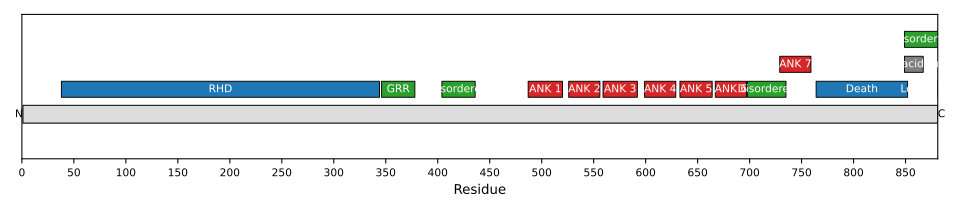
1: NF-kappa-B is a pleiotropic transcription factor present in almost all cell types and is the endpoint of a series of signal transduction events that are initiated by a vast array of stimuli related to many biological processes such as inflammation, immunity, differentiation, cell growth, tumorigenesis and apoptosis. NF-kappa-B is a homo- or heterodimeric complex formed by the Rel-like domain-containing proteins RELA/p65, RELB, NFKB1/p105, NFKB1/p50, REL and NFKB2/p52. The dimers bind at kappa-B sites in the DNA of their target genes and the individual dimers have distinct preferences for different kappa-B sites that they can bind with distinguishable affinity and specificity. Different dimer combinations act as transcriptional activators or repressors, respectively. NF-kappa-B is controlled by various mechanisms of post-translational modification and subcellular compartmentalization as well as by interactions with other cofactors or corepressors. NF-kappa-B complexes are held in the cytoplasm in an inactive state complexed with members of the NF-kappa-B inhibitor (I-kappa-B) family. In a conventional activation pathway, I-kappa-B is phosphorylated by I-kappa-B kinases (IKKs) in response to different activators, subsequently degraded thus liberating the active NF-kappa-B complex which translocates to the nucleus. In a non-canonical activation pathway, the MAP3K14-activated CHUK/IKKA homodimer phosphorylates NFKB2/p100 associated with RelB, inducing its proteolytic processing to NFKB2/p52 and the formation of NF-kappa-B RelB-p52 complexes. The NF-kappa-B heterodimeric RelB-p52 complex is a transcriptional activator. The NF-kappa-B p52-p52 homodimer is a transcriptional repressor. NFKB2 appears to have dual functions such as cytoplasmic retention of attached NF-kappa-B proteins by p100 and generation of p52 by a cotranslational processing. The proteasome-mediated process ensures the production of both p52 and p100 and preserves their independent function. p52 binds to the kappa-B consensus sequence 5'-GGRNNYYCC-3', located in the enhancer region of genes involved in immune response and acute phase reactions. p52 and p100 are respectively the minor and major form; the processing of p100 being relatively poor. Isoform p49 is a subunit of the NF-kappa-B protein complex, which stimulates the HIV enhancer in synergy with p65. In concert with RELB, regulates the circadian clock by repressing the transcriptional activator activity of the CLOCK-BMAL1 heterodimer