Heterogeneous nuclear ribonucleoprotein U (hnRNP U) (GRIP120) (Nuclear p120 ribonucleoprotein) (Scaffold-attachment factor A) (SAF-A) (p120) (pp120)
1_MSSSP 6_ VNVKK 11_ LKVSE 16_ LKEEL 21_ KKRRL 26_ SDKGL 31_ KAELM 36_ ERLQA 41_ ALDDE 46_ EAGGR 51_ PAMEP 56_ GNGSL 61_ DLGGD 66_ SAGRS 71_ GAGLE 76_ QEAAA 81_ GGDEE 86_ EEEEE 91_ EEEEG 96_ ISALD 101_ GDQME 106_ LGEEN 111_ GAAGA 116_ ADSGP 121_ MEEEE 126_ AASED 131_ ENGDD 136_ QGFQE 141_ GEDEL 146_ GDEEE 151_ GAGDE 156_ NGHGE 161_ QQPQP 166_ PATQQ 171_ QQPQQ 176_ QRGAA 181_ KEAAG 186_ KSSGP 191_ TSLFA 196_ VTVAP 201_ PGARQ 206_ GQQQA 211_ GGKKK 216_ AEGGG 221_ GGGRP 226_ GAPAA 231_ GDGKT 236_ EQKGG 241_ DKKRG 246_ VKRPR 251_ EDHGR 256_ GYFEY 261_ IEENK 266_ YSRAK 271_ SPQPP 276_ VEEED 281_ EHFDD 286_ TVVCL 291_ DTYNC 296_ DLHFK 301_ ISRDR 306_ LSASS 311_ LTMES 316_ FAFLW 321_ AGGRA 326_ SYGVS 331_ KGKVC 336_ FEMKV 341_ TEKIP 346_ VRHLY 351_ TKDID 356_ IHEVR 361_ IGWSL 366_ TTSGM 371_ LLGEE 376_ EFSYG 381_ YSLKG 386_ IKTCN 391_ CETED 396_ YGEKF 401_ DENDV 406_ ITCFA 411_ NFESD 416_ EVELS 421_ YAKNG 426_ QDLGV 431_ AFKIS 436_ KEVLA 441_ GRPLF 446_ PHVLC 451_ HNCAV 456_ EFNFG 461_ QKEKP 466_ YFPIP 471_ EEYTF 476_ IQNVP 481_ LEDRV 486_ RGPKG 491_ PEEKK 496_ DCEVV 501_ MMIGL 506_ PGAGK 511_ TTWVT 516_ KHAAE 521_ NPGKY 526_ NILGT 531_ NTIMD 536_ KMMVA 541_ GFKKQ 546_ MADTG 551_ KLNTL 556_ LQRAP 561_ QCLGK 566_ FIEIA 571_ ARKKR 576_ NFILD 581_ QTNVS 586_ AAAQR 591_ RKMCL 596_ FAGFQ 601_ RKAVV 606_ VCPKD 611_ EDYKQ 616_ RTQKK 621_ AEVEG 626_ KDLPE 631_ HAVLK 636_ MKGNF 641_ TLPEV 646_ AECFD 651_ EITYV 656_ ELQKE 661_ EAQKL 666_ LEQYK 671_ EESKK 676_ ALPPE 681_ KKQNT 686_ GSKKS 691_ NKNKS 696_ GKNQF 701_ NRGGG 706_ HRGRG 711_ GFNMR 716_ GGNFR 721_ GGAPG 726_ NRGGY 731_ NRRGN 736_ MPQRG 741_ GGGGG 746_ SGGIG 751_ YPYPR 756_ APVFP 761_ GRGSY 766_ SNRGN 771_ YNRGG 776_ MPNRG 781_ NYNQN 786_ FRGRG 791_ NNRGY 796_ KNQSQ 801_ GYNQW 806_ QQGQF 811_ WGQKP 816_WSQHY
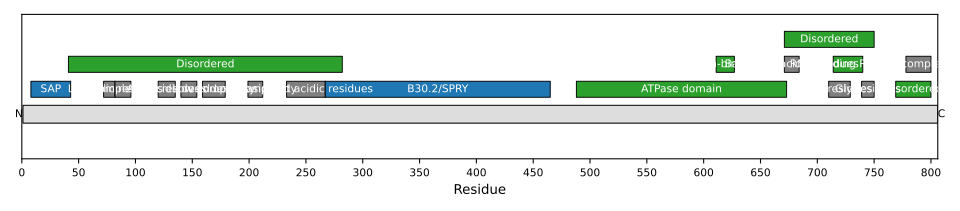
1: DNA- and RNA-binding protein involved in several cellular processes such as nuclear chromatin organization, telomere-length regulation, transcription, mRNA alternative splicing and stability, Xist-mediated transcriptional silencing and mitotic cell progression (PubMed:10490622, PubMed:18082603, PubMed:19029303, PubMed:22325991, PubMed:25986610, PubMed:28622508). Plays a role in the regulation of interphase large-scale gene-rich chromatin organization through chromatin-associated RNAs (caRNAs) in a transcription-dependent manner, and thereby maintains genomic stability (PubMed:1324173, PubMed:28622508, PubMed:8174554). Required for the localization of the long non-coding Xist RNA on the inactive chromosome X (Xi) and the subsequent initiation and maintenance of X-linked transcriptional gene silencing during X-inactivation (By similarity). Plays a role as a RNA polymerase II (Pol II) holoenzyme transcription regulator (PubMed:10490622, PubMed:15711563, PubMed:19617346, PubMed:23811339, PubMed:8174554, PubMed:9353307). Promotes transcription initiation by direct association with the core-TFIIH basal transcription factor complex for the assembly of a functional pre-initiation complex with Pol II in a actin-dependent manner (PubMed:10490622, PubMed:15711563). Blocks Pol II transcription elongation activity by inhibiting the C-terminal domain (CTD) phosphorylation of Pol II and dissociates from Pol II pre-initiation complex prior to productive transcription elongation (PubMed:10490622). Positively regulates CBX5-induced transcriptional gene silencing and retention of CBX5 in the nucleus (PubMed:19617346). Negatively regulates glucocorticoid-mediated transcriptional activation (PubMed:9353307). Key regulator of transcription initiation and elongation in embryonic stem cells upon leukemia inhibitory factor (LIF) signaling (By similarity). Involved in the long non-coding RNA H19-mediated Pol II transcriptional repression (PubMed:23811339). Participates in the circadian regulation of the core clock component BMAL1 transcription (By similarity). Plays a role in the regulation of telomere length (PubMed:18082603). Plays a role as a global pre-mRNA alternative splicing modulator by regulating U2 small nuclear ribonucleoprotein (snRNP) biogenesis (PubMed:22325991). Plays a role in mRNA stability (PubMed:17174306, PubMed:17289661, PubMed:19029303). Component of the CRD-mediated complex that promotes MYC mRNA stabilization (PubMed:19029303). Enhances the expression of specific genes, such as tumor necrosis factor TNFA, by regulating mRNA stability, possibly through binding to the 3'-untranslated region (UTR) (PubMed:17174306). Plays a role in mitotic cell cycle regulation (PubMed:21242313, PubMed:25986610). Involved in the formation of stable mitotic spindle microtubules (MTs) attachment to kinetochore, spindle organization and chromosome congression (PubMed:21242313). Phosphorylation at Ser-59 by PLK1 is required for chromosome alignement and segregation and progression through mitosis (PubMed:25986610). Also contributes to the targeting of AURKA to mitotic spindle MTs (PubMed:21242313). Binds to double- and single-stranded DNA and RNA, poly(A), poly(C) and poly(G) oligoribonucleotides (PubMed:1628625, PubMed:8068679, PubMed:8174554, PubMed:9204873, PubMed:9405365). Binds to chromatin-associated RNAs (caRNAs) (PubMed:28622508). Associates with chromatin to scaffold/matrix attachment region (S/MAR) elements in a chromatin-associated RNAs (caRNAs)-dependent manner (PubMed:10671544, PubMed:11003645, PubMed:11909954, PubMed:1324173, PubMed:28622508, PubMed:7509195, PubMed:9204873, PubMed:9405365). Binds to the Xist RNA (PubMed:26244333). Binds the long non-coding H19 RNA (PubMed:23811339). Binds to SMN1/2 pre-mRNAs at G/U-rich regions (PubMed:22325991). Binds to small nuclear RNAs (snRNAs) (PubMed:22325991). Binds to the 3'-UTR of TNFA mRNA (PubMed:17174306). Binds (via RNA-binding RGG-box region) to the long non-coding Xist RNA; this binding is direct and bridges the Xist RNA and the inactive chromosome X (Xi) (By similarity). Also negatively regulates embryonic stem cell differentiation upon LIF signaling (By similarity). Required for embryonic development (By similarity). Binds to brown fat long non-coding RNA 1 (Blnc1); facilitates the recruitment of Blnc1 by ZBTB7B required to drive brown and beige fat development and thermogenesis (By similarity)
2: (Microbial infection) Negatively regulates immunodeficiency virus type 1 (HIV-1) replication by preventing the accumulation of viral mRNA transcripts in the cytoplasm