Transcription factor RelB (I-Rel)
1_MLRSG 6_ PASGP 11_ SVPTG 16_ RAMPS 21_ RRVAR 26_ PPAAP 31_ ELGAL 36_ GSPDL 41_ SSLSL 46_ AVSRS 51_ TDELE 56_ IIDEY 61_ IKENG 66_ FGLDG 71_ GQPGP 76_ GEGLP 81_ RLVSR 86_ GAASL 91_ STVTL 96_ GPVAP 101_ PATPP 106_ PWGCP 111_ LGRLV 116_ SPAPG 121_ PGPQP 126_ HLVIT 131_ EQPKQ 136_ RGMRF 141_ RYECE 146_ GRSAG 151_ SILGE 156_ SSTEA 161_ SKTLP 166_ AIELR 171_ DCGGL 176_ REVEV 181_ TACLV 186_ WKDWP 191_ HRVHP 196_ HSLVG 201_ KDCTD 206_ GICRV 211_ RLRPH 216_ VSPRH 221_ SFNNL 226_ GIQCV 231_ RKKEI 236_ EAAIE 241_ RKIQL 246_ GIDPY 251_ NAGSL 256_ KNHQE 261_ VDMNV 266_ VRICF 271_ QASYR 276_ DQQGQ 281_ MRRMD 286_ PVLSE 291_ PVYDK 296_ KSTNT 301_ SELRI 306_ CRINK 311_ ESGPC 316_ TGGEE 321_ LYLLC 326_ DKVQK 331_ EDISV 336_ VFSRA 341_ SWEGR 346_ ADFSQ 351_ ADVHR 356_ QIAIV 361_ FKTPP 366_ YEDLE 371_ IVEPV 376_ TVNVF 381_ LQRLT 386_ DGVCS 391_ EPLPF 396_ TYLPR 401_ DHDSY 406_ GVDKK 411_ RKRGM 416_ PDVLG 421_ ELNSS 426_ DPHGI 431_ ESKRR 436_ KKKPA 441_ ILDHF 446_ LPNHG 451_ SGPFL 456_ PPSAL 461_ LPDPD 466_ FFSGT 471_ VSLPG 476_ LEPPG 481_ GPDLL 486_ DDGFA 491_ YDPTA 496_ PTLFT 501_ MLDLL 506_ PPAPP 511_ HASAV 516_ VCSGG 521_ AGAVV 526_ GETPG 531_ PEPLT 536_ LDSYQ 541_ APGPG 546_ DGGTA 551_ SLVGS 556_ NMFPN 561_ HYREA 566_ AFGGG 571_LLSPG
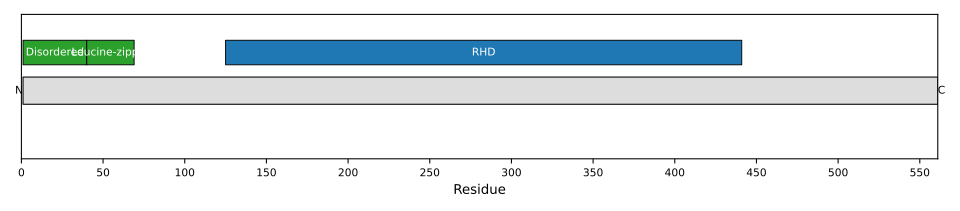
1: NF-kappa-B is a pleiotropic transcription factor which is present in almost all cell types and is involved in many biological processed such as inflammation, immunity, differentiation, cell growth, tumorigenesis and apoptosis. NF-kappa-B is a homo- or heterodimeric complex formed by the Rel-like domain-containing proteins RELA/p65, RELB, NFKB1/p105, NFKB1/p50, REL and NFKB2/p52. The dimers bind at kappa-B sites in the DNA of their target genes and the individual dimers have distinct preferences for different kappa-B sites that they can bind with distinguishable affinity and specificity. Different dimer combinations act as transcriptional activators or repressors, respectively. NF-kappa-B is controlled by various mechanisms of post-translational modification and subcellular compartmentalization as well as by interactions with other cofactors or corepressors. NF-kappa-B complexes are held in the cytoplasm in an inactive state complexed with members of the NF-kappa-B inhibitor (I-kappa-B) family. In a conventional activation pathway, I-kappa-B is phosphorylated by I-kappa-B kinases (IKKs) in response to different activators, subsequently degraded thus liberating the active NF-kappa-B complex which translocates to the nucleus. NF-kappa-B heterodimeric RelB-p50 and RelB-p52 complexes are transcriptional activators. RELB neither associates with DNA nor with RELA/p65 or REL. Stimulates promoter activity in the presence of NFKB2/p49. As a member of the NUPR1/RELB/IER3 survival pathway, may provide pancreatic ductal adenocarcinoma with remarkable resistance to cell stress, such as starvation or gemcitabine treatment. Regulates the circadian clock by repressing the transcriptional activator activity of the CLOCK-BMAL1 heterodimer in a CRY1/CRY2 independent manner. Increased repression of the heterodimer is seen in the presence of NFKB2/p52. Is required for both T and B lymphocyte maturation and function (PubMed:26385063)