Exosome component 10 (EC 3.1.13.-) (Autoantigen PM/Scl 2) (P100 polymyositis-scleroderma overlap syndrome-associated autoantigen) (Polymyositis/scleroderma autoantigen 100 kDa) (PM/Scl-100) (Polymyositis/scleroderma autoantigen 2)
1_MAPPS 6_ TREPR 11_ VLSAT 16_ SATKS 21_ DGEMV 26_ LPGFP 31_ DADSF 36_ VKFAL 41_ GSVVA 46_ VTKAS 51_ GGLPQ 56_ FGDEY 61_ DFYRS 66_ FPGFQ 71_ AFCET 76_ QGDRL 81_ LQCMS 86_ RVMQY 91_ HGCRS 96_ NIKDR 101_ SKVTE 106_ LEDKF 111_ DLLVD 116_ ANDVI 121_ LERVG 126_ ILLDE 131_ ASGVN 136_ KNQQP 141_ VLPAG 146_ LQVPK 151_ TVVSS 156_ WNRKA 161_ AEYGK 166_ KAKSE 171_ TFRLL 176_ HAKNI 181_ IRPQL 186_ KFREK 191_ IDNSN 196_ TPFLP 201_ KIFIK 206_ PNAQK 211_ PLPQA 216_ LSKER 221_ RERPQ 226_ DRPED 231_ LDVPP 236_ ALADF 241_ IHQQR 246_ TQQVE 251_ QDMFA 256_ HPYQY 261_ ELNHF 266_ TPADA 271_ VLQKP 276_ QPQLY 281_ RPIEE 286_ TPCHF 291_ ISSLD 296_ ELVEL 301_ NEKLL 306_ NCQEF 311_ AVDLE 316_ HHSYR 321_ SFLGL 326_ TCLMQ 331_ ISTRT 336_ EDFII 341_ DTLEL 346_ RSDMY 351_ ILNES 356_ LTDPA 361_ IVKVF 366_ HGADS 371_ DIEWL 376_ QKDFG 381_ LYVVN 386_ MFDTH 391_ QAARL 396_ LNLGR 401_ HSLDH 406_ LLKLY 411_ CNVDS 416_ NKQYQ 421_ LADWR 426_ IRPLP 431_ EEMLS 436_ YARDD 441_ THYLL 446_ YIYDK 451_ MRLEM 456_ WERGN 461_ GQPVQ 466_ LQVVW 471_ QRSRD 476_ ICLKK 481_ FIKPI 486_ FTDES 491_ YLELY 496_ RKQKK 501_ HLNTQ 506_ QLTAF 511_ QLLFA 516_ WRDKT 521_ ARRED 526_ ESYGY 531_ VLPNH 536_ MMLKI 541_ AEELP 546_ KEPQG 551_ IIACC 556_ NPVPP 561_ LVRQQ 566_ INEMH 571_ LLIQQ 576_ AREMP 581_ LLKSE 586_ VAAGV 591_ KKSGP 596_ LPSAE 601_ RLENV 606_ LFGPH 611_ DCSHA 616_ PPDGY 621_ PIIPT 626_ SGSVP 631_ VQKQA 636_ SLFPD 641_ EKEDN 646_ LLGTT 651_ CLIAT 656_ AVITL 661_ FNEPS 666_ AEDSK 671_ KGPLT 676_ VAQKK 681_ AQNIM 686_ ESFEN 691_ PFRMF 696_ LPSLG 701_ HRAPV 706_ SQAAK 711_ FDPST 716_ KIYEI 721_ SNRWK 726_ LAQVQ 731_ VQKDS 736_ KEAVK 741_ KKAAE 746_ QTAAR 751_ EQAKE 756_ ACKAA 761_ AEQAI 766_ SVRQQ 771_ VVLEN 776_ AAKKR 781_ ERATS 786_ DPRTT 791_ EQKQE 796_ KKRLK 801_ ISKKP 806_ KDPEP 811_ PEKEF 816_ TPYDY 821_ SQSDF 826_ KAFAG 831_ NSKSK 836_ VSSQF 841_ DPNKQ 846_ TPSGK 851_ KCIAA 856_ KKIKQ 861_ SVGNK 866_ SMSFP 871_ TGKSD 876_RGFRY
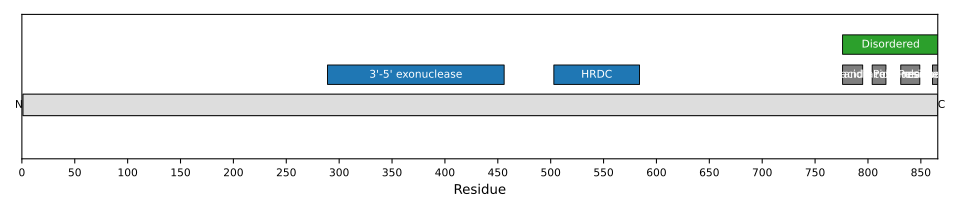
1: Catalytic component of the RNA exosome complex which has 3'->5' exoribonuclease activity and participates in a multitude of cellular RNA processing and degradation events. In the nucleus, the RNA exosome complex is involved in proper maturation of stable RNA species such as rRNA, snRNA and snoRNA, in the elimination of RNA processing by-products and non-coding 'pervasive' transcripts, such as antisense RNA species and promoter-upstream transcripts (PROMPTs), and of mRNAs with processing defects, thereby limiting or excluding their export to the cytoplasm. Part of the small subunit (SSU) processome, first precursor of the small eukaryotic ribosomal subunit. During the assembly of the SSU processome in the nucleolus, many ribosome biogenesis factors, an RNA chaperone and ribosomal proteins associate with the nascent pre-rRNA and work in concert to generate RNA folding, modifications, rearrangements and cleavage as well as targeted degradation of pre-ribosomal RNA by the RNA exosome (PubMed:34516797). The RNA exosome may be involved in Ig class switch recombination (CSR) and/or Ig variable region somatic hypermutation (SHM) by targeting AICDA deamination activity to transcribed dsDNA substrates. In the cytoplasm, the RNA exosome complex is involved in general mRNA turnover and specifically degrades inherently unstable mRNAs containing AU-rich elements (AREs) within their 3' untranslated regions, and in RNA surveillance pathways, preventing translation of aberrant mRNAs. It seems to be involved in degradation of histone mRNA. EXOSC10 is required for nucleolar localization of C1D and probably mediates the association of MTREX, C1D and MPHOSPH6 with the RNA exosome involved in the maturation of 5.8S rRNA. Plays a role in the recruitment of replication protein A complex (RPA) and RAD51 to DNA double-strand breaks caused by irradiation, contributing to DNA repair by homologous recombination (PubMed:25632158, PubMed:31086179). Regulates levels of damage-induced RNAs in order to prevent DNA-RNA hybrid formation at DNA double-strand breaks and limit DNA end resection after damage (PubMed:31086179). Plays a role in oocyte development, maturation and survival (By similarity). Required for normal testis development and mitotic division of spermatogonia (By similarity). Plays a role in proper embryo development (By similarity). Required for global protein translation (PubMed:26857222, PubMed:36912080). Required for cell proliferation (PubMed:36912080). Regulates metabolism of C9orf72-derived repeat RNA that can be translated into toxic dipeptide repeat proteins (PubMed:32830871)