DNA repair protein complementing XP-C cells (Xeroderma pigmentosum group C-complementing protein) (p125)
1_MARKR 6_ AAGGE 11_ PRGRE 16_ LRSQK 21_ SKAKS 26_ KARRE 31_ EEEED 36_ AFEDE 41_ KPPKK 46_ SLLSK 51_ VSQGK 56_ RKRGC 61_ SHPGG 66_ SADGP 71_ AKKKV 76_ AKVTV 81_ KSENL 86_ KVIKD 91_ EALSD 96_ GDDLR 101_ DFPSD 106_ LKKAH 111_ HLKRG 116_ ATMNE 121_ DSNEE 126_ EEESE 131_ NDWEE 136_ VEELS 141_ EPVLG 146_ DVRES 151_ TAFSR 156_ SLLPV 161_ KPVEI 166_ EIETP 171_ EQAKT 176_ RERSE 181_ KIKLE 186_ FETYL 191_ RRAMK 196_ RFNKG 201_ VHEDT 206_ HKVHL 211_ LCLLA 216_ NGFYR 221_ NNICS 226_ QPDLH 231_ AIGLS 236_ IIPAR 241_ FTRVL 246_ PRDVD 251_ TYYLS 256_ NLVKW 261_ FIGTF 266_ TVNAE 271_ LSASE 276_ QDNLQ 281_ TTLER 286_ RFAIY 291_ SARDD 296_ EELVH 301_ IFLLI 306_ LRALQ 311_ LLTRL 316_ VLSLQ 321_ PIPLK 326_ SATAK 331_ GKKPS 336_ KERLT 341_ ADPGG 346_ SSETS 351_ SQVLE 356_ NHTKP 361_ KTSKG 366_ TKQEE 371_ TFAKG 376_ TCRPS 381_ AKGKR 386_ NKGGR 391_ KKRSK 396_ PSSSE 401_ EDEGP 406_ GDKQE 411_ KATQR 416_ RPHGR 421_ ERRVA 426_ SRVSY 431_ KEESG 436_ SDEAG 441_ SGSDF 446_ ELSSG 451_ EASDP 456_ SDEDS 461_ EPGPP 466_ KQRKA 471_ PAPQR 476_ TKAGS 481_ KSASR 486_ THRGS 491_ HRKDP 496_ SLPAA 501_ SSSSS 506_ SSKRG 511_ KKMCS 516_ DGEKA 521_ EKRSI 526_ AGIDQ 531_ WLEVF 536_ CEQEE 541_ KWVCV 546_ DCVHG 551_ VVGQP 556_ LTCYK 561_ YATKP 566_ MTYVV 571_ GIDSD 576_ GWVRD 581_ VTQRY 586_ DPVWM 591_ TVTRK 596_ CRVDA 601_ EWWAE 606_ TLRPY 611_ QSPFM 616_ DREKK 621_ EDLEF 626_ QAKHM 631_ DQPLP 636_ TAIGL 641_ YKNHP 646_ LYALK 651_ RHLLK 656_ YEAIY 661_ PETAA 666_ ILGYC 671_ RGEAV 676_ YSRDC 681_ VHTLH 686_ SRDTW 691_ LKKAR 696_ VVRLG 701_ EVPYK 706_ MVKGF 711_ SNRAR 716_ KARLA 721_ EPQLR 726_ EENDL 731_ GLFGY 736_ WQTEE 741_ YQPPV 746_ AVDGK 751_ VPRNE 756_ FGNVY 761_ LFLPS 766_ MMPIG 771_ CVQLN 776_ LPNLH 781_ RVARK 786_ LDIDC 791_ VQAIT 796_ GFDFH 801_ GGYSH 806_ PVTDG 811_ YIVCE 816_ EFKDV 821_ LLTAW 826_ ENEQA 831_ VIERK 836_ EKEKK 841_ EKRAL 846_ GNWKL 851_ LAKGL 856_ LIRER 861_ LKRRY 866_ GPKSE 871_ AAAPH 876_ TDAGG 881_ GLSSD 886_ EEEGT 891_ SSQAE 896_ AARIL 901_ AASWP 906_ QNRED 911_ EEKQK 916_ LKGGP 921_ KKTKR 926_ EKKAA 931_ASHLF
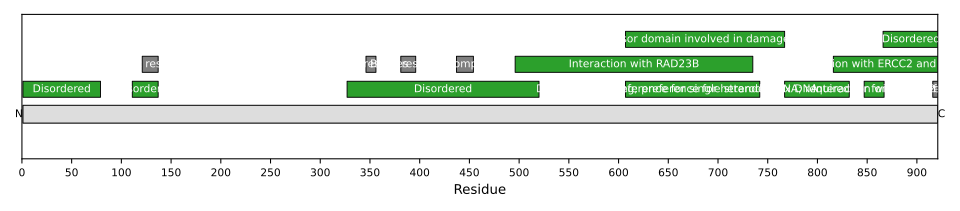
1: Involved in global genome nucleotide excision repair (GG-NER) by acting as damage sensing and DNA-binding factor component of the XPC complex (PubMed:10734143, PubMed:10873465, PubMed:12509299, PubMed:12547395, PubMed:19609301, PubMed:19941824, PubMed:20028083, PubMed:20649465, PubMed:20798892, PubMed:9734359). Has only a low DNA repair activity by itself which is stimulated by RAD23B and RAD23A. Has a preference to bind DNA containing a short single-stranded segment but not to damaged oligonucleotides (PubMed:10734143, PubMed:19609301, PubMed:20649465). This feature is proposed to be related to a dynamic sensor function: XPC can rapidly screen duplex DNA for non-hydrogen-bonded bases by forming a transient nucleoprotein intermediate complex which matures into a stable recognition complex through an intrinsic single-stranded DNA-binding activity (PubMed:10734143, PubMed:19609301, PubMed:20649465). The XPC complex is proposed to represent the first factor bound at the sites of DNA damage and together with other core recognition factors, XPA, RPA and the TFIIH complex, is part of the pre-incision (or initial recognition) complex (PubMed:10873465, PubMed:12509299, PubMed:12547395, PubMed:19941824, PubMed:20028083, PubMed:20798892, PubMed:9734359). The XPC complex recognizes a wide spectrum of damaged DNA characterized by distortions of the DNA helix such as single-stranded loops, mismatched bubbles or single-stranded overhangs (PubMed:10873465, PubMed:12509299, PubMed:12547395, PubMed:19941824, PubMed:20028083, PubMed:20798892, PubMed:9734359). The orientation of XPC complex binding appears to be crucial for inducing a productive NER (PubMed:10873465, PubMed:12509299, PubMed:12547395, PubMed:19941824, PubMed:20028083, PubMed:20798892, PubMed:9734359). XPC complex is proposed to recognize and to interact with unpaired bases on the undamaged DNA strand which is followed by recruitment of the TFIIH complex and subsequent scanning for lesions in the opposite strand in a 5'-to-3' direction by the NER machinery (PubMed:10873465, PubMed:12509299, PubMed:12547395, PubMed:19941824, PubMed:20028083, PubMed:20798892, PubMed:9734359). Cyclobutane pyrimidine dimers (CPDs) which are formed upon UV-induced DNA damage esacpe detection by the XPC complex due to a low degree of structural perurbation. Instead they are detected by the UV-DDB complex which in turn recruits and cooperates with the XPC complex in the respective DNA repair (PubMed:10873465, PubMed:12509299, PubMed:12547395, PubMed:19941824, PubMed:20028083, PubMed:20798892, PubMed:9734359). In vitro, the XPC:RAD23B dimer is sufficient to initiate NER; it preferentially binds to cisplatin and UV-damaged double-stranded DNA and also binds to a variety of chemically and structurally diverse DNA adducts (PubMed:20028083). XPC:RAD23B contacts DNA both 5' and 3' of a cisplatin lesion with a preference for the 5' side. XPC:RAD23B induces a bend in DNA upon binding. XPC:RAD23B stimulates the activity of DNA glycosylases TDG and SMUG1 (PubMed:20028083)
2: In absence of DNA repair, the XPC complex also acts as a transcription coactivator: XPC interacts with the DNA-binding transcription factor E2F1 at a subset of promoters to recruit KAT2A and histone acetyltransferase complexes (HAT) (PubMed:29973595, PubMed:31527837). KAT2A recruitment specifically promotes acetylation of histone variant H2A.Z.1/H2A.Z, but not H2A.Z.2/H2A.V, thereby promoting expression of target genes (PubMed:31527837)