POU domain, class 4, transcription factor 1 (Brain-specific homeobox/POU domain protein 3A) (Brain-3A) (Brn-3A) (Homeobox/POU domain protein RDC-1) (Oct-T1)
1_MMSMN 6_ SKQPH 11_ FAMHP 16_ TLPEH 21_ KYPSL 26_ HSSSE 31_ AIRRA 36_ CLPTP 41_ PLQSN 46_ LFASL 51_ DETLL 56_ ARAEA 61_ LAAVD 66_ IAVSQ 71_ GKSHP 76_ FKPDA 81_ TYHTM 86_ NSVPC 91_ TSTST 96_ VPLAH 101_ HHHHH 106_ HHHQA 111_ LEPGD 116_ LLDHI 121_ SSPSL 126_ ALMAG 131_ AGGAG 136_ AAAGG 141_ GGAHD 146_ GPGGG 151_ GGPGG 156_ GGGPG 161_ GGPGG 166_ GGGGG 171_ PGGGG 176_ GGPGG 181_ GLLGG 186_ SAHPH 191_ PHMHS 196_ LGHLS 201_ HPAAA 206_ AAMNM 211_ PSGLP 216_ HPGLV 221_ AAAAH 226_ HGAAA 231_ AAAAA 236_ AAGQV 241_ AAASA 246_ AAAVV 251_ GAAGL 256_ ASICD 261_ SDTDP 266_ RELEA 271_ FAERF 276_ KQRRI 281_ KLGVT 286_ QADVG 291_ SALAN 296_ LKIPG 301_ VGSLS 306_ QSTIC 311_ RFESL 316_ TLSHN 321_ NMIAL 326_ KPILQ 331_ AWLEE 336_ AEGAQ 341_ REKMN 346_ KPELF 351_ NGGEK 356_ KRKRT 361_ SIAAP 366_ EKRSL 371_ EAYFA 376_ VQPRP 381_ SSEKI 386_ AAIAE 391_ KLDLK 396_ KNVVR 401_ VWFCN 406_ QRQKQ 411_KRMKF
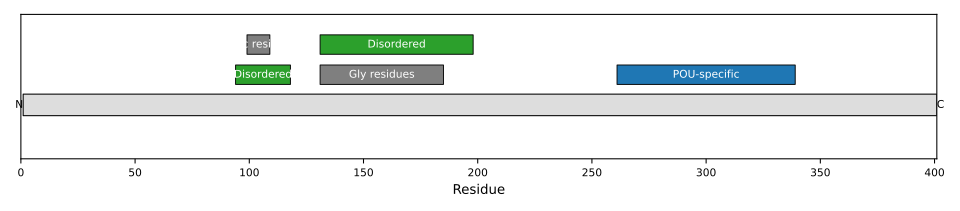
1: Multifunctional transcription factor with different regions mediating its different effects. Acts by binding (via its C-terminal domain) to sequences related to the consensus octamer motif 5'-ATGCAAAT-3' in the regulatory regions of its target genes. Regulates the expression of specific genes involved in differentiation and survival within a subset of neuronal lineages. It has been shown that activation of some of these genes requires its N-terminal domain, maybe through a neuronal-specific cofactor. Activates BCL2 expression and protects neuronal cells from apoptosis (via the N-terminal domain). Induces neuronal process outgrowth and the coordinate expression of genes encoding synaptic proteins. Exerts its major developmental effects in somatosensory neurons and in brainstem nuclei involved in motor control. Stimulates the binding affinity of the nuclear estrogene receptor ESR1 to DNA estrogen response element (ERE), and hence modulates ESR1-induced transcriptional activity. May positively regulate POU4F2 and POU4F3. Regulates dorsal root ganglion sensory neuron specification and axonal projection into the spinal cord. Plays a role in TNFSF11-mediated terminal osteoclast differentiation. Negatively regulates its own expression interacting directly with a highly conserved autoregulatory domain surrounding the transcription initiation site
2: Able to act as transcription factor, cannot regulate the expression of the same subset of genes than isoform 1. Does not have antiapoptotic effect on neuronal cells