Protein kinase C epsilon type (EC 2.7.11.13) (nPKC-epsilon)
1_MVVFN 6_ GLLKI 11_ KICEA 16_ VSLKP 21_ TAWSL 26_ RHAVG 31_ PRPQT 36_ FLLDP 41_ YIALN 46_ VDDSR 51_ IGQTA 56_ TKQKT 61_ NSPAW 66_ HDEFV 71_ TDVCN 76_ GRKIE 81_ LAVFH 86_ DAPIG 91_ YDDFV 96_ ANCTI 101_ QFEEL 106_ LQNGS 111_ RHFED 116_ WIDLE 121_ PEGRV 126_ YVIID 131_ LSGSS 136_ GEAPK 141_ DNEER 146_ VFRER 151_ MRPRK 156_ RQGAV 161_ RRRVH 166_ QVNGH 171_ KFMAT 176_ YLRQP 181_ TYCSH 186_ CRDFI 191_ WGVIG 196_ KQGYQ 201_ CQVCT 206_ CVVHK 211_ RCHEL 216_ IITKC 221_ AGLKK 226_ QETPD 231_ QVGSQ 236_ RFSVN 241_ MPHKF 246_ GIHNY 251_ KVPTF 256_ CDHCG 261_ SLLWG 266_ LLRQG 271_ LQCKV 276_ CKMNV 281_ HRRCE 286_ TNVAP 291_ NCGVD 296_ ARGIA 301_ KVLAD 306_ LGVTP 311_ DKITN 316_ SGQRR 321_ KKLIA 326_ GAESP 331_ QPASG 336_ SSPSE 341_ EDRSK 346_ SAPTS 351_ PCDQE 356_ IKELE 361_ NNIRK 366_ ALSFD 371_ NRGEE 376_ HRAAS 381_ SPDGQ 386_ LMSPG 391_ ENGEV 396_ RQGQA 401_ KRLGL 406_ DEFNF 411_ IKVLG 416_ KGSFG 421_ KVMLA 426_ ELKGK 431_ DEVYA 436_ VKVLK 441_ KDVIL 446_ QDDDV 451_ DCTMT 456_ EKRIL 461_ ALARK 466_ HPYLT 471_ QLYCC 476_ FQTKD 481_ RLFFV 486_ MEYVN 491_ GGDLM 496_ FQIQR 501_ SRKFD 506_ EPRSR 511_ FYAAE 516_ VTSAL 521_ MFLHQ 526_ HGVIY 531_ RDLKL 536_ DNILL 541_ DAEGH 546_ CKLAD 551_ FGMCK 556_ EGILN 561_ GVTTT 566_ TFCGT 571_ PDYIA 576_ PEILQ 581_ ELEYG 586_ PSVDW 591_ WALGV 596_ LMYEM 601_ MAGQP 606_ PFEAD 611_ NEDDL 616_ FESIL 621_ HDDVL 626_ YPVWL 631_ SKEAV 636_ SILKA 641_ FMTKN 646_ PHKRL 651_ GCVAS 656_ QNGED 661_ AIKQH 666_ PFFKE 671_ IDWVL 676_ LEQKK 681_ IKPPF 686_ KPRIK 691_ TKRDV 696_ NNFDQ 701_ DFTRE 706_ EPVLT 711_ LVDEA 716_ IVKQI 721_ NQEEF 726_ KGFSY 731_FGEDL
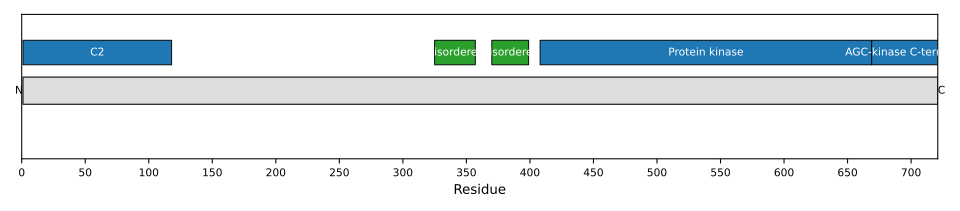
1: Calcium-independent, phospholipid- and diacylglycerol (DAG)-dependent serine/threonine-protein kinase that plays essential roles in the regulation of multiple cellular processes linked to cytoskeletal proteins, such as cell adhesion, motility, migration and cell cycle, functions in neuron growth and ion channel regulation, and is involved in immune response, cancer cell invasion and regulation of apoptosis. Mediates cell adhesion to the extracellular matrix via integrin-dependent signaling, by mediating angiotensin-2-induced activation of integrin beta-1 (ITGB1) in cardiac fibroblasts. Phosphorylates MARCKS, which phosphorylates and activates PTK2/FAK, leading to the spread of cardiomyocytes. Involved in the control of the directional transport of ITGB1 in mesenchymal cells by phosphorylating vimentin (VIM), an intermediate filament (IF) protein. In epithelial cells, associates with and phosphorylates keratin-8 (KRT8), which induces targeting of desmoplakin at desmosomes and regulates cell-cell contact. Phosphorylates IQGAP1, which binds to CDC42, mediating epithelial cell-cell detachment prior to migration. In HeLa cells, contributes to hepatocyte growth factor (HGF)-induced cell migration, and in human corneal epithelial cells, plays a critical role in wound healing after activation by HGF. During cytokinesis, forms a complex with YWHAB, which is crucial for daughter cell separation, and facilitates abscission by a mechanism which may implicate the regulation of RHOA. In cardiac myocytes, regulates myofilament function and excitation coupling at the Z-lines, where it is indirectly associated with F-actin via interaction with COPB1. During endothelin-induced cardiomyocyte hypertrophy, mediates activation of PTK2/FAK, which is critical for cardiomyocyte survival and regulation of sarcomere length. Plays a role in the pathogenesis of dilated cardiomyopathy via persistent phosphorylation of troponin I (TNNI3). Involved in nerve growth factor (NFG)-induced neurite outgrowth and neuron morphological change independently of its kinase activity, by inhibition of RHOA pathway, activation of CDC42 and cytoskeletal rearrangement. May be involved in presynaptic facilitation by mediating phorbol ester-induced synaptic potentiation. Phosphorylates gamma-aminobutyric acid receptor subunit gamma-2 (GABRG2), which reduces the response of GABA receptors to ethanol and benzodiazepines and may mediate acute tolerance to the intoxicating effects of ethanol. Upon PMA treatment, phosphorylates the capsaicin- and heat-activated cation channel TRPV1, which is required for bradykinin-induced sensitization of the heat response in nociceptive neurons. Is able to form a complex with PDLIM5 and N-type calcium channel, and may enhance channel activities and potentiates fast synaptic transmission by phosphorylating the pore-forming alpha subunit CACNA1B (CaV2.2). In prostate cancer cells, interacts with and phosphorylates STAT3, which increases DNA-binding and transcriptional activity of STAT3 and seems to be essential for prostate cancer cell invasion. Downstream of TLR4, plays an important role in the lipopolysaccharide (LPS)-induced immune response by phosphorylating and activating TICAM2/TRAM, which in turn activates the transcription factor IRF3 and subsequent cytokines production. In differentiating erythroid progenitors, is regulated by EPO and controls the protection against the TNFSF10/TRAIL-mediated apoptosis, via BCL2. May be involved in the regulation of the insulin-induced phosphorylation and activation of AKT1. Phosphorylates NLRP5/MATER and may thereby modulate AKT pathway activation in cumulus cells (PubMed:19542546). Phosphorylates and activates LRRK1, which phosphorylates RAB proteins involved in intracellular trafficking (PubMed:36040231)