Dual specificity mitogen-activated protein kinase kinase 1 (MAP kinase kinase 1) (MAPKK 1) (MKK1) (EC 2.7.12.2) (ERK activator kinase 1) (MAPK/ERK kinase 1) (MEK 1)
1_MPKKK 6_ PTPIQ 11_ LNPAP 16_ DGSAV 21_ NGTSS 26_ AETNL 31_ EALQK 36_ KLEEL 41_ ELDEQ 46_ QRKRL 51_ EAFLT 56_ QKQKV 61_ GELKD 66_ DDFEK 71_ ISELG 76_ AGNGG 81_ VVFKV 86_ SHKPS 91_ GLVMA 96_ RKLIH 101_ LEIKP 106_ AIRNQ 111_ IIREL 116_ QVLHE 121_ CNSPY 126_ IVGFY 131_ GAFYS 136_ DGEIS 141_ ICMEH 146_ MDGGS 151_ LDQVL 156_ KKAGR 161_ IPEQI 166_ LGKVS 171_ IAVIK 176_ GLTYL 181_ REKHK 186_ IMHRD 191_ VKPSN 196_ ILVNS 201_ RGEIK 206_ LCDFG 211_ VSGQL 216_ IDSMA 221_ NSFVG 226_ TRSYM 231_ SPERL 236_ QGTHY 241_ SVQSD 246_ IWSMG 251_ LSLVE 256_ MAVGR 261_ YPIPP 266_ PDAKE 271_ LELMF 276_ GCQVE 281_ GDAAE 286_ TPPRP 291_ RTPGR 296_ PLSSY 301_ GMDSR 306_ PPMAI 311_ FELLD 316_ YIVNE 321_ PPPKL 326_ PSGVF 331_ SLEFQ 336_ DFVNK 341_ CLIKN 346_ PAERA 351_ DLKQL 356_ MVHAF 361_ IKRSD 366_ AEEVD 371_ FAGWL 376_ CSTIG 381_ LNQPS 386_TPTHA
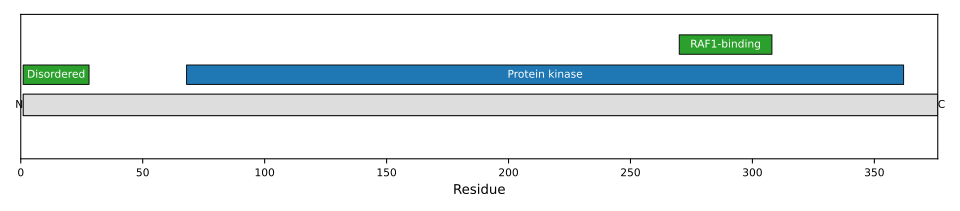
1: Dual specificity protein kinase which acts as an essential component of the MAP kinase signal transduction pathway. Binding of extracellular ligands such as growth factors, cytokines and hormones to their cell-surface receptors activates RAS and this initiates RAF1 activation. RAF1 then further activates the dual-specificity protein kinases MAP2K1/MEK1 and MAP2K2/MEK2. Both MAP2K1/MEK1 and MAP2K2/MEK2 function specifically in the MAPK/ERK cascade, and catalyze the concomitant phosphorylation of a threonine and a tyrosine residue in a Thr-Glu-Tyr sequence located in the extracellular signal-regulated kinases MAPK3/ERK1 and MAPK1/ERK2, leading to their activation and further transduction of the signal within the MAPK/ERK cascade. Activates BRAF in a KSR1 or KSR2-dependent manner; by binding to KSR1 or KSR2 releases the inhibitory intramolecular interaction between KSR1 or KSR2 protein kinase and N-terminal domains which promotes KSR1 or KSR2-BRAF dimerization and BRAF activation (PubMed:29433126). Depending on the cellular context, this pathway mediates diverse biological functions such as cell growth, adhesion, survival and differentiation, predominantly through the regulation of transcription, metabolism and cytoskeletal rearrangements. One target of the MAPK/ERK cascade is peroxisome proliferator-activated receptor gamma (PPARG), a nuclear receptor that promotes differentiation and apoptosis. MAP2K1/MEK1 has been shown to export PPARG from the nucleus. The MAPK/ERK cascade is also involved in the regulation of endosomal dynamics, including lysosome processing and endosome cycling through the perinuclear recycling compartment (PNRC), as well as in the fragmentation of the Golgi apparatus during mitosis