Angiopoietin-1 receptor (EC 2.7.10.1) (Endothelial tyrosine kinase) (Tunica interna endothelial cell kinase) (Tyrosine kinase with Ig and EGF homology domains-2) (Tyrosine-protein kinase receptor TEK) (Tyrosine-protein kinase receptor TIE-2) (hTIE2) (p140 TEK) (CD antigen CD202b)
1_MDSLA 6_ SLVLC 11_ GVSLL 16_ LSGTV 21_ EGAMD 26_ LILIN 31_ SLPLV 36_ SDAET 41_ SLTCI 46_ ASGWR 51_ PHEPI 56_ TIGRD 61_ FEALM 66_ NQHQD 71_ PLEVT 76_ QDVTR 81_ EWAKK 86_ VVWKR 91_ EKASK 96_ INGAY 101_ FCEGR 106_ VRGEA 111_ IRIRT 116_ MKMRQ 121_ QASFL 126_ PATLT 131_ MTVDK 136_ GDNVN 141_ ISFKK 146_ VLIKE 151_ EDAVI 156_ YKNGS 161_ FIHSV 166_ PRHEV 171_ PDILE 176_ VHLPH 181_ AQPQD 186_ AGVYS 191_ ARYIG 196_ GNLFT 201_ SAFTR 206_ LIVRR 211_ CEAQK 216_ WGPEC 221_ NHLCT 226_ ACMNN 231_ GVCHE 236_ DTGEC 241_ ICPPG 246_ FMGRT 251_ CEKAC 256_ ELHTF 261_ GRTCK 266_ ERCSG 271_ QEGCK 276_ SYVFC 281_ LPDPY 286_ GCSCA 291_ TGWKG 296_ LQCNE 301_ ACHPG 306_ FYGPD 311_ CKLRC 316_ SCNNG 321_ EMCDR 326_ FQGCL 331_ CSPGW 336_ QGLQC 341_ EREGI 346_ QRMTP 351_ KIVDL 356_ PDHIE 361_ VNSGK 366_ FNPIC 371_ KASGW 376_ PLPTN 381_ EEMTL 386_ VKPDG 391_ TVLHP 396_ KDFNH 401_ TDHFS 406_ VAIFT 411_ IHRIL 416_ PPDSG 421_ VWVCS 426_ VNTVA 431_ GMVEK 436_ PFNIS 441_ VKVLP 446_ KPLNA 451_ PNVID 456_ TGHNF 461_ AVINI 466_ SSEPY 471_ FGDGP 476_ IKSKK 481_ LLYKP 486_ VNHYE 491_ AWQHI 496_ QVTNE 501_ IVTLN 506_ YLEPR 511_ TEYEL 516_ CVQLV 521_ RRGEG 526_ GEGHP 531_ GPVRR 536_ FTTAS 541_ IGLPP 546_ PRGLN 551_ LLPKS 556_ QTTLN 561_ LTWQP 566_ IFPSS 571_ EDDFY 576_ VEVER 581_ RSVQK 586_ SDQQN 591_ IKVPG 596_ NLTSV 601_ LLNNL 606_ HPREQ 611_ YVVRA 616_ RVNTK 621_ AQGEW 626_ SEDLT 631_ AWTLS 636_ DILPP 641_ QPENI 646_ KISNI 651_ THSSA 656_ VISWT 661_ ILDGY 666_ SISSI 671_ TIRYK 676_ VQGKN 681_ EDQHV 686_ DVKIK 691_ NATIT 696_ QYQLK 701_ GLEPE 706_ TAYQV 711_ DIFAE 716_ NNIGS 721_ SNPAF 726_ SHELV 731_ TLPES 736_ QAPAD 741_ LGGGK 746_ MLLIA 751_ ILGSA 756_ GMTCL 761_ TVLLA 766_ FLIIL 771_ QLKRA 776_ NVQRR 781_ MAQAF 786_ QNVRE 791_ EPAVQ 796_ FNSGT 801_ LALNR 806_ KVKNN 811_ PDPTI 816_ YPVLD 821_ WNDIK 826_ FQDVI 831_ GEGNF 836_ GQVLK 841_ ARIKK 846_ DGLRM 851_ DAAIK 856_ RMKEY 861_ ASKDD 866_ HRDFA 871_ GELEV 876_ LCKLG 881_ HHPNI 886_ INLLG 891_ ACEHR 896_ GYLYL 901_ AIEYA 906_ PHGNL 911_ LDFLR 916_ KSRVL 921_ ETDPA 926_ FAIAN 931_ STAST 936_ LSSQQ 941_ LLHFA 946_ ADVAR 951_ GMDYL 956_ SQKQF 961_ IHRDL 966_ AARNI 971_ LVGEN 976_ YVAKI 981_ ADFGL 986_ SRGQE 991_ VYVKK 996_ TMGRL 1001_ PVRWM 1006_ AIESL 1011_ NYSVY 1016_ TTNSD 1021_ VWSYG 1026_ VLLWE 1031_ IVSLG 1036_ GTPYC 1041_ GMTCA 1046_ ELYEK 1051_ LPQGY 1056_ RLEKP 1061_ LNCDD 1066_ EVYDL 1071_ MRQCW 1076_ REKPY 1081_ ERPSF 1086_ AQILV 1091_ SLNRM 1096_ LEERK 1101_ TYVNT 1106_ TLYEK 1111_ FTYAG 1116_IDCSA
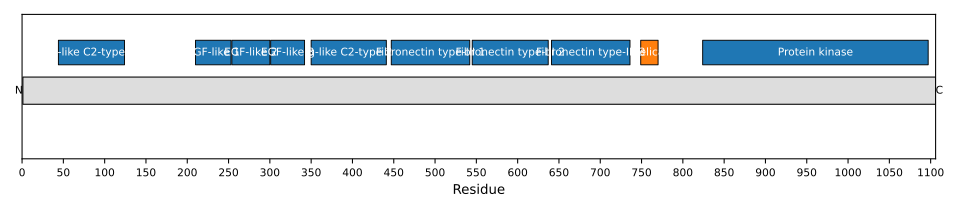
1: Tyrosine-protein kinase that acts as a cell-surface receptor for ANGPT1, ANGPT2 and ANGPT4 and regulates angiogenesis, endothelial cell survival, proliferation, migration, adhesion and cell spreading, reorganization of the actin cytoskeleton, but also maintenance of vascular quiescence. Has anti-inflammatory effects by preventing the leakage of pro-inflammatory plasma proteins and leukocytes from blood vessels. Required for normal angiogenesis and heart development during embryogenesis. Required for post-natal hematopoiesis. After birth, activates or inhibits angiogenesis, depending on the context. Inhibits angiogenesis and promotes vascular stability in quiescent vessels, where endothelial cells have tight contacts. In quiescent vessels, ANGPT1 oligomers recruit TEK to cell-cell contacts, forming complexes with TEK molecules from adjoining cells, and this leads to preferential activation of phosphatidylinositol 3-kinase and the AKT1 signaling cascades. In migrating endothelial cells that lack cell-cell adhesions, ANGT1 recruits TEK to contacts with the extracellular matrix, leading to the formation of focal adhesion complexes, activation of PTK2/FAK and of the downstream kinases MAPK1/ERK2 and MAPK3/ERK1, and ultimately to the stimulation of sprouting angiogenesis. ANGPT1 signaling triggers receptor dimerization and autophosphorylation at specific tyrosine residues that then serve as binding sites for scaffold proteins and effectors. Signaling is modulated by ANGPT2 that has lower affinity for TEK, can promote TEK autophosphorylation in the absence of ANGPT1, but inhibits ANGPT1-mediated signaling by competing for the same binding site. Signaling is also modulated by formation of heterodimers with TIE1, and by proteolytic processing that gives rise to a soluble TEK extracellular domain. The soluble extracellular domain modulates signaling by functioning as decoy receptor for angiopoietins. TEK phosphorylates DOK2, GRB7, GRB14, PIK3R1; SHC1 and TIE1