Antigen peptide transporter 2 (APT2) (EC 7.4.2.-) (ATP-binding cassette sub-family B member 3) (Peptide supply factor 2) (Peptide transporter PSF2) (PSF-2) (Peptide transporter TAP2) (Peptide transporter involved in antigen processing 2) (Really interesting new gene 11 protein) (RING11)
1_MRLPD 6_ LRPWT 11_ SLLLV 16_ DAALL 21_ WLLQG 26_ PLGTL 31_ LPQGL 36_ PGLWL 41_ EGTLR 46_ LGGLW 51_ GLLKL 56_ RGLLG 61_ FVGTL 66_ LLPLC 71_ LATPL 76_ TVSLR 81_ ALVAG 86_ ASRAP 91_ PARVA 96_ SAPWS 101_ WLLVG 106_ YGAAG 111_ LSWSL 116_ WAVLS 121_ PPGAQ 126_ EKEQD 131_ QVNNK 136_ VLMWR 141_ LLKLS 146_ RPDLP 151_ LLVAA 156_ FFFLV 161_ LAVLG 166_ ETLIP 171_ HYSGR 176_ VIDIL 181_ GGDFD 186_ PHAFA 191_ SAIFF 196_ MCLFS 201_ FGSSL 206_ SAGCR 211_ GGCFT 216_ YTMSR 221_ INLRI 226_ REQLF 231_ SSLLR 236_ QDLGF 241_ FQETK 246_ TGELN 251_ SRLSS 256_ DTTLM 261_ SNWLP 266_ LNANV 271_ LLRSL 276_ VKVVG 281_ LYGFM 286_ LSISP 291_ RLTLL 296_ SLLHM 301_ PFTIA 306_ AEKVY 311_ NTRHQ 316_ EVLRE 321_ IQDAV 326_ ARAGQ 331_ VVREA 336_ VGGLQ 341_ TVRSF 346_ GAEEH 351_ EVCRY 356_ KEALE 361_ QCRQL 366_ YWRRD 371_ LERAL 376_ YLLVR 381_ RVLHL 386_ GVQML 391_ MLSCG 396_ LQQMQ 401_ DGELT 406_ QGSLL 411_ SFMIY 416_ QESVG 421_ SYVQT 426_ LVYIY 431_ GDMLS 436_ NVGAA 441_ EKVFS 446_ YMDRQ 451_ PNLPS 456_ PGTLA 461_ PTTLQ 466_ GVVKF 471_ QDVSF 476_ AYPNR 481_ PDRPV 486_ LKGLT 491_ FTLRP 496_ GEVTA 501_ LVGPN 506_ GSGKS 511_ TVAAL 516_ LQNLY 521_ QPTGG 526_ QVLLD 531_ EKPIS 536_ QYEHC 541_ YLHSQ 546_ VVSVG 551_ QEPVL 556_ FSGSV 561_ RNNIA 566_ YGLQS 571_ CEDDK 576_ VMAAA 581_ QAAHA 586_ DDFIQ 591_ EMEHG 596_ IYTDV 601_ GEKGS 606_ QLAAG 611_ QKQRL 616_ AIARA 621_ LVRDP 626_ RVLIL 631_ DEATS 636_ ALDVQ 641_ CEQAL 646_ QDWNS 651_ RGDRT 656_ VLVIA 661_ HRLQT 666_ VQRAH 671_ QILVL 676_ QEGKL 681_QKLAQ
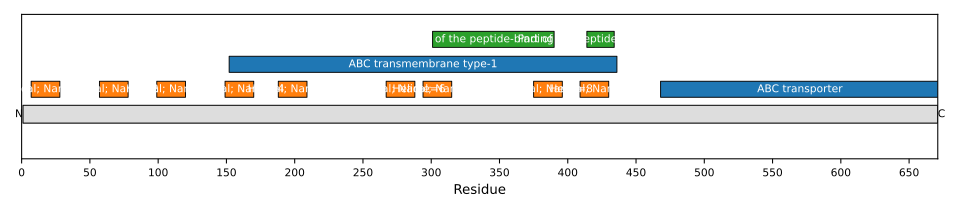
1: ABC transporter associated with antigen processing. In complex with TAP1 mediates unidirectional translocation of peptide antigens from cytosol to endoplasmic reticulum (ER) for loading onto MHC class I (MHCI) molecules (PubMed:25377891, PubMed:25656091). Uses the chemical energy of ATP to export peptides against the concentration gradient (PubMed:25377891). During the transport cycle alternates between 'inward-facing' state with peptide binding site facing the cytosol to 'outward-facing' state with peptide binding site facing the ER lumen. Peptide antigen binding to ATP-loaded TAP1-TAP2 induces a switch to hydrolysis-competent 'outward-facing' conformation ready for peptide loading onto nascent MHCI molecules. Subsequently ATP hydrolysis resets the transporter to the 'inward facing' state for a new cycle (PubMed:11274390, PubMed:25377891, PubMed:25656091). Typically transports intracellular peptide antigens of 8 to 13 amino acids that arise from cytosolic proteolysis via IFNG-induced immunoproteasome. Binds peptides with free N- and C-termini, the first three and the C-terminal residues being critical. Preferentially selects peptides having a highly hydrophobic residue at position 3 and hydrophobic or charged residues at the C-terminal anchor. Proline at position 2 has the most destabilizing effect (PubMed:11274390, PubMed:7500034, PubMed:9256420). As a component of the peptide loading complex (PLC), acts as a molecular scaffold essential for peptide-MHCI assembly and antigen presentation (PubMed:1538751, PubMed:25377891, PubMed:26611325)