Transcription factor p65 (Nuclear factor NF-kappa-B p65 subunit) (Nuclear factor of kappa light polypeptide gene enhancer in B-cells 3)
1_MDELF 6_ PLIFP 11_ AEPAQ 16_ ASGPY 21_ VEIIE 26_ QPKQR 31_ GMRFR 36_ YKCEG 41_ RSAGS 46_ IPGER 51_ STDTT 56_ KTHPT 61_ IKING 66_ YTGPG 71_ TVRIS 76_ LVTKD 81_ PPHRP 86_ HPHEL 91_ VGKDC 96_ RDGFY 101_ EAELC 106_ PDRCI 111_ HSFQN 116_ LGIQC 121_ VKKRD 126_ LEQAI 131_ SQRIQ 136_ TNNNP 141_ FQVPI 146_ EEQRG 151_ DYDLN 156_ AVRLC 161_ FQVTV 166_ RDPSG 171_ RPLRL 176_ PPVLS 181_ HPIFD 186_ NRAPN 191_ TAELK 196_ ICRVN 201_ RNSGS 206_ CLGGD 211_ EIFLL 216_ CDKVQ 221_ KEDIE 226_ VYFTG 231_ PGWEA 236_ RGSFS 241_ QADVH 246_ RQVAI 251_ VFRTP 256_ PYADP 261_ SLQAP 266_ VRVSM 271_ QLRRP 276_ SDREL 281_ SEPME 286_ FQYLP 291_ DTDDR 296_ HRIEE 301_ KRKRT 306_ YETFK 311_ SIMKK 316_ SPFSG 321_ PTDPR 326_ PPPRR 331_ IAVPS 336_ RSSAS 341_ VPKPA 346_ PQPYP 351_ FTSSL 356_ STINY 361_ DEFPT 366_ MVFPS 371_ GQISQ 376_ ASALA 381_ PAPPQ 386_ VLPQA 391_ PAPAP 396_ APAMV 401_ SALAQ 406_ APAPV 411_ PVLAP 416_ GPPQA 421_ VAPPA 426_ PKPTQ 431_ AGEGT 436_ LSEAL 441_ LQLQF 446_ DDEDL 451_ GALLG 456_ NSTDP 461_ AVFTD 466_ LASVD 471_ NSEFQ 476_ QLLNQ 481_ GIPVA 486_ PHTTE 491_ PMLME 496_ YPEAI 501_ TRLVT 506_ GAQRP 511_ PDPAP 516_ APLGA 521_ PGLPN 526_ GLLSG 531_ DEDFS 536_ SIADM 541_ DFSAL 546_LSQIS
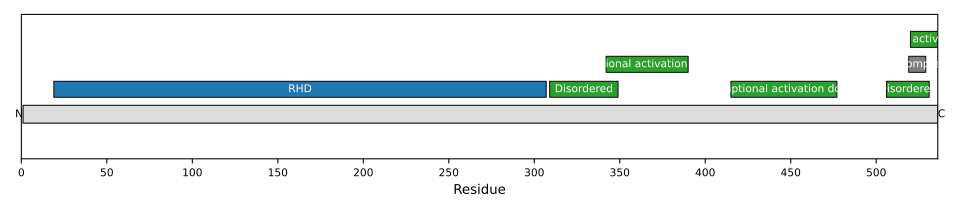
1: NF-kappa-B is a pleiotropic transcription factor present in almost all cell types and is the endpoint of a series of signal transduction events that are initiated by a vast array of stimuli related to many biological processes such as inflammation, immunity, differentiation, cell growth, tumorigenesis and apoptosis. NF-kappa-B is a homo- or heterodimeric complex formed by the Rel-like domain-containing proteins RELA/p65, RELB, NFKB1/p105, NFKB1/p50, REL and NFKB2/p52. The heterodimeric RELA-NFKB1 complex appears to be most abundant one. The dimers bind at kappa-B sites in the DNA of their target genes and the individual dimers have distinct preferences for different kappa-B sites that they can bind with distinguishable affinity and specificity. Different dimer combinations act as transcriptional activators or repressors, respectively. The NF-kappa-B heterodimeric RELA-NFKB1 and RELA-REL complexes, for instance, function as transcriptional activators. NF-kappa-B is controlled by various mechanisms of post-translational modification and subcellular compartmentalization as well as by interactions with other cofactors or corepressors. NF-kappa-B complexes are held in the cytoplasm in an inactive state complexed with members of the NF-kappa-B inhibitor (I-kappa-B) family. In a conventional activation pathway, I-kappa-B is phosphorylated by I-kappa-B kinases (IKKs) in response to different activators, subsequently degraded thus liberating the active NF-kappa-B complex which translocates to the nucleus. The inhibitory effect of I-kappa-B on NF-kappa-B through retention in the cytoplasm is exerted primarily through the interaction with RELA. RELA shows a weak DNA-binding site which could contribute directly to DNA binding in the NF-kappa-B complex. Besides its activity as a direct transcriptional activator, it is also able to modulate promoters accessibility to transcription factors and thereby indirectly regulate gene expression. Associates with chromatin at the NF-kappa-B promoter region via association with DDX1. Essential for cytokine gene expression in T-cells (PubMed:15790681). The NF-kappa-B homodimeric RELA-RELA complex appears to be involved in invasin-mediated activation of IL-8 expression. Key transcription factor regulating the IFN response during SARS-CoV-2 infection (PubMed:33440148)