Keratin, type I cytoskeletal 17 (39.1) (Cytokeratin-17) (CK-17) (Keratin-17) (K17)
1_MTTSI 6_ RQFTS 11_ SSSIK 16_ GSSGL 21_ GGGSS 26_ RTSCR 31_ LSGGL 36_ GAGSC 41_ RLGSA 46_ GGLGS 51_ TLGGS 56_ SYSSC 61_ YSFGS 66_ GGGYG 71_ SSFGG 76_ VDGLL 81_ AGGEK 86_ ATMQN 91_ LNDRL 96_ ASYLD 101_ KVRAL 106_ EEANT 111_ ELEVK 116_ IRDWY 121_ QRQAP 126_ GPARD 131_ YSQYY 136_ RTIEE 141_ LQNKI 146_ LTATV 151_ DNANI 156_ LLQID 161_ NARLA 166_ ADDFR 171_ TKFET 176_ EQALR 181_ LSVEA 186_ DINGL 191_ RRVLD 196_ ELTLA 201_ RADLE 206_ MQIEN 211_ LKEEL 216_ AYLKK 221_ NHEEE 226_ MNALR 231_ GQVGG 236_ EINVE 241_ MDAAP 246_ GVDLS 251_ RILNE 256_ MRDQY 261_ EKMAE 266_ KNRKD 271_ AEDWF 276_ FSKTE 281_ ELNRE 286_ VATNS 291_ ELVQS 296_ GKSEI 301_ SELRR 306_ TMQAL 311_ EIELQ 316_ SQLSM 321_ KASLE 326_ GNLAE 331_ TENRY 336_ CVQLS 341_ QIQGL 346_ IGSVE 351_ EQLAQ 356_ LRCEM 361_ EQQNQ 366_ EYKIL 371_ LDVKT 376_ RLEQE 381_ IATYR 386_ RLLEG 391_ EDAHL 396_ TQYKK 401_ EPVTT 406_ RQVRT 411_ IVEEV 416_ QDGKV 421_ ISSRE 426_QVHQT
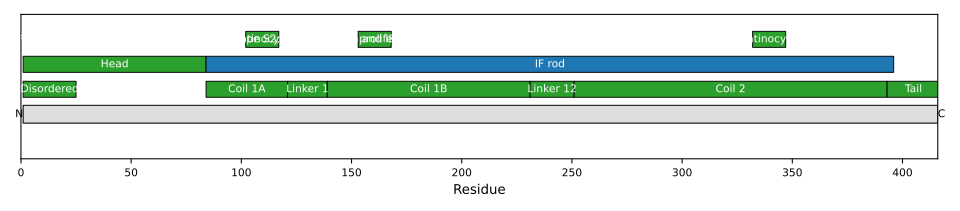
1: Type I keratin involved in the formation and maintenance of various skin appendages, specifically in determining shape and orientation of hair (By similarity). Required for the correct growth of hair follicles, in particular for the persistence of the anagen (growth) state (By similarity). Modulates the function of TNF-alpha in the specific context of hair cycling. Regulates protein synthesis and epithelial cell growth through binding to the adapter protein SFN and by stimulating Akt/mTOR pathway (By similarity). Involved in tissue repair. May be a marker of basal cell differentiation in complex epithelia and therefore indicative of a certain type of epithelial 'stem cells'. Acts as a promoter of epithelial proliferation by acting a regulator of immune response in skin: promotes Th1/Th17-dominated immune environment contributing to the development of basaloid skin tumors (By similarity). May act as an autoantigen in the immunopathogenesis of psoriasis, with certain peptide regions being a major target for autoreactive T-cells and hence causing their proliferation