Protein kinase C theta type (EC 2.7.11.13) (nPKC-theta)
1_MSPFL 6_ RIGLS 11_ NFDCG 16_ SCQSC 21_ QGEAV 26_ NPYCA 31_ VLVKE 36_ YVESE 41_ NGQMY 46_ IQKKP 51_ TMYPP 56_ WDSTF 61_ DAHIN 66_ KGRVM 71_ QIIVK 76_ GKNVD 81_ LISET 86_ TVELY 91_ SLAER 96_ CRKNN 101_ GKTEI 106_ WLELK 111_ PQGRM 116_ LMNAR 121_ YFLEM 126_ SDTKD 131_ MNEFE 136_ TEGFF 141_ ALHQR 146_ RGAIK 151_ QAKVH 156_ HVKCH 161_ EFTAT 166_ FFPQP 171_ TFCSV 176_ CHEFV 181_ WGLNK 186_ QGYQC 191_ RQCNA 196_ AIHKK 201_ CIDKV 206_ IAKCT 211_ GSAIN 216_ SRETM 221_ FHKER 226_ FKIDM 231_ PHRFK 236_ VYNYK 241_ SPTFC 246_ EHCGT 251_ LLWGL 256_ ARQGL 261_ KCDAC 266_ GMNVH 271_ HRCQT 276_ KVANL 281_ CGINQ 286_ KLMAE 291_ ALAMI 296_ ESTQQ 301_ ARCLR 306_ DTEQI 311_ FREGP 316_ VEIGL 321_ PCSIK 326_ NEARP 331_ PCLPT 336_ PGKRE 341_ PQGIS 346_ WESPL 351_ DEVDK 356_ MCHLP 361_ EPELN 366_ KERPS 371_ LQIKL 376_ KIEDF 381_ ILHKM 386_ LGKGS 391_ FGKVF 396_ LAEFK 401_ KTNQF 406_ FAIKA 411_ LKKDV 416_ VLMDD 421_ DVECT 426_ MVEKR 431_ VLSLA 436_ WEHPF 441_ LTHMF 446_ CTFQT 451_ KENLF 456_ FVMEY 461_ LNGGD 466_ LMYHI 471_ QSCHK 476_ FDLSR 481_ ATFYA 486_ AEIIL 491_ GLQFL 496_ HSKGI 501_ VYRDL 506_ KLDNI 511_ LLDKD 516_ GHIKI 521_ ADFGM 526_ CKENM 531_ LGDAK 536_ TNTFC 541_ GTPDY 546_ IAPEI 551_ LLGQK 556_ YNHSV 561_ DWWSF 566_ GVLLY 571_ EMLIG 576_ QSPFH 581_ GQDEE 586_ ELFHS 591_ IRMDN 596_ PFYPR 601_ WLEKE 606_ AKDLL 611_ VKLFV 616_ REPEK 621_ RLGVR 626_ GDIRQ 631_ HPLFR 636_ EINWE 641_ ELERK 646_ EIDPP 651_ FRPKV 656_ KSPFD 661_ CSNFD 666_ KEFLN 671_ EKPRL 676_ SFADR 681_ ALINS 686_ MDQNM 691_ FRNFS 696_ FMNPG 701_MERLI
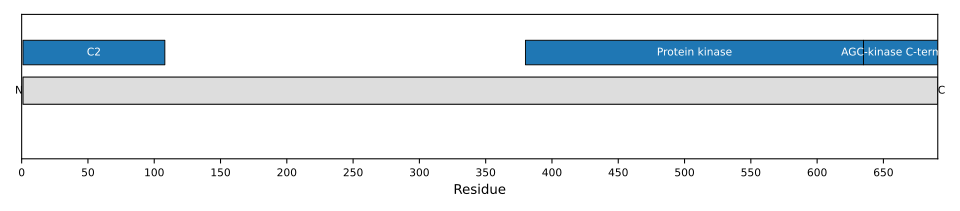
1: Calcium-independent, phospholipid- and diacylglycerol (DAG)-dependent serine/threonine-protein kinase that mediates non-redundant functions in T-cell receptor (TCR) signaling, including T-cells activation, proliferation, differentiation and survival, by mediating activation of multiple transcription factors such as NF-kappa-B, JUN, NFATC1 and NFATC2. In TCR-CD3/CD28-co-stimulated T-cells, is required for the activation of NF-kappa-B and JUN, which in turn are essential for IL2 production, and participates in the calcium-dependent NFATC1 and NFATC2 transactivation (PubMed:21964608). Mediates the activation of the canonical NF-kappa-B pathway (NFKB1) by direct phosphorylation of CARD11 on several serine residues, inducing CARD11 association with lipid rafts and recruitment of the BCL10-MALT1 complex, which then activates IKK complex, resulting in nuclear translocation and activation of NFKB1. May also play an indirect role in activation of the non-canonical NF-kappa-B (NFKB2) pathway. In the signaling pathway leading to JUN activation, acts by phosphorylating the mediator STK39/SPAK and may not act through MAP kinases signaling. Plays a critical role in TCR/CD28-induced NFATC1 and NFATC2 transactivation by participating in the regulation of reduced inositol 1,4,5-trisphosphate generation and intracellular calcium mobilization. After costimulation of T-cells through CD28 can phosphorylate CBLB and is required for the ubiquitination and subsequent degradation of CBLB, which is a prerequisite for the activation of TCR. During T-cells differentiation, plays an important role in the development of T-helper 2 (Th2) cells following immune and inflammatory responses, and, in the development of inflammatory autoimmune diseases, is necessary for the activation of IL17-producing Th17 cells. May play a minor role in Th1 response. Upon TCR stimulation, mediates T-cell protective survival signal by phosphorylating BAD, thus protecting T-cells from BAD-induced apoptosis, and by up-regulating BCL-X(L)/BCL2L1 levels through NF-kappa-B and JUN pathways. In platelets, regulates signal transduction downstream of the ITGA2B, CD36/GP4, F2R/PAR1 and F2RL3/PAR4 receptors, playing a positive role in 'outside-in' signaling and granule secretion signal transduction. May relay signals from the activated ITGA2B receptor by regulating the uncoupling of WASP and WIPF1, thereby permitting the regulation of actin filament nucleation and branching activity of the Arp2/3 complex. May mediate inhibitory effects of free fatty acids on insulin signaling by phosphorylating IRS1, which in turn blocks IRS1 tyrosine phosphorylation and downstream activation of the PI3K/AKT pathway. Phosphorylates MSN (moesin) in the presence of phosphatidylglycerol or phosphatidylinositol. Phosphorylates PDPK1 at 'Ser-504' and 'Ser-532' and negatively regulates its ability to phosphorylate PKB/AKT1. Phosphorylates CCDC88A/GIV and inhibits its guanine nucleotide exchange factor activity (PubMed:23509302). Phosphorylates and activates LRRK1, which phosphorylates RAB proteins involved in intracellular trafficking (PubMed:36040231)