Proto-oncogene c-Rel
1_MASGA 6_ YNPYI 11_ EIIEQ 16_ PRQRG 21_ MRFRY 26_ KCEGR 31_ SAGSI 36_ PGEHS 41_ TDNNR 46_ TYPSI 51_ QIMNY 56_ YGKGK 61_ VRITL 66_ VTKND 71_ PYKPH 76_ PHDLV 81_ GKDCR 86_ DGYYE 91_ AEFGQ 96_ ERRPL 101_ FFQNL 106_ GIRCV 111_ KKKEV 116_ KEAII 121_ TRIKA 126_ GINPF 131_ NVPEK 136_ QLNDI 141_ EDCDL 146_ NVVRL 151_ CFQVF 156_ LPDEH 161_ GNLTT 166_ ALPPV 171_ VSNPI 176_ YDNRA 181_ PNTAE 186_ LRICR 191_ VNKNC 196_ GSVRG 201_ GDEIF 206_ LLCDK 211_ VQKDD 216_ IEVRF 221_ VLNDW 226_ EAKGI 231_ FSQAD 236_ VHRQV 241_ AIVFK 246_ TPPYC 251_ KAITE 256_ PVTVK 261_ MQLRR 266_ PSDQE 271_ VSESM 276_ DFRYL 281_ PDEKD 286_ TYGNK 291_ AKKQK 296_ TTLLF 301_ QKLCQ 306_ DHVET 311_ GFRHV 316_ DQDGL 321_ ELLTS 326_ GDPPT 331_ LASQS 336_ AGITV 341_ NFPER 346_ PRPGL 351_ LGSIG 356_ EGRYF 361_ KKEPN 366_ LFSHD 371_ AVVRE 376_ MPTGV 381_ SSQAE 386_ SYYPS 391_ PGPIS 396_ SGLSH 401_ HASMA 406_ PLPSS 411_ SWSSV 416_ AHPTP 421_ RSGNT 426_ NPLSS 431_ FSTRT 436_ LPSNS 441_ QGIPP 446_ FLRIP 451_ VGNDL 456_ NASNA 461_ CIYNN 466_ ADDIV 471_ GMEAS 476_ SMPSA 481_ DLYGI 486_ SDPNM 491_ LSNCS 496_ VNMMT 501_ TSSDS 506_ MGETD 511_ NPRLL 516_ SMNLE 521_ NPSCN 526_ SVLDP 531_ RDLRQ 536_ LHQMS 541_ SSSMS 546_ AGANS 551_ NTTVF 556_ VSQSD 561_ AFEGS 566_ DFSCA 571_ DNSMI 576_ NESGP 581_ SNSTN 586_ PNSHG 591_ FVQDS 596_ QYSGI 601_ GSMQN 606_ EQLSD 611_SFPYE
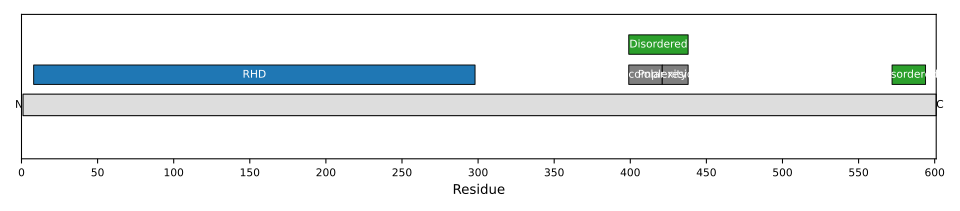
1: Proto-oncogene that may play a role in differentiation and lymphopoiesis. NF-kappa-B is a pleiotropic transcription factor which is present in almost all cell types and is involved in many biological processed such as inflammation, immunity, differentiation, cell growth, tumorigenesis and apoptosis. NF-kappa-B is a homo- or heterodimeric complex formed by the Rel-like domain-containing proteins RELA/p65, RELB, NFKB1/p105, NFKB1/p50, REL and NFKB2/p52. The dimers bind at kappa-B sites in the DNA of their target genes and the individual dimers have distinct preferences for different kappa-B sites that they can bind with distinguishable affinity and specificity. Different dimer combinations act as transcriptional activators or repressors, respectively. NF-kappa-B is controlled by various mechanisms of post-translational modification and subcellular compartmentalization as well as by interactions with other cofactors or corepressors. NF-kappa-B complexes are held in the cytoplasm in an inactive state complexed with members of the NF-kappa-B inhibitor (I-kappa-B) family. In a conventional activation pathway, I-kappa-B is phosphorylated by I-kappa-B kinases (IKKs) in response to different activators, subsequently degraded thus liberating the active NF-kappa-B complex which translocates to the nucleus. The NF-kappa-B heterodimer RELA/p65-c-Rel is a transcriptional activator