Protein kinase C delta type (EC 2.7.11.13) (Tyrosine-protein kinase PRKCD) (EC 2.7.10.2) (nPKC-delta) [Cleaved into: Protein kinase C delta type regulatory subunit; Protein kinase C delta type catalytic subunit (Sphingosine-dependent protein kinase-1) (SDK1)]
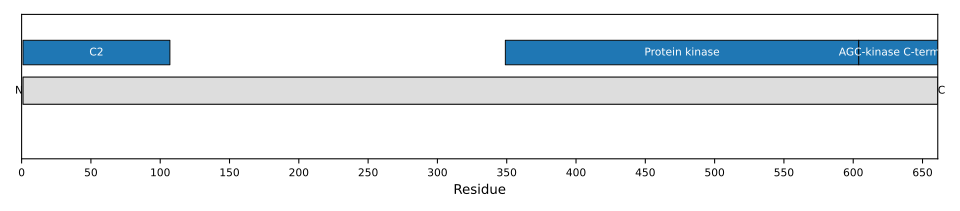
1_MAPFL 6_ RIAFN 11_ SYELG 16_ SLQAE 21_ DEANQ 26_ PFCAV 31_ KMKEA 36_ LSTER 41_ GKTLV 46_ QKKPT 51_ MYPEW 56_ KSTFD 61_ AHIYE 66_ GRVIQ 71_ IVLMR 76_ AAEEP 81_ VSEVT 86_ VGVSV 91_ LAERC 96_ KKNNG 101_ KAEFW 106_ LDLQP 111_ QAKVL 116_ MSVQY 121_ FLEDV 126_ DCKQS 131_ MRSED 136_ EAKFP 141_ TMNRR 146_ GAIKQ 151_ AKIHY 156_ IKNHE 161_ FIATF 166_ FGQPT 171_ FCSVC 176_ KDFVW 181_ GLNKQ 186_ GYKCR 191_ QCNAA 196_ IHKKC 201_ IDKII 206_ GRCTG 211_ TAANS 216_ RDTIF 221_ QKERF 226_ NIDMP 231_ HRFKV 236_ HNYMS 241_ PTFCD 246_ HCGSL 251_ LWGLV 256_ KQGLK 261_ CEDCG 266_ MNVHH 271_ KCREK 276_ VANLC 281_ GINQK 286_ LLAEA 291_ LNQVT 296_ QRASR 301_ RSDSA 306_ SSEPV 311_ GIYQG 316_ FEKKT 321_ GVAGE 326_ DMQDN 331_ SGTYG 336_ KIWEG 341_ SSKCN 346_ INNFI 351_ FHKVL 356_ GKGSF 361_ GKVLL 366_ GELKG 371_ RGEYF 376_ AIKAL 381_ KKDVV 386_ LIDDD 391_ VECTM 396_ VEKRV 401_ LTLAA 406_ ENPFL 411_ THLIC 416_ TFQTK 421_ DHLFF 426_ VMEFL 431_ NGGDL 436_ MYHIQ 441_ DKGRF 446_ ELYRA 451_ TFYAA 456_ EIMCG 461_ LQFLH 466_ SKGII 471_ YRDLK 476_ LDNVL 481_ LDRDG 486_ HIKIA 491_ DFGMC 496_ KENIF 501_ GESRA 506_ STFCG 511_ TPDYI 516_ APEIL 521_ QGLKY 526_ TFSVD 531_ WWSFG 536_ VLLYE 541_ MLIGQ 546_ SPFHG 551_ DDEDE 556_ LFESI 561_ RVDTP 566_ HYPRW 571_ ITKES 576_ KDILE 581_ KLFER 586_ EPTKR 591_ LGVTG 596_ NIKIH 601_ PFFKT 606_ INWTL 611_ LEKRR 616_ LEPPF 621_ RPKVK 626_ SPRDY 631_ SNFDQ 636_ EFLNE 641_ KARLS 646_ YSDKN 651_ LIDSM 656_ DQSAF 661_ AGFSF 666_ VNPKF 671_EHLLE
1: Calcium-independent, phospholipid- and diacylglycerol (DAG)-dependent serine/threonine-protein kinase that plays contrasting roles in cell death and cell survival by functioning as a pro-apoptotic protein during DNA damage-induced apoptosis, but acting as an anti-apoptotic protein during cytokine receptor-initiated cell death, is involved in tumor suppression as well as survival of several cancers, is required for oxygen radical production by NADPH oxidase and acts as positive or negative regulator in platelet functional responses (PubMed:21406692, PubMed:21810427). Negatively regulates B cell proliferation and also has an important function in self-antigen induced B cell tolerance induction (By similarity). Upon DNA damage, activates the promoter of the death-promoting transcription factor BCLAF1/Btf to trigger BCLAF1-mediated p53/TP53 gene transcription and apoptosis (PubMed:21406692, PubMed:21810427). In response to oxidative stress, interact with and activate CHUK/IKKA in the nucleus, causing the phosphorylation of p53/TP53 (PubMed:21406692, PubMed:21810427). In the case of ER stress or DNA damage-induced apoptosis, can form a complex with the tyrosine-protein kinase ABL1 which trigger apoptosis independently of p53/TP53 (PubMed:21406692, PubMed:21810427). In cytosol can trigger apoptosis by activating MAPK11 or MAPK14, inhibiting AKT1 and decreasing the level of X-linked inhibitor of apoptosis protein (XIAP), whereas in nucleus induces apoptosis via the activation of MAPK8 or MAPK9. Upon ionizing radiation treatment, is required for the activation of the apoptosis regulators BAX and BAK, which trigger the mitochondrial cell death pathway. Can phosphorylate MCL1 and target it for degradation which is sufficient to trigger for BAX activation and apoptosis. Is required for the control of cell cycle progression both at G1/S and G2/M phases. Mediates phorbol 12-myristate 13-acetate (PMA)-induced inhibition of cell cycle progression at G1/S phase by up-regulating the CDK inhibitor CDKN1A/p21 and inhibiting the cyclin CCNA2 promoter activity. In response to UV irradiation can phosphorylate CDK1, which is important for the G2/M DNA damage checkpoint activation (By similarity). Can protect glioma cells from the apoptosis induced by TNFSF10/TRAIL, probably by inducing increased phosphorylation and subsequent activation of AKT1 (PubMed:15774464). Is highly expressed in a number of cancer cells and promotes cell survival and resistance against chemotherapeutic drugs by inducing cyclin D1 (CCND1) and hyperphosphorylation of RB1, and via several pro-survival pathways, including NF-kappa-B, AKT1 and MAPK1/3 (ERK1/2). Involved in antifungal immunity by mediating phosphorylation and activation of CARD9 downstream of C-type lectin receptors activation, promoting interaction between CARD9 and BCL10, followed by activation of NF-kappa-B and MAP kinase p38 pathways (By similarity). Can also act as tumor suppressor upon mitogenic stimulation with PMA or TPA. In N-formyl-methionyl-leucyl-phenylalanine (fMLP)-treated cells, is required for NCF1 (p47-phox) phosphorylation and activation of NADPH oxidase activity, and regulates TNF-elicited superoxide anion production in neutrophils, by direct phosphorylation and activation of NCF1 or indirectly through MAPK1/3 (ERK1/2) signaling pathways (PubMed:19801500). May also play a role in the regulation of NADPH oxidase activity in eosinophil after stimulation with IL5, leukotriene B4 or PMA (PubMed:11748588). In collagen-induced platelet aggregation, acts a negative regulator of filopodia formation and actin polymerization by interacting with and negatively regulating VASP phosphorylation (PubMed:16940418). Downstream of PAR1, PAR4 and CD36/GP4 receptors, regulates differentially platelet dense granule secretion; acts as a positive regulator in PAR-mediated granule secretion, whereas it negatively regulates CD36/GP4-mediated granule release (PubMed:19587372). Phosphorylates MUC1 in the C-terminal and regulates the interaction between MUC1 and beta-catenin (PubMed:11877440). The catalytic subunit phosphorylates 14-3-3 proteins (YWHAB, YWHAZ and YWHAH) in a sphingosine-dependent fashion (By similarity). Phosphorylates ELAVL1 in response to angiotensin-2 treatment (PubMed:18285462). Phosphorylates mitochondrial phospholipid scramblase 3 (PLSCR3), resulting in increased cardiolipin expression on the mitochondrial outer membrane which facilitates apoptosis (PubMed:12649167). Phosphorylates SMPD1 which induces SMPD1 secretion (PubMed:17303575)