Tyrosine-protein kinase BTK (EC 2.7.10.2) (Agammaglobulinemia tyrosine kinase) (ATK) (B-cell progenitor kinase) (BPK) (Bruton tyrosine kinase)
1_MAAVI 6_ LESIF 11_ LKRSQ 16_ QKKKT 21_ SPLNF 26_ KKRLF 31_ LLTVH 36_ KLSYY 41_ EYDFE 46_ RGRRG 51_ SKKGS 56_ IDVEK 61_ ITCVE 66_ TVVPE 71_ KNPPP 76_ ERQIP 81_ RRGEE 86_ SSEME 91_ QISII 96_ ERFPY 101_ PFQVV 106_ YDEGP 111_ LYVFS 116_ PTEEL 121_ RKRWI 126_ HQLKN 131_ VIRYN 136_ SDLVQ 141_ KYHPC 146_ FWIDG 151_ QYLCC 156_ SQTAK 161_ NAMGC 166_ QILEN 171_ RNGSL 176_ KPGSS 181_ HRKTK 186_ KPLPP 191_ TPEED 196_ QILKK 201_ PLPPE 206_ PAAAP 211_ VSTSE 216_ LKKVV 221_ ALYDY 226_ MPMNA 231_ NDLQL 236_ RKGDE 241_ YFILE 246_ ESNLP 251_ WWRAR 256_ DKNGQ 261_ EGYIP 266_ SNYVT 271_ EAEDS 276_ IEMYE 281_ WYSKH 286_ MTRSQ 291_ AEQLL 296_ KQEGK 301_ EGGFI 306_ VRDSS 311_ KAGKY 316_ TVSVF 321_ AKSTG 326_ DPQGV 331_ IRHYV 336_ VCSTP 341_ QSQYY 346_ LAEKH 351_ LFSTI 356_ PELIN 361_ YHQHN 366_ SAGLI 371_ SRLKY 376_ PVSQQ 381_ NKNAP 386_ STAGL 391_ GYGSW 396_ EIDPK 401_ DLTFL 406_ KELGT 411_ GQFGV 416_ VKYGK 421_ WRGQY 426_ DVAIK 431_ MIKEG 436_ SMSED 441_ EFIEE 446_ AKVMM 451_ NLSHE 456_ KLVQL 461_ YGVCT 466_ KQRPI 471_ FIITE 476_ YMANG 481_ CLLNY 486_ LREMR 491_ HRFQT 496_ QQLLE 501_ MCKDV 506_ CEAME 511_ YLESK 516_ QFLHR 521_ DLAAR 526_ NCLVN 531_ DQGVV 536_ KVSDF 541_ GLSRY 546_ VLDDE 551_ YTSSV 556_ GSKFP 561_ VRWSP 566_ PEVLM 571_ YSKFS 576_ SKSDI 581_ WAFGV 586_ LMWEI 591_ YSLGK 596_ MPYER 601_ FTNSE 606_ TAEHI 611_ AQGLR 616_ LYRPH 621_ LASEK 626_ VYTIM 631_ YSCWH 636_ EKADE 641_ RPTFK 646_ ILLSN 651_ILDVM
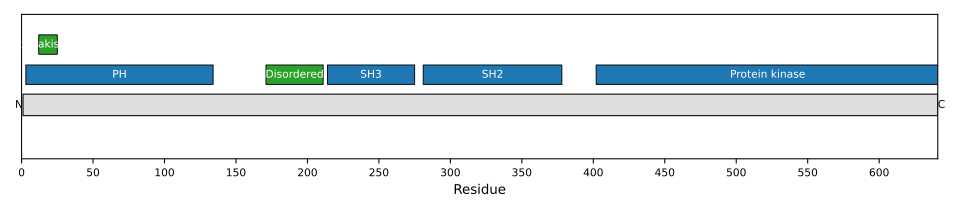
1: Non-receptor tyrosine kinase indispensable for B lymphocyte development, differentiation and signaling (PubMed:19290921). Binding of antigen to the B-cell antigen receptor (BCR) triggers signaling that ultimately leads to B-cell activation (PubMed:19290921). After BCR engagement and activation at the plasma membrane, phosphorylates PLCG2 at several sites, igniting the downstream signaling pathway through calcium mobilization, followed by activation of the protein kinase C (PKC) family members (PubMed:11606584). PLCG2 phosphorylation is performed in close cooperation with the adapter protein B-cell linker protein BLNK (PubMed:11606584). BTK acts as a platform to bring together a diverse array of signaling proteins and is implicated in cytokine receptor signaling pathways (PubMed:16517732, PubMed:17932028). Plays an important role in the function of immune cells of innate as well as adaptive immunity, as a component of the Toll-like receptors (TLR) pathway (PubMed:16517732). The TLR pathway acts as a primary surveillance system for the detection of pathogens and are crucial to the activation of host defense (PubMed:16517732). Especially, is a critical molecule in regulating TLR9 activation in splenic B-cells (PubMed:16517732, PubMed:17932028). Within the TLR pathway, induces tyrosine phosphorylation of TIRAP which leads to TIRAP degradation (PubMed:16415872). BTK also plays a critical role in transcription regulation (PubMed:19290921). Induces the activity of NF-kappa-B, which is involved in regulating the expression of hundreds of genes (PubMed:19290921). BTK is involved on the signaling pathway linking TLR8 and TLR9 to NF-kappa-B (PubMed:19290921). Acts as an activator of NLRP3 inflammasome assembly by mediating phosphorylation of NLRP3 (PubMed:34554188). Transiently phosphorylates transcription factor GTF2I on tyrosine residues in response to BCR (PubMed:9012831). GTF2I then translocates to the nucleus to bind regulatory enhancer elements to modulate gene expression (PubMed:9012831). ARID3A and NFAT are other transcriptional target of BTK (PubMed:16738337). BTK is required for the formation of functional ARID3A DNA-binding complexes (PubMed:16738337). There is however no evidence that BTK itself binds directly to DNA (PubMed:16738337). BTK has a dual role in the regulation of apoptosis (PubMed:9751072). Plays a role in STING1-mediated induction of type I interferon (IFN) response by phosphorylating DDX41 (PubMed:25704810)