Complement component 1 Q subcomponent-binding protein, mitochondrial (ASF/SF2-associated protein p32) (Glycoprotein gC1qBP) (C1qBP) (Hyaluronan-binding protein 1) (Mitochondrial matrix protein p32) (gC1q-R protein) (p33) (SF2AP32)
1_MLPLL 6_ RCVPR 11_ VLGSS 16_ VAGLR 21_ AAAPA 26_ SPFRQ 31_ LLQPA 36_ PRLCT 41_ RPFGL 46_ LSVRA 51_ GSERR 56_ PGLLR 61_ PRGPC 66_ ACGCG 71_ CGSLH 76_ TDGDK 81_ AFVDF 86_ LSDEI 91_ KEERK 96_ IQKHK 101_ TLPKM 106_ SGGWE 111_ LELNG 116_ TEAKL 121_ VRKVA 126_ GEKIT 131_ VTFNI 136_ NNSIP 141_ PTFDG 146_ EEEPS 151_ QGQKV 156_ EEQEP 161_ ELTST 166_ PNFVV 171_ EVIKN 176_ DDGKK 181_ ALVLD 186_ CHYPE 191_ DEVGQ 196_ EDEAE 201_ SDIFS 206_ IREVS 211_ FQSTG 216_ ESEWK 221_ DTNYT 226_ LNTDS 231_ LDWAL 236_ YDHLM 241_ DFLAD 246_ RGVDN 251_ TFADE 256_ LVELS 261_ TALEH 266_ QEYIT 271_ FLEDL 276_KSFVK
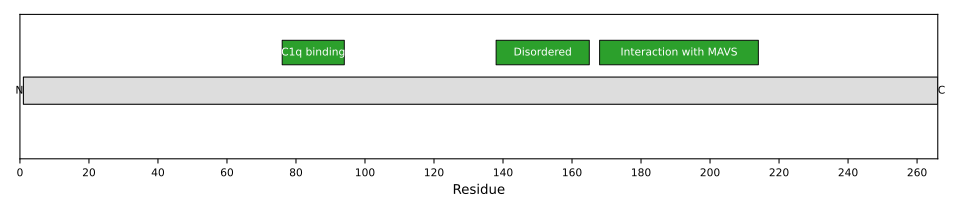
1: Multifunctional and multicompartmental protein involved in inflammation and infection processes, ribosome biogenesis, protein synthesis in mitochondria, regulation of apoptosis, transcriptional regulation and pre-mRNA splicing (PubMed:10022843, PubMed:10479529, PubMed:10722602, PubMed:11086025, PubMed:11859136, PubMed:15243141, PubMed:16140380, PubMed:16177118, PubMed:17881511, PubMed:18676636, PubMed:19004836, PubMed:19164550, PubMed:20810993, PubMed:21536856, PubMed:21544310, PubMed:22700724, PubMed:28942965, PubMed:8662673, PubMed:8710908, PubMed:9461517). At the cell surface is thought to act as an endothelial receptor for plasma proteins of the complement and kallikrein-kinin cascades (PubMed:10479529, PubMed:11859136, PubMed:8662673, PubMed:8710908). Putative receptor for C1q; specifically binds to the globular 'heads' of C1q thus inhibiting C1; may perform the receptor function through a complex with C1qR/CD93 (PubMed:20810993, PubMed:8195709). In complex with cytokeratin-1/KRT1 is a high affinity receptor for kininogen-1/HMWK (PubMed:21544310). Can also bind other plasma proteins, such as coagulation factor XII leading to its autoactivation. May function to bind initially fluid kininogen-1 to the cell membrane. The secreted form may enhance both extrinsic and intrinsic coagulation pathways. It is postulated that the cell surface form requires docking with transmembrane proteins for downstream signaling which might be specific for a cell-type or response. By acting as C1q receptor is involved in chemotaxis of immature dendritic cells and neutrophils and is proposed to signal through CD209/DC-SIGN on immature dendritic cells, through integrin alpha-4/beta-1 during trophoblast invasion of the decidua, and through integrin beta-1 during endothelial cell adhesion and spreading (PubMed:16140380, PubMed:22700724, PubMed:9461517). Signaling involved in inhibition of innate immune response is implicating the PI3K-AKT/PKB pathway (PubMed:16177118). Required for protein synthesis in mitochondria (PubMed:28942965). In mitochondrial translation may be involved in formation of functional 55S mitoribosomes; the function seems to involve its RNA-binding activity (By similarity). Acts as a RNA modification reader, which specifically recognizes and binds mitochondrial RNAs modified by C5-methylcytosine (m5C) in response to stress, and promotes recruitment of the mitochondrial degradosome complex, leading to their degradation (PubMed:39019044). May be involved in the nucleolar ribosome maturation process; the function may involve the exchange of FBL for RRP1 in the association with pre-ribosome particles (By similarity). Involved in regulation of RNA splicing by inhibiting the RNA-binding capacity of SRSF1 and its phosphorylation (PubMed:10022843, PubMed:21536856). Is required for the nuclear translocation of splicing factor U2AF1L4 (By similarity). Involved in regulation of CDKN2A- and HRK-mediated apoptosis. Stabilizes mitochondrial CDKN2A isoform smARF (PubMed:17486078). May be involved in regulation of FOXC1 transcriptional activity and NFY/CCAAT-binding factor complex-mediated transcription (PubMed:15243141, PubMed:18676636). May play a role in antibacterial defense as it can bind to cell surface hyaluronan and inhibit Streptococcus pneumoniae hyaluronate lyase (PubMed:19004836). May be involved in modulation of the immune response; ligation by HCV core protein is resulting in suppression of interleukin-12 production in monocyte-derived dendritic cells (PubMed:11086025, PubMed:17881511). Involved in regulation of antiviral response by inhibiting RIGI- and IFIH1-mediated signaling pathways probably involving its association with MAVS after viral infection (PubMed:19164550). Acts as a regulator of DNA repair via homologous recombination by inhibiting the activity of MRE11: interacts with unphosphorylated MRE11 and RAD50 in absence of DNA damage, preventing formation and activity of the MRN complex. Following DNA damage, dissociates from phosphorylated MRE11, allowing formation of the MRN complex (PubMed:31353207)
2: (Microbial infection) Involved in HIV-1 replication, presumably by contributing to splicing of viral RNA
3: (Microbial infection) In infection processes acts as an attachment site for microbial proteins, including Listeria monocytogenes internalin B (InlB) and Staphylococcus aureus protein A
4: (Microbial infection) Involved in replication of Rubella virus