Early activation antigen CD69 (Activation inducer molecule) (AIM) (BL-AC/P26) (C-type lectin domain family 2 member C) (EA1) (Early T-cell activation antigen p60) (GP32/28) (Leukocyte surface antigen Leu-23) (MLR-3) (CD antigen CD69)
1_MSSEN 6_ CFVAE 11_ NSSLH 16_ PESGQ 21_ ENDAT 26_ SPHFS 31_ TRHEG 36_ SFQVP 41_ VLCAV 46_ MNVVF 51_ ITILI 56_ IALIA 61_ LSVGQ 66_ YNCPG 71_ QYTFS 76_ MPSDS 81_ HVSSC 86_ SEDWV 91_ GYQRK 96_ CYFIS 101_ TVKRS 106_ WTSAQ 111_ NACSE 116_ HGATL 121_ AVIDS 126_ EKDMN 131_ FLKRY 136_ AGREE 141_ HWVGL 146_ KKEPG 151_ HPWKW 156_ SNGKE 161_ FNNWF 166_ NVTGS 171_ DKCVF 176_ LKNTE 181_ VSSME 186_ CEKNL 191_YWICN
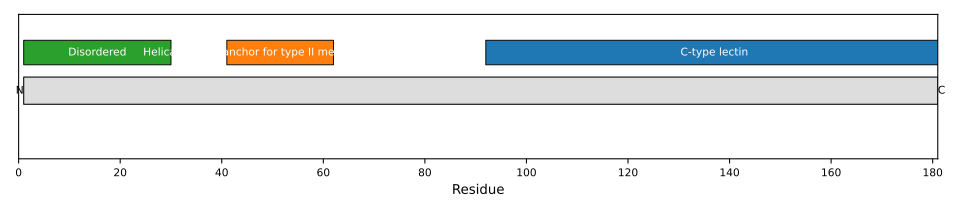
1: Transmembrane protein expressed mainly on T-cells resident in mucosa that plays an essential role in immune cell homeostasis. Rapidly expressed on the surface of platelets, T-lymphocytes and NK cells upon activation by various stimuli, such as antigen recognition or cytokine signaling, stimulates different signaling pathways in different cell types (PubMed:24752896, PubMed:26296369, PubMed:35930205). Negatively regulates Th17 cell differentiation through its carbohydrate dependent interaction with galectin-1/LGALS1 present on immature dendritic cells (PubMed:24752896). Association of CD69 cytoplasmic tail with the JAK3/STAT5 signaling pathway regulates the transcription of RORgamma/RORC and, consequently, differentiation toward the Th17 lineage (By similarity). Also acts via the S100A8/S100A9 complex present on peripheral blood mononuclear cells to promote the conversion of naive CD4 T-cells into regulatory T-cells (PubMed:26296369). Acts as an oxidized low-density lipoprotein (oxLDL) receptor in CD4 T-lymphocytes and negatively regulates the inflammatory response by inducing the expression of PDCD1 through the activation of NFAT (PubMed:35930205). Participates in adipose tissue-derived mesenchymal stem cells (ASCs)-mediated protection against P.aeruginosa infection. Mechanistically, specifically recognizes P.aeruginosa to promote ERK1 activation, followed by granulocyte-macrophage colony-stimulating factor (GM-CSF) and other inflammatory cytokines secretion (PubMed:34841721). In eosinophils, induces IL-10 production through the ERK1/2 pathway (By similarity). Negatively regulates the chemotactic responses of effector lymphocytes and dendritic cells (DCs) to sphingosine 1 phosphate/S1P by acting as a S1PR1 receptor agonist and facilitating the internalization and degradation of the receptor (PubMed:37039481)