ATP-dependent RNA helicase A (EC 3.6.4.13) (DEAH box protein 9) (DExH-box helicase 9) (Leukophysin) (LKP) (Nuclear DNA helicase II) (NDH II) (RNA helicase A)
1_MGDVK 6_ NFLYA 11_ WCGKR 16_ KMTPS 21_ YEIRA 26_ VGNKN 31_ RQKFM 36_ CEVQV 41_ EGYNY 46_ TGMGN 51_ STNKK 56_ DAQSN 61_ AARDF 66_ VNYLV 71_ RINEI 76_ KSEEV 81_ PAFGV 86_ ASPPP 91_ LTDTP 96_ DTTAN 101_ AEGDL 106_ PTTMG 111_ GPLPP 116_ HLALK 121_ AENNS 126_ EVGAS 131_ GYGVP 136_ GPTWD 141_ RGANL 146_ KDYYS 151_ RKEEQ 156_ EVQAT 161_ LESEE 166_ VDLNA 171_ GLHGN 176_ WTLEN 181_ AKARL 186_ NQYFQ 191_ KEKIQ 196_ GEYKY 201_ TQVGP 206_ DHNRS 211_ FIAEM 216_ TIYIK 221_ QLGRR 226_ IFARE 231_ HGSNK 236_ KLAAQ 241_ SCALS 246_ LVRQL 251_ YHLGV 256_ VEAYS 261_ GLTKK 266_ KEGET 271_ VEPYK 276_ VNLSQ 281_ DLEHQ 286_ LQNII 291_ QELNL 296_ EILPP 301_ PEDPS 306_ VPVAL 311_ NIGKL 316_ AQFEP 321_ SQRQN 326_ QVGVV 331_ PWSPP 336_ QSNWN 341_ PWTSS 346_ NIDEG 351_ PLAFA 356_ TPEQI 361_ SMDLK 366_ NELMY 371_ QLEQD 376_ HDLQA 381_ ILQER 386_ ELLPV 391_ KKFES 396_ EILEA 401_ ISQNS 406_ VVIIR 411_ GATGC 416_ GKTTQ 421_ VPQFI 426_ LDDFI 431_ QNDRA 436_ AECNI 441_ VVTQP 446_ RRISA 451_ VSVAE 456_ RVAFE 461_ RGEEP 466_ GKSCG 471_ YSVRF 476_ ESILP 481_ RPHAS 486_ IMFCT 491_ VGVLL 496_ RKLEA 501_ GIRGI 506_ SHVIV 511_ DEIHE 516_ RDINT 521_ DFLLV 526_ VLRDV 531_ VQAYP 536_ EVRIV 541_ LMSAT 546_ IDTSM 551_ FCEYF 556_ FNCPI 561_ IEVYG 566_ RTYPV 571_ QEYFL 576_ EDCIQ 581_ MTHFV 586_ PPPKD 591_ KKKKD 596_ KDDDG 601_ GEDDD 606_ ANCNL 611_ ICGDE 616_ YGPET 621_ RLSMS 626_ QLNEK 631_ ETPFE 636_ LIEAL 641_ LKYIE 646_ TLNVP 651_ GAVLV 656_ FLPGW 661_ NLIYT 666_ MQKHL 671_ EMNPH 676_ FGSHR 681_ YQILP 686_ LHSQI 691_ PREEQ 696_ RKVFD 701_ PVPVG 706_ VTKVI 711_ LSTNI 716_ AETSI 721_ TINDV 726_ VYVID 731_ SCKQK 736_ VKLFT 741_ AHNNM 746_ TNYAT 751_ VWASK 756_ TNLEQ 761_ RKGRA 766_ GRVRP 771_ GFCFH 776_ LCSRA 781_ RFERL 786_ ETHMT 791_ PEMFR 796_ TPLHE 801_ IALSI 806_ KLLRL 811_ GGIGQ 816_ FLAKA 821_ IEPPP 826_ LDAVI 831_ EAEHT 836_ LRELD 841_ ALDAN 846_ DELTP 851_ LGRIL 856_ AKLPI 861_ EPRFG 866_ KMMIM 871_ GCIFY 876_ VGDAI 881_ CTIAA 886_ ATCFP 891_ EPFIN 896_ EGKRL 901_ GYIHR 906_ NFAGN 911_ RFSDH 916_ VALLS 921_ VFQAW 926_ DDARM 931_ GGEEA 936_ EIRFC 941_ EHKRL 946_ NMATL 951_ RMTWE 956_ AKVQL 961_ KEILI 966_ NSGFP 971_ EDCLL 976_ TQVFT 981_ NTGPD 986_ NNLDV 991_ VISLL 996_ AFGVY 1001_ PNVCY 1006_ HKEKR 1011_ KILTT 1016_ EGRNA 1021_ LIHKS 1026_ SVNCP 1031_ FSSQD 1036_ MKYPS 1041_ PFFVF 1046_ GEKIR 1051_ TRAIS 1056_ AKGMT 1061_ LVTPL 1066_ QLLLF 1071_ ASKKV 1076_ QSDGQ 1081_ IVLVD 1086_ DWIKL 1091_ QISHE 1096_ AAACI 1101_ TGLRA 1106_ AMEAL 1111_ VVEVT 1116_ KQPAI 1121_ ISQLD 1126_ PVNER 1131_ MLNMI 1136_ RQISR 1141_ PSAAG 1146_ INLMI 1151_ GSTRY 1156_ GDGPR 1161_ PPKMA 1166_ RYDNG 1171_ SGYRR 1176_ GGSSY 1181_ SGGGY 1186_ GGGYS 1191_ SGGYG 1196_ SGGYG 1201_ GSANS 1206_ FRAGY 1211_ GAGVG 1216_ GGYRG 1221_ VSRGG 1226_ FRGNS 1231_ GGDYR 1236_ GPSGG 1241_ YRGSG 1246_ GFQRG 1251_ GGRGA 1256_ YGTGY 1261_FGQGR
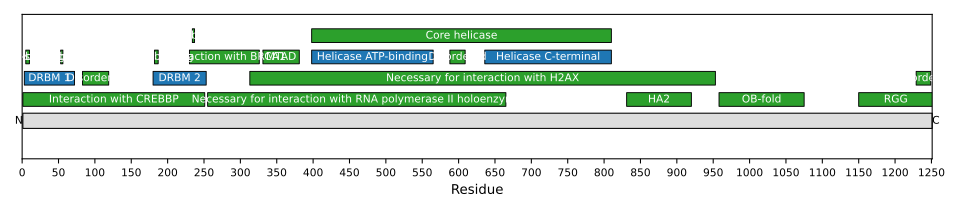
1: Multifunctional ATP-dependent nucleic acid helicase that unwinds DNA and RNA in a 3' to 5' direction and that plays important roles in many processes, such as DNA replication, transcriptional activation, post-transcriptional RNA regulation, mRNA translation and RNA-mediated gene silencing (PubMed:11416126, PubMed:12711669, PubMed:15355351, PubMed:16680162, PubMed:17531811, PubMed:20669935, PubMed:21561811, PubMed:24049074, PubMed:24990949, PubMed:25062910, PubMed:28221134, PubMed:9111062, PubMed:37467750). Requires a 3'-single-stranded tail as entry site for acid nuclei unwinding activities as well as the binding and hydrolyzing of any of the four ribo- or deoxyribo-nucleotide triphosphates (NTPs) (PubMed:1537828). Unwinds numerous nucleic acid substrates such as double-stranded (ds) DNA and RNA, DNA:RNA hybrids, DNA and RNA forks composed of either partially complementary DNA duplexes or DNA:RNA hybrids, respectively, and also DNA and RNA displacement loops (D- and R-loops), triplex-helical DNA (H-DNA) structure and DNA and RNA-based G-quadruplexes (PubMed:20669935, PubMed:21561811, PubMed:24049074). Binds dsDNA, single-stranded DNA (ssDNA), dsRNA, ssRNA and poly(A)-containing RNA (PubMed:10198287, PubMed:9111062). Also binds to circular dsDNA or dsRNA of either linear and/or circular forms and stimulates the relaxation of supercoiled DNAs catalyzed by topoisomerase TOP2A (PubMed:12711669). Plays a role in DNA replication at origins of replication and cell cycle progression (PubMed:24990949). Plays a role as a transcriptional coactivator acting as a bridging factor between polymerase II holoenzyme and transcription factors or cofactors, such as BRCA1, CREBBP, RELA and SMN1 (PubMed:11038348, PubMed:11149922, PubMed:11416126, PubMed:15355351, PubMed:28221134, PubMed:9323138, PubMed:9662397). Binds to the CDKN2A promoter (PubMed:11038348). Plays several roles in post-transcriptional regulation of gene expression (PubMed:28221134, PubMed:28355180). In cooperation with NUP98, promotes pre-mRNA alternative splicing activities of a subset of genes (PubMed:11402034, PubMed:16680162, PubMed:28221134, PubMed:28355180). As component of a large PER complex, is involved in the negative regulation of 3' transcriptional termination of circadian target genes such as PER1 and NR1D1 and the control of the circadian rhythms (By similarity). Also acts as a nuclear resolvase that is able to bind and neutralize harmful massive secondary double-stranded RNA structures formed by inverted-repeat Alu retrotransposon elements that are inserted and transcribed as parts of genes during the process of gene transposition (PubMed:28355180). Involved in the positive regulation of nuclear export of constitutive transport element (CTE)-containing unspliced mRNA (PubMed:10924507, PubMed:11402034, PubMed:9162007). Component of the coding region determinant (CRD)-mediated complex that promotes cytoplasmic MYC mRNA stability (PubMed:19029303). Plays a role in mRNA translation (PubMed:28355180). Positively regulates translation of selected mRNAs through its binding to post-transcriptional control element (PCE) in the 5'-untranslated region (UTR) (PubMed:16680162). Involved with LARP6 in the translation stimulation of type I collagen mRNAs for CO1A1 and CO1A2 through binding of a specific stem-loop structure in their 5'-UTRs (PubMed:22190748). Stimulates LIN28A-dependent mRNA translation probably by facilitating ribonucleoprotein remodeling during the process of translation (PubMed:21247876). Plays also a role as a small interfering (siRNA)-loading factor involved in the RNA-induced silencing complex (RISC) loading complex (RLC) assembly, and hence functions in the RISC-mediated gene silencing process (PubMed:17531811). Binds preferentially to short double-stranded RNA, such as those produced during rotavirus intestinal infection (PubMed:28636595). This interaction may mediate NLRP9 inflammasome activation and trigger inflammatory response, including IL18 release and pyroptosis (PubMed:28636595). Finally, mediates the attachment of heterogeneous nuclear ribonucleoproteins (hnRNPs) to actin filaments in the nucleus (PubMed:11687588)
2: (Microbial infection) Plays a role in HIV-1 replication and virion infectivity (PubMed:11096080, PubMed:19229320, PubMed:25149208, PubMed:27107641). Enhances HIV-1 transcription by facilitating the binding of RNA polymerase II holoenzyme to the proviral DNA (PubMed:11096080, PubMed:25149208). Binds (via DRBM domain 2) to the HIV-1 TAR RNA and stimulates HIV-1 transcription of transactivation response element (TAR)-containing mRNAs (PubMed:11096080, PubMed:9892698). Involved also in HIV-1 mRNA splicing and transport (PubMed:25149208). Positively regulates HIV-1 gag mRNA translation, through its binding to post-transcriptional control element (PCE) in the 5'-untranslated region (UTR) (PubMed:16680162). Binds (via DRBM domains) to a HIV-1 double-stranded RNA region of the primer binding site (PBS)-segment of the 5'-UTR, and hence stimulates DHX9 incorporation into virions and virion infectivity (PubMed:27107641). Also plays a role as a cytosolic viral MyD88-dependent DNA and RNA sensors in plasmacytoid dendritic cells (pDCs), and hence induce antiviral innate immune responses (PubMed:20696886, PubMed:21957149). Binds (via the OB-fold region) to viral single-stranded DNA unmethylated C-phosphate-G (CpG) oligonucleotide (PubMed:20696886)