Peptidyl-prolyl cis-trans isomerase D (PPIase D) (EC 5.2.1.8) (40 kDa peptidyl-prolyl cis-trans isomerase) (Cyclophilin-40) (CYP-40) (Cyclophilin-related protein) (Rotamase D)
1_MSHPS 6_ PQAKP 11_ SNPSN 16_ PRVFF 21_ DVDIG 26_ GERVG 31_ RIVLE 36_ LFADI 41_ VPKTA 46_ ENFRA 51_ LCTGE 56_ KGIGH 61_ TTGKP 66_ LHFKG 71_ CPFHR 76_ IIKKF 81_ MIQGG 86_ DFSNQ 91_ NGTGG 96_ ESIYG 101_ EKFED 106_ ENFHY 111_ KHDRE 116_ GLLSM 121_ ANAGR 126_ NTNGS 131_ QFFIT 136_ TVPTP 141_ HLDGK 146_ HVVFG 151_ QVIKG 156_ IGVAR 161_ ILENV 166_ EVKGE 171_ KPAKL 176_ CVIAE 181_ CGELK 186_ EGDDG 191_ GIFPK 196_ DGSGD 201_ SHPDF 206_ PEDAD 211_ IDLKD 216_ VDKIL 221_ LITED 226_ LKNIG 231_ NTFFK 236_ SQNWE 241_ MAIKK 246_ YAEVL 251_ RYVDS 256_ SKAVI 261_ ETADR 266_ AKLQP 271_ IALSC 276_ VLNIG 281_ ACKLK 286_ MSNWQ 291_ GAIDS 296_ CLEAL 301_ ELDPS 306_ NTKAL 311_ YRRAQ 316_ GWQGL 321_ KEYDQ 326_ ALADL 331_ KKAQG 336_ IAPED 341_ KAIQA 346_ ELLKV 351_ KQKIK 356_ AQKDK 361_EKAVY
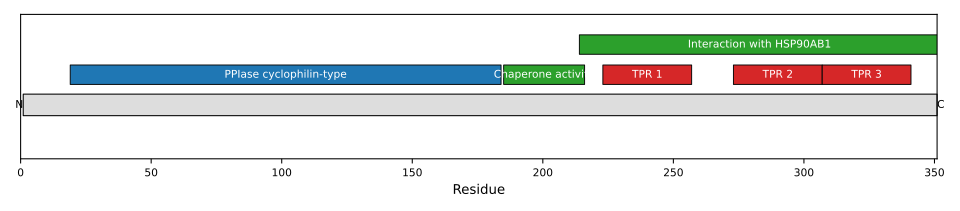
1: PPIase that catalyzes the cis-trans isomerization of proline imidic peptide bonds in oligopeptides and may therefore assist protein folding (PubMed:11350175, PubMed:20676357). Proposed to act as a co-chaperone in HSP90 complexes such as in unligated steroid receptors heterocomplexes. Different co-chaperones seem to compete for association with HSP90 thus establishing distinct HSP90-co-chaperone-receptor complexes with the potential to exert tissue-specific receptor activity control. May have a preference for estrogen receptor complexes and is not found in glucocorticoid receptor complexes. May be involved in cytoplasmic dynein-dependent movement of the receptor from the cytoplasm to the nucleus. May regulate MYB by inhibiting its DNA-binding activity. Involved in regulation of AHR signaling by promoting the formation of the AHR:ARNT dimer; the function is independent of HSP90 but requires the chaperone activity. Involved in regulation of UV radiation-induced apoptosis. Promotes cell viability in anaplastic lymphoma kinase-positive anaplastic large-cell lymphoma (ALK+ ALCL) cell lines
2: (Microbial infection) May be involved in hepatitis C virus (HCV) replication and release