Potassium voltage-gated channel subfamily A member 1 (Voltage-gated K(+) channel HuKI) (Voltage-gated potassium channel HBK1) (Voltage-gated potassium channel subunit Kv1.1)
1_MTVMS 6_ GENVD 11_ EASAA 16_ PGHPQ 21_ DGSYP 26_ RQADH 31_ DDHEC 36_ CERVV 41_ INISG 46_ LRFET 51_ QLKTL 56_ AQFPN 61_ TLLGN 66_ PKKRM 71_ RYFDP 76_ LRNEY 81_ FFDRN 86_ RPSFD 91_ AILYY 96_ YQSGG 101_ RLRRP 106_ VNVPL 111_ DMFSE 116_ EIKFY 121_ ELGEE 126_ AMEKF 131_ REDEG 136_ FIKEE 141_ ERPLP 146_ EKEYQ 151_ RQVWL 156_ LFEYP 161_ ESSGP 166_ ARVIA 171_ IVSVM 176_ VILIS 181_ IVIFC 186_ LETLP 191_ ELKDD 196_ KDFTG 201_ TVHRI 206_ DNTTV 211_ IYNSN 216_ IFTDP 221_ FFIVE 226_ TLCII 231_ WFSFE 236_ LVVRF 241_ FACPS 246_ KTDFF 251_ KNIMN 256_ FIDIV 261_ AIIPY 266_ FITLG 271_ TEIAE 276_ QEGNQ 281_ KGEQA 286_ TSLAI 291_ LRVIR 296_ LVRVF 301_ RIFKL 306_ SRHSK 311_ GLQIL 316_ GQTLK 321_ ASMRE 326_ LGLLI 331_ FFLFI 336_ GVILF 341_ SSAVY 346_ FAEAE 351_ EAESH 356_ FSSIP 361_ DAFWW 366_ AVVSM 371_ TTVGY 376_ GDMYP 381_ VTIGG 386_ KIVGS 391_ LCAIA 396_ GVLTI 401_ ALPVP 406_ VIVSN 411_ FNYFY 416_ HRETE 421_ GEEQA 426_ QLLHV 431_ SSPNL 436_ ASDSD 441_ LSRRS 446_ SSTMS 451_ KSEYM 456_ EIEED 461_ MNNSI 466_ AHYRQ 471_ VNIRT 476_ ANCTT 481_ ANQNC 486_VNKSK
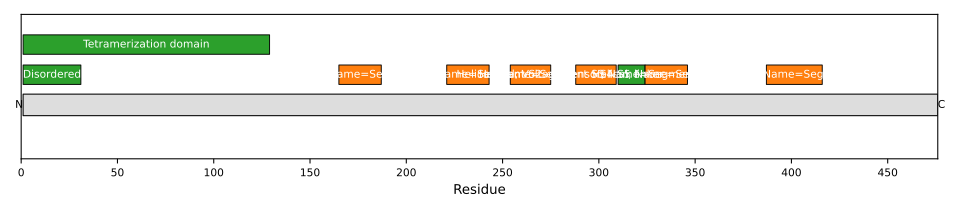
1: Voltage-gated potassium channel that mediates transmembrane potassium transport in excitable membranes, primarily in the brain and the central nervous system, but also in the kidney (PubMed:19903818, PubMed:8845167). Contributes to the regulation of the membrane potential and nerve signaling, and prevents neuronal hyperexcitability (PubMed:17156368). Forms tetrameric potassium-selective channels through which potassium ions pass in accordance with their electrochemical gradient. The channel alternates between opened and closed conformations in response to the voltage difference across the membrane (PubMed:19912772). Can form functional homotetrameric channels and heterotetrameric channels that contain variable proportions of KCNA1, KCNA2, KCNA4, KCNA5, KCNA6, KCNA7, and possibly other family members as well; channel properties depend on the type of alpha subunits that are part of the channel (PubMed:12077175, PubMed:17156368). Channel properties are modulated by cytoplasmic beta subunits that regulate the subcellular location of the alpha subunits and promote rapid inactivation of delayed rectifier potassium channels (PubMed:12077175, PubMed:17156368). In vivo, membranes probably contain a mixture of heteromeric potassium channel complexes, making it difficult to assign currents observed in intact tissues to any particular potassium channel family member. Homotetrameric KCNA1 forms a delayed-rectifier potassium channel that opens in response to membrane depolarization, followed by slow spontaneous channel closure (PubMed:19307729, PubMed:19903818, PubMed:19912772, PubMed:19968958). In contrast, a heterotetrameric channel formed by KCNA1 and KCNA4 shows rapid inactivation (PubMed:17156368). Regulates neuronal excitability in hippocampus, especially in mossy fibers and medial perforant path axons, preventing neuronal hyperexcitability. Response to toxins that are selective for KCNA1, respectively for KCNA2, suggests that heteromeric potassium channels composed of both KCNA1 and KCNA2 play a role in pacemaking and regulate the output of deep cerebellar nuclear neurons (By similarity). May function as down-stream effector for G protein-coupled receptors and inhibit GABAergic inputs to basolateral amygdala neurons (By similarity). May contribute to the regulation of neurotransmitter release, such as gamma-aminobutyric acid (GABA) release (By similarity). Plays a role in regulating the generation of action potentials and preventing hyperexcitability in myelinated axons of the vagus nerve, and thereby contributes to the regulation of heart contraction (By similarity). Required for normal neuromuscular responses (PubMed:11026449, PubMed:17136396). Regulates the frequency of neuronal action potential firing in response to mechanical stimuli, and plays a role in the perception of pain caused by mechanical stimuli, but does not play a role in the perception of pain due to heat stimuli (By similarity). Required for normal responses to auditory stimuli and precise location of sound sources, but not for sound perception (By similarity). The use of toxins that block specific channels suggest that it contributes to the regulation of the axonal release of the neurotransmitter dopamine (By similarity). Required for normal postnatal brain development and normal proliferation of neuronal precursor cells in the brain (By similarity). Plays a role in the reabsorption of Mg(2+) in the distal convoluted tubules in the kidney and in magnesium ion homeostasis, probably via its effect on the membrane potential (PubMed:19307729, PubMed:23903368)