Forkhead box protein O1 (Forkhead box protein O1A) (Forkhead in rhabdomyosarcoma)
1_MAEAP 6_ QVVEI 11_ DPDFE 16_ PLPRP 21_ RSCTW 26_ PLPRP 31_ EFSQS 36_ NSATS 41_ SPAPS 46_ GSAAA 51_ NPDAA 56_ AGLPS 61_ ASAAA 66_ VSADF 71_ MSNLS 76_ LLEES 81_ EDFPQ 86_ APGSV 91_ AAAVA 96_ AAAAA 101_ AATGG 106_ LCGDF 111_ QGPEA 116_ GCLHP 121_ APPQP 126_ PPPGP 131_ LSQHP 136_ PVPPA 141_ AAGPL 146_ AGQPR 151_ KSSSS 156_ RRNAW 161_ GNLSY 166_ ADLIT 171_ KAIES 176_ SAEKR 181_ LTLSQ 186_ IYEWM 191_ VKSVP 196_ YFKDK 201_ GDSNS 206_ SAGWK 211_ NSIRH 216_ NLSLH 221_ SKFIR 226_ VQNEG 231_ TGKSS 236_ WWMLN 241_ PEGGK 246_ SGKSP 251_ RRRAA 256_ SMDNN 261_ SKFAK 266_ SRSRA 271_ AKKKA 276_ SLQSG 281_ QEGAG 286_ DSPGS 291_ QFSKW 296_ PASPG 301_ SHSND 306_ DFDNW 311_ STFRP 316_ RTSSN 321_ ASTIS 326_ GRLSP 331_ IMTEQ 336_ DDLGE 341_ GDVHS 346_ MVYPP 351_ SAAKM 356_ ASTLP 361_ SLSEI 366_ SNPEN 371_ MENLL 376_ DNLNL 381_ LSSPT 386_ SLTVS 391_ TQSSP 396_ GTMMQ 401_ QTPCY 406_ SFAPP 411_ NTSLN 416_ SPSPN 421_ YQKYT 426_ YGQSS 431_ MSPLP 436_ QMPIQ 441_ TLQDN 446_ KSSYG 451_ GMSQY 456_ NCAPG 461_ LLKEL 466_ LTSDS 471_ PPHND 476_ IMTPV 481_ DPGVA 486_ QPNSR 491_ VLGQN 496_ VMMGP 501_ NSVMS 506_ TYGSQ 511_ ASHNK 516_ MMNPS 521_ SHTHP 526_ GHAQQ 531_ TSAVN 536_ GRPLP 541_ HTVST 546_ MPHTS 551_ GMNRL 556_ TQVKT 561_ PVQVP 566_ LPHPM 571_ QMSAL 576_ GGYSS 581_ VSSCN 586_ GYGRM 591_ GLLHQ 596_ EKLPS 601_ DLDGM 606_ FIERL 611_ DCDME 616_ SIIRN 621_ DLMDG 626_ DTLDF 631_ NFDNV 636_ LPNQS 641_ FPHSV 646_KTTTH
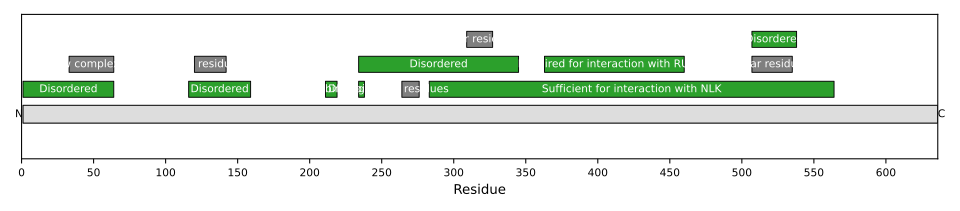
1: Transcription factor that is the main target of insulin signaling and regulates metabolic homeostasis in response to oxidative stress (PubMed:10358076, PubMed:12228231, PubMed:15220471, PubMed:15890677, PubMed:18356527, PubMed:19221179, PubMed:20543840, PubMed:21245099). Binds to the insulin response element (IRE) with consensus sequence 5'-TT[G/A]TTTTG-3' and the related Daf-16 family binding element (DBE) with consensus sequence 5'-TT[G/A]TTTAC-3' (PubMed:10358076). Activity suppressed by insulin (PubMed:10358076). Main regulator of redox balance and osteoblast numbers and controls bone mass (By similarity). Orchestrates the endocrine function of the skeleton in regulating glucose metabolism (By similarity). Also acts as a key regulator of chondrogenic commitment of skeletal progenitor cells in response to lipid availability: when lipids levels are low, translocates to the nucleus and promotes expression of SOX9, which induces chondrogenic commitment and suppresses fatty acid oxidation (By similarity). Acts synergistically with ATF4 to suppress osteocalcin/BGLAP activity, increasing glucose levels and triggering glucose intolerance and insulin insensitivity (By similarity). Also suppresses the transcriptional activity of RUNX2, an upstream activator of osteocalcin/BGLAP (By similarity). Acts as an inhibitor of glucose sensing in pancreatic beta cells by acting as a transcription repressor and suppressing expression of PDX1 (By similarity). In hepatocytes, promotes gluconeogenesis by acting together with PPARGC1A and CEBPA to activate the expression of genes such as IGFBP1, G6PC1 and PCK1 (By similarity). Also promotes gluconeogenesis by directly promoting expression of PPARGC1A and G6PC1 (PubMed:17024043). Important regulator of cell death acting downstream of CDK1, PKB/AKT1 and STK4/MST1 (PubMed:18356527, PubMed:19221179). Promotes neural cell death (PubMed:18356527). Mediates insulin action on adipose tissue (By similarity). Regulates the expression of adipogenic genes such as PPARG during preadipocyte differentiation and, adipocyte size and adipose tissue-specific gene expression in response to excessive calorie intake (By similarity). Regulates the transcriptional activity of GADD45A and repair of nitric oxide-damaged DNA in beta-cells (By similarity). Required for the autophagic cell death induction in response to starvation or oxidative stress in a transcription-independent manner (PubMed:20543840). Mediates the function of MLIP in cardiomyocytes hypertrophy and cardiac remodeling (By similarity). Positive regulator of apoptosis in cardiac smooth muscle cells as a result of its transcriptional activation of pro-apoptotic genes (PubMed:19483080). Regulates endothelial cell (EC) viability and apoptosis in a PPIA/CYPA-dependent manner via transcription of CCL2 and BCL2L11 which are involved in EC chemotaxis and apoptosis (PubMed:31063815)