POU domain, class 4, transcription factor 2 (Brain-specific homeobox/POU domain protein 3B) (Brain-3B) (Brn-3B)
1_MMMMS 6_ LNSKQ 11_ AFSMP 16_ HGGSL 21_ HVEPK 26_ YSALH 31_ STSPG 36_ SSAPI 41_ APSAS 46_ SPSSS 51_ SNAGG 56_ GGGGG 61_ GGGGG 66_ GGGRS 71_ SSSSS 76_ SGSSG 81_ GGGSE 86_ AMRRA 91_ CLPTP 96_ PSNIF 101_ GGLDE 106_ SLLAR 111_ AEALA 116_ AVDIV 121_ SQSKS 126_ HHHHP 131_ PHHSP 136_ FKPDA 141_ TYHTM 146_ NTIPC 151_ TSAAS 156_ SSSVP 161_ ISHPS 166_ ALAGT 171_ HHHHH 176_ HHHHH 181_ HHQPH 186_ QALEG 191_ ELLEH 196_ LSPGL 201_ ALGAM 206_ AGPDG 211_ AVVST 216_ PAHAP 221_ HMATM 226_ NPMHQ 231_ AALSM 236_ AHAHG 241_ LPSHM 246_ GCMSD 251_ VDADP 256_ RDLEA 261_ FAERF 266_ KQRRI 271_ KLGVT 276_ QADVG 281_ SALAN 286_ LKIPG 291_ VGSLS 296_ QSTIC 301_ RFESL 306_ TLSHN 311_ NMIAL 316_ KPILQ 321_ AWLEE 326_ AEKSH 331_ REKLT 336_ KPELF 341_ NGAEK 346_ KRKRT 351_ SIAAP 356_ EKRSL 361_ EAYFA 366_ IQPRP 371_ SSEKI 376_ AAIAE 381_ KLDLK 386_ KNVVR 391_ VWFCN 396_ QRQKQ 401_KRMKY
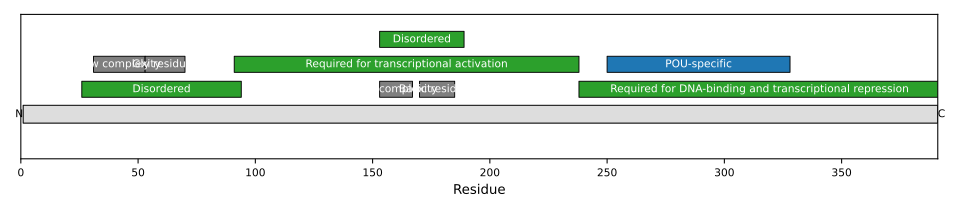
1: Tissue-specific DNA-binding transcription factor involved in the development and differentiation of target cells (PubMed:19266028, PubMed:23805044). Functions either as activator or repressor modulating the rate of target gene transcription through RNA polymerase II enzyme in a promoter-dependent manner (PubMed:19266028, PubMed:23805044). Binds to the consensus octamer motif 5'-AT[A/T]A[T/A]T[A/T]A-3' of promoter of target genes. Plays a fundamental role in the gene regulatory network essential for retinal ganglion cell (RGC) differentiation. Binds to an octamer site to form a ternary complex with ISL1; cooperates positively with ISL1 and ISL2 to potentiate transcriptional activation of RGC target genes being involved in RGC fate commitment in the developing retina and RGC axon formation and pathfinding. Inhibits DLX1 and DLX2 transcriptional activities preventing DLX1- and DLX2-mediated ability to promote amacrine cell fate specification. In cooperation with TP53 potentiates transcriptional activation of BAX promoter activity increasing neuronal cell apoptosis. Negatively regulates BAX promoter activity in the absence of TP53. Acts as a transcriptional coactivator via its interaction with the transcription factor ESR1 by enhancing its effect on estrogen response element (ERE)-containing promoter. Antagonizes the transcriptional stimulatory activity of POU4F1 by preventing its binding to an octamer motif. Involved in TNFSF11-mediated terminal osteoclast differentiation (By similarity)