Mitogen-activated protein kinase kinase kinase kinase 2 (EC 2.7.11.1) (B lymphocyte serine/threonine-protein kinase) (Germinal center kinase) (GC kinase) (MAPK/ERK kinase kinase kinase 2) (MEK kinase kinase 2) (MEKKK 2) (Rab8-interacting protein)
1_MALLR 6_ DVSLQ 11_ DPRDR 16_ FELLQ 21_ RVGAG 26_ TYGDV 31_ YKARD 36_ TVTSE 41_ LAAVK 46_ IVKLD 51_ PGDDI 56_ SSLQQ 61_ EITIL 66_ RECRH 71_ PNVVA 76_ YIGSY 81_ LRNDR 86_ LWICM 91_ EFCGG 96_ GSLQE 101_ IYHAT 106_ GPLEE 111_ RQIAY 116_ VCREA 121_ LKGLH 126_ HLHSQ 131_ GKIHR 136_ DIKGA 141_ NLLLT 146_ LQGDV 151_ KLADF 156_ GVSGE 161_ LTASV 166_ AKRRS 171_ FIGTP 176_ YWMAP 181_ EVAAV 186_ ERKGG 191_ YNELC 196_ DVWAL 201_ GITAI 206_ ELGEL 211_ QPPLF 216_ HLHPM 221_ RALML 226_ MSKSS 231_ FQPPK 236_ LRDKT 241_ RWTQN 246_ FHHFL 251_ KLALT 256_ KNPKK 261_ RPTAE 266_ KLLQH 271_ PFTTQ 276_ QLPRA 281_ LLTQL 286_ LDKAS 291_ DPHLG 296_ TPSPE 301_ DCELE 306_ TYDMF 311_ PDTIH 316_ SRGQH 321_ GPAER 326_ TPSEI 331_ QFHQV 336_ KFGAP 341_ RRKET 346_ DPLNE 351_ PWEEE 356_ WTLLG 361_ KEELS 366_ GSLLQ 371_ SVQEA 376_ LEERS 381_ LTIRS 386_ ASEFQ 391_ ELDSP 396_ DDTMG 401_ TIKRA 406_ PFLGP 411_ LPTDP 416_ PAEEP 421_ LSSPP 426_ GTLPP 431_ PPSGP 436_ NSSPL 441_ LPTAW 446_ ATMKQ 451_ REDPE 456_ RSSCH 461_ GLPPT 466_ PKVHM 471_ GACFS 476_ KVFNG 481_ CPLRI 486_ HAAVT 491_ WIHPV 496_ TRDQF 501_ LVVGA 506_ EEGIY 511_ TLNLH 516_ ELHED 521_ TLEKL 526_ ISHRC 531_ SWLYC 536_ VNNVL 541_ LSLSG 546_ KSTHI 551_ WAHDL 556_ PGLFE 561_ QRRLQ 566_ QQVPL 571_ SIPTN 576_ RLTQR 581_ IIPRR 586_ FALST 591_ KIPDT 596_ KGCLQ 601_ CRVVR 606_ NPYTG 611_ ATFLL 616_ AALPT 621_ SLLLL 626_ QWYEP 631_ LQKFL 636_ LLKNF 641_ SSPLP 646_ SPAGM 651_ LEPLV 656_ LDGKE 661_ LPQVC 666_ VGAEG 671_ PEGPG 676_ CRVLF 681_ HVLPL 686_ EAGLT 691_ PDILI 696_ PPEGI 701_ PGSAQ 706_ QVIQV 711_ DRDTI 716_ LVSFE 721_ RCVRI 726_ VNMQG 731_ EPTAT 736_ LAPEL 741_ TFDFP 746_ IETVV 751_ CLQDS 756_ VLAFW 761_ SHGMQ 766_ GRSLD 771_ TNEVT 776_ QEITD 781_ ETRIF 786_ RVLGA 791_ HRDII 796_ LESIP 801_ TDNPE 806_ AHSNL 811_YILTG
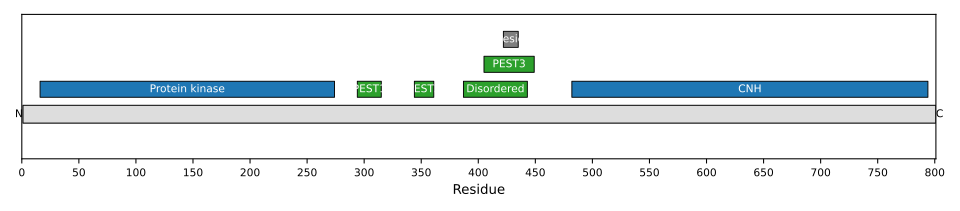
1: Serine/threonine-protein kinase which acts as an essential component of the MAP kinase signal transduction pathway. Acts as a MAPK kinase kinase kinase (MAP4K) and is an upstream activator of the stress-activated protein kinase/c-Jun N-terminal kinase (SAP/JNK) signaling pathway and to a lesser extent of the p38 MAPKs signaling pathway. Required for the efficient activation of JNKs by TRAF6-dependent stimuli, including pathogen-associated molecular patterns (PAMPs) such as polyinosine-polycytidine (poly(IC)), lipopolysaccharides (LPS), lipid A, peptidoglycan (PGN), or bacterial flagellin. To a lesser degree, IL-1 and engagement of CD40 also stimulate MAP4K2-mediated JNKs activation. The requirement for MAP4K2/GCK is most pronounced for LPS signaling, and extends to LPS stimulation of c-Jun phosphorylation and induction of IL-8. Enhances MAP3K1 oligomerization, which may relieve N-terminal mediated MAP3K1 autoinhibition and lead to activation following autophosphorylation. Also mediates the SAP/JNK signaling pathway and the p38 MAPKs signaling pathway through activation of the MAP3Ks MAP3K10/MLK2 and MAP3K11/MLK3. May play a role in the regulation of vesicle targeting or fusion. regulation of vesicle targeting or fusion. Activator of the Hippo signaling pathway which plays a pivotal role in organ size control and tumor suppression by restricting proliferation and promoting apoptosis. MAP4Ks act in parallel to and are partially redundant with STK3/MST2 and STK4/MST2 in the phosphorylation and activation of LATS1/2, and establish MAP4Ks as components of the expanded Hippo pathway (PubMed:26437443)