Epidermal growth factor receptor kinase substrate 8
1_MNGHI 6_ SNHPS 11_ SFGMY 16_ PSQMN 21_ GYGSS 26_ PTFSQ 31_ TDREH 36_ GSKTS 41_ AKALY 46_ EQRKN 51_ YARDS 56_ VSSVS 61_ DISQY 66_ RVEHL 71_ TTFVL 76_ DRKDA 81_ MITVD 86_ DGIRK 91_ LKLLD 96_ AKGKV 101_ WTQDM 106_ ILQVD 111_ DRAVS 116_ LIDLE 121_ SKNEL 126_ ENFPL 131_ NTIQH 136_ CQAVM 141_ HSCSY 146_ DSVLA 151_ LVCKE 156_ PTQNK 161_ PDLHL 166_ FQCDE 171_ VKANL 176_ ISEDI 181_ ESAIS 186_ DSKGG 191_ KQKRR 196_ PDALR 201_ MISNA 206_ DPSIP 211_ PPPRA 216_ PAPAP 221_ PGTVT 226_ QVDVR 231_ SRVAA 236_ WSAWA 241_ ADQGD 246_ FEKPR 251_ QYHEQ 256_ EETPE 261_ MMAAR 266_ IDRDV 271_ QILNH 276_ ILDDI 281_ EFFIT 286_ KLQKA 291_ AEAFS 296_ ELSKR 301_ KKNKK 306_ GKRKG 311_ PGEGV 316_ LTLRA 321_ KPPPP 326_ DEFLD 331_ CFQKF 336_ KHGFN 341_ LLAKL 346_ KSHIQ 351_ NPSAA 356_ DLVHF 361_ LFTPL 366_ NMVVQ 371_ ATGGP 376_ ELASS 381_ VLSPL 386_ LNKDT 391_ IDFLN 396_ YTVNG 401_ DERQL 406_ WMSLG 411_ GTWMK 416_ ARAEW 421_ PKEQF 426_ IPPYV 431_ PRFRN 436_ GWEPP 441_ MLNFM 446_ GATME 451_ QDLYQ 456_ LAESV 461_ ANVAE 466_ HQRKQ 471_ EIKRL 476_ STEHS 481_ SVSEY 486_ HPADG 491_ YAFSS 496_ NIYTR 501_ GSHLD 506_ QGEAA 511_ VAFKP 516_ TSNRH 521_ IDRNY 526_ EPLKT 531_ QPKKY 536_ AKSKY 541_ DFVAR 546_ NNSEL 551_ SVLKD 556_ DILEI 561_ LDDRK 566_ QWWKV 571_ RNASG 576_ DSGFV 581_ PNNIL 586_ DIVRP 591_ PESGL 596_ GRADP 601_ PYTHT 606_ IQKQR 611_ MEYGP 616_ RPADT 621_ PPAPS 626_ PPPTP 631_ APVPV 636_ PLPPS 641_ TPAPV 646_ PVSKV 651_ PANIT 656_ RQNSS 661_ SSDSG 666_ GSIVR 671_ DSQRH 676_ KQLPV 681_ DRRKS 686_ QMEEV 691_ QDELI 696_ HRLTI 701_ GRSAA 706_ QKKFH 711_ VPRQN 716_ VPVIN 721_ ITYDS 726_ TPEDV 731_ KTWLQ 736_ SKGFN 741_ PVTVN 746_ SLGVL 751_ NGAQL 756_ FSLNK 761_ DELRT 766_ VCPEG 771_ ARVYS 776_ QITVQ 781_ KAALE 786_ DSSGS 791_ SELQE 796_ IMRRR 801_ QEKIS 806_ AAASD 811_ SGVES 816_FDEGS
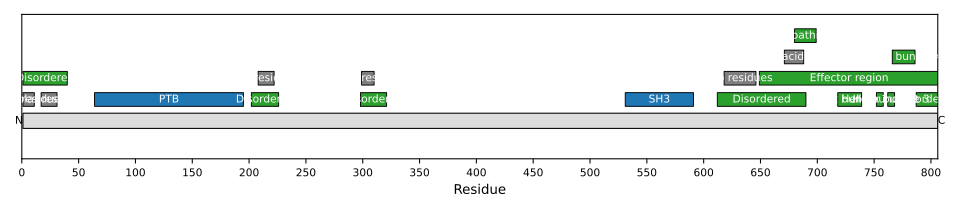
1: Signaling adapter that controls various cellular protrusions by regulating actin cytoskeleton dynamics and architecture. Depending on its association with other signal transducers, can regulate different processes. Together with SOS1 and ABI1, forms a trimeric complex that participates in transduction of signals from Ras to Rac by activating the Rac-specific guanine nucleotide exchange factor (GEF) activity. Acts as a direct regulator of actin dynamics by binding actin filaments and has both barbed-end actin filament capping and actin bundling activities depending on the context. Displays barbed-end actin capping activity when associated with ABI1, thereby regulating actin-based motility process: capping activity is auto-inhibited and inhibition is relieved upon ABI1 interaction. Also shows actin bundling activity when associated with BAIAP2, enhancing BAIAP2-dependent membrane extensions and promoting filopodial protrusions. Involved in the regulation of processes such as axonal filopodia growth, stereocilia length, dendritic cell migration and cancer cell migration and invasion. Acts as a regulator of axonal filopodia formation in neurons: in the absence of neurotrophic factors, negatively regulates axonal filopodia formation via actin-capping activity. In contrast, it is phosphorylated in the presence of BDNF leading to inhibition of its actin-capping activity and stimulation of filopodia formation. Component of a complex with WHRN and MYO15A that localizes at stereocilia tips and is required for elongation of the stereocilia actin core. Indirectly involved in cell cycle progression; its degradation following ubiquitination being required during G2 phase to promote cell shape changes