TNF receptor-associated factor 3 (EC 2.3.2.27) (CD40 receptor-associated factor 1) (CRAF1) (CD40-binding protein) (CD40BP) (LMP1-associated protein 1) (LAP1) (RING-type E3 ubiquitin transferase TRAF3)
1_MESSK 6_ KMDSP 11_ GALQT 16_ NPPLK 21_ LHTDR 26_ SAGTP 31_ VFVPE 36_ QGGYK 41_ EKFVK 46_ TVEDK 51_ YKCEK 56_ CHLVL 61_ CSPKQ 66_ TECGH 71_ RFCES 76_ CMAAL 81_ LSSSS 86_ PKCTA 91_ CQESI 96_ VKDKV 101_ FKDNC 106_ CKREI 111_ LALQI 116_ YCRNE 121_ SRGCA 126_ EQLML 131_ GHLLV 136_ HLKND 141_ CHFEE 146_ LPCVR 151_ PDCKE 156_ KVLRK 161_ DLRDH 166_ VEKAC 171_ KYREA 176_ TCSHC 181_ KSQVP 186_ MIALQ 191_ KHEDT 196_ DCPCV 201_ VVSCP 206_ HKCSV 211_ QTLLR 216_ SELSA 221_ HLSEC 226_ VNAPS 231_ TCSFK 236_ RYGCV 241_ FQGTN 246_ QQIKA 251_ HEASS 256_ AVQHV 261_ NLLKE 266_ WSNSL 271_ EKKVS 276_ LLQNE 281_ SVEKN 286_ KSIQS 291_ LHNQI 296_ CSFEI 301_ EIERQ 306_ KEMLR 311_ NNESK 316_ ILHLQ 321_ RVIDS 326_ QAEKL 331_ KELDK 336_ EIRPF 341_ RQNWE 346_ EADSM 351_ KSSVE 356_ SLQNR 361_ VTELE 366_ SVDKS 371_ AGQVA 376_ RNTGL 381_ LESQL 386_ SRHDQ 391_ MLSVH 396_ DIRLA 401_ DMDLR 406_ FQVLE 411_ TASYN 416_ GVLIW 421_ KIRDY 426_ KRRKQ 431_ EAVMG 436_ KTLSL 441_ YSQPF 446_ YTGYF 451_ GYKMC 456_ ARVYL 461_ NGDGM 466_ GKGTH 471_ LSLFF 476_ VIMRG 481_ EYDAL 486_ LPWPF 491_ KQKVT 496_ LMLMD 501_ QGSSR 506_ RHLGD 511_ AFKPD 516_ PNSSS 521_ FKKPT 526_ GEMNI 531_ ASGCP 536_ VFVAQ 541_ TVLEN 546_ GTYIK 551_ DDTIF 556_ IKVIV 561_DTSDL
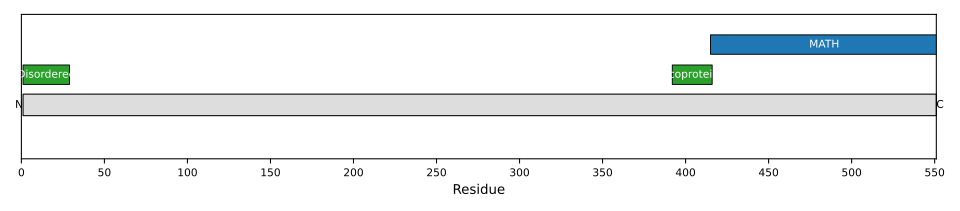
1: Cytoplasmic E3 ubiquitin ligase that regulates various signaling pathways, such as the NF-kappa-B, mitogen-activated protein kinase (MAPK) and interferon regulatory factor (IRF) pathways, and thus controls a lot of biological processes in both immune and non-immune cell types (PubMed:33148796, PubMed:33608556). In TLR and RLR signaling pathways, acts as an E3 ubiquitin ligase promoting the synthesis of 'Lys-63'-linked polyubiquitin chains on several substrates such as ASC that lead to the activation of the type I interferon response or the inflammasome (PubMed:25847972, PubMed:27980081). Following the activation of certain TLRs such as TLR4, acts as a negative NF-kappa-B regulator, possibly to avoid unregulated inflammatory response, and its degradation via 'Lys-48'-linked polyubiquitination is required for MAPK activation and production of inflammatory cytokines. Alternatively, when TLR4 orchestrates bacterial expulsion, TRAF3 undergoes 'Lys-33'-linked polyubiquitination and subsequently binds to RALGDS, mobilizing the exocyst complex to rapidly expel intracellular bacteria back for clearance (PubMed:27438768). Also acts as a constitutive negative regulator of the alternative NF-kappa-B pathway, which controls B-cell survival and lymphoid organ development. Required for normal antibody isotype switching from IgM to IgG. Plays a role T-cell dependent immune responses. Down-regulates proteolytic processing of NFKB2, and thereby inhibits non-canonical activation of NF-kappa-B. Promotes ubiquitination and proteasomal degradation of MAP3K14