5'-AMP-activated protein kinase catalytic subunit alpha-1 (AMPK subunit alpha-1) (EC 2.7.11.1) (Acetyl-CoA carboxylase kinase) (ACACA kinase) (EC 2.7.11.27) (Hydroxymethylglutaryl-CoA reductase kinase) (HMGCR kinase) (EC 2.7.11.31) (Tau-protein kinase PRKAA1) (EC 2.7.11.26)
1_MRRLS 6_ SWRKM 11_ ATAEK 16_ QKHDG 21_ RVKIG 26_ HYILG 31_ DTLGV 36_ GTFGK 41_ VKVGK 46_ HELTG 51_ HKVAV 56_ KILNR 61_ QKIRS 66_ LDVVG 71_ KIRRE 76_ IQNLK 81_ LFRHP 86_ HIIKL 91_ YQVIS 96_ TPSDI 101_ FMVME 106_ YVSGG 111_ ELFDY 116_ ICKNG 121_ RLDEK 126_ ESRRL 131_ FQQIL 136_ SGVDY 141_ CHRHM 146_ VVHRD 151_ LKPEN 156_ VLLDA 161_ HMNAK 166_ IADFG 171_ LSNMM 176_ SDGEF 181_ LRTSC 186_ GSPNY 191_ AAPEV 196_ ISGRL 201_ YAGPE 206_ VDIWS 211_ SGVIL 216_ YALLC 221_ GTLPF 226_ DDDHV 231_ PTLFK 236_ KICDG 241_ IFYTP 246_ QYLNP 251_ SVISL 256_ LKHML 261_ QVDPM 266_ KRATI 271_ KDIRE 276_ HEWFK 281_ QDLPK 286_ YLFPE 291_ DPSYS 296_ STMID 301_ DEALK 306_ EVCEK 311_ FECSE 316_ EEVLS 321_ CLYNR 326_ NHQDP 331_ LAVAY 336_ HLIID 341_ NRRIM 346_ NEAKD 351_ FYLAT 356_ SPPDS 361_ FLDDH 366_ HLTRP 371_ HPERV 376_ PFLVA 381_ ETPRA 386_ RHTLD 391_ ELNPQ 396_ KSKHQ 401_ GVRKA 406_ KWHLG 411_ IRSQS 416_ RPNDI 421_ MAEVC 426_ RAIKQ 431_ LDYEW 436_ KVVNP 441_ YYLRV 446_ RRKNP 451_ VTSTY 456_ SKMSL 461_ QLYQV 466_ DSRTY 471_ LLDFR 476_ SIDDE 481_ ITEAK 486_ SGTAT 491_ PQRSG 496_ SVSNY 501_ RSCQR 506_ SDSDA 511_ EAQGK 516_ SSEVS 521_ LTSSV 526_ TSLDS 531_ SPVDL 536_ TPRPG 541_ SHTIE 546_ FFEMC 551_ANLIK
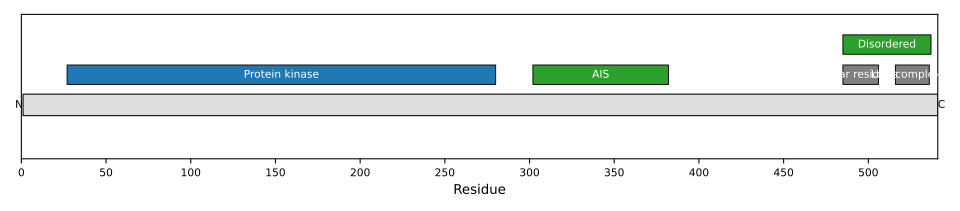
1: Catalytic subunit of AMP-activated protein kinase (AMPK), an energy sensor protein kinase that plays a key role in regulating cellular energy metabolism (PubMed:17307971, PubMed:17712357, PubMed:24563466, PubMed:37821951). In response to reduction of intracellular ATP levels, AMPK activates energy-producing pathways and inhibits energy-consuming processes: inhibits protein, carbohydrate and lipid biosynthesis, as well as cell growth and proliferation (PubMed:17307971, PubMed:17712357). AMPK acts via direct phosphorylation of metabolic enzymes, and by longer-term effects via phosphorylation of transcription regulators (PubMed:17307971, PubMed:17712357). Regulates lipid synthesis by phosphorylating and inactivating lipid metabolic enzymes such as ACACA, ACACB, GYS1, HMGCR and LIPE; regulates fatty acid and cholesterol synthesis by phosphorylating acetyl-CoA carboxylase (ACACA and ACACB) and hormone-sensitive lipase (LIPE) enzymes, respectively (By similarity). Promotes lipolysis of lipid droplets by mediating phosphorylation of isoform 1 of CHKA (CHKalpha2) (PubMed:34077757). Regulates insulin-signaling and glycolysis by phosphorylating IRS1, PFKFB2 and PFKFB3 (By similarity). AMPK stimulates glucose uptake in muscle by increasing the translocation of the glucose transporter SLC2A4/GLUT4 to the plasma membrane, possibly by mediating phosphorylation of TBC1D4/AS160 (By similarity). Regulates transcription and chromatin structure by phosphorylating transcription regulators involved in energy metabolism such as CRTC2/TORC2, FOXO3, histone H2B, HDAC5, MEF2C, MLXIPL/ChREBP, EP300, HNF4A, p53/TP53, SREBF1, SREBF2 and PPARGC1A (PubMed:11518699, PubMed:11554766, PubMed:15866171, PubMed:17711846, PubMed:18184930). Acts as a key regulator of glucose homeostasis in liver by phosphorylating CRTC2/TORC2, leading to CRTC2/TORC2 sequestration in the cytoplasm (By similarity). In response to stress, phosphorylates 'Ser-36' of histone H2B (H2BS36ph), leading to promote transcription (By similarity). Acts as a key regulator of cell growth and proliferation by phosphorylating FNIP1, TSC2, RPTOR, WDR24 and ATG1/ULK1: in response to nutrient limitation, negatively regulates the mTORC1 complex by phosphorylating RPTOR component of the mTORC1 complex and by phosphorylating and activating TSC2 (PubMed:14651849, PubMed:18439900, PubMed:20160076, PubMed:21205641). Also phosphorylates and inhibits GATOR2 subunit WDR24 in response to nutrient limitation, leading to suppress glucose-mediated mTORC1 activation (PubMed:36732624). In response to energetic stress, phosphorylates FNIP1, inactivating the non-canonical mTORC1 signaling, thereby promoting nuclear translocation of TFEB and TFE3, and inducing transcription of lysosomal or autophagy genes (PubMed:37079666). In response to nutrient limitation, promotes autophagy by phosphorylating and activating ATG1/ULK1 (PubMed:21205641). In that process, it also activates WDR45/WIPI4 (PubMed:28561066). Phosphorylates CASP6, thereby preventing its autoprocessing and subsequent activation (PubMed:32029622). In response to nutrient limitation, phosphorylates transcription factor FOXO3 promoting FOXO3 mitochondrial import (By similarity). Also acts as a regulator of cellular polarity by remodeling the actin cytoskeleton; probably by indirectly activating myosin (PubMed:17486097). AMPK also acts as a regulator of circadian rhythm by mediating phosphorylation of CRY1, leading to destabilize it (By similarity). May regulate the Wnt signaling pathway by phosphorylating CTNNB1, leading to stabilize it (By similarity). Also has tau-protein kinase activity: in response to amyloid beta A4 protein (APP) exposure, activated by CAMKK2, leading to phosphorylation of MAPT/TAU; however the relevance of such data remains unclear in vivo (By similarity). Also phosphorylates CFTR, EEF2K, KLC1, NOS3 and SLC12A1 (PubMed:12519745, PubMed:20074060). Regulates hepatic lipogenesis. Activated via SIRT3, represses sterol regulatory element-binding protein (SREBP) transcriptional activities and ATP-consuming lipogenesis to restore cellular energy balance. Upon stress, regulates mitochondrial fragmentation through phosphorylation of MTFR1L (PubMed:36367943)