Serine/threonine-protein kinase PAK 2 (EC 2.7.11.1) (Gamma-PAK) (PAK65) (S6/H4 kinase) (p21-activated kinase 2) (PAK-2) (p58) [Cleaved into: PAK-2p27 (p27); PAK-2p34 (p34) (C-t-PAK2)]
1_MSDNG 6_ ELEDK 11_ PPAPP 16_ VRMSS 21_ TIFST 26_ GGKDP 31_ LSANH 36_ SLKPL 41_ PSVPE 46_ EKKPR 51_ HKIIS 56_ IFSGT 61_ EKGSK 66_ KKEKE 71_ RPEIS 76_ PPSDF 81_ EHTIH 86_ VGFDA 91_ VTGEF 96_ TGMPE 101_ QWARL 106_ LQTSN 111_ ITKLE 116_ QKKNP 121_ QAVLD 126_ VLKFY 131_ DSNTV 136_ KQKYL 141_ SFTPP 146_ EKDGF 151_ PSGTP 156_ ALNAK 161_ GTEAP 166_ AVVTE 171_ EEDDD 176_ EETAP 181_ PVIAP 186_ RPDHT 191_ KSIYT 196_ RSVID 201_ PVPAP 206_ VGDSH 211_ VDGAA 216_ KSLDK 221_ QKKKT 226_ KMTDE 231_ EIMEK 236_ LRTIV 241_ SIGDP 246_ KKKYT 251_ RYEKI 256_ GQGAS 261_ GTVFT 266_ ATDVA 271_ LGQEV 276_ AIKQI 281_ NLQKQ 286_ PKKEL 291_ IINEI 296_ LVMKE 301_ LKNPN 306_ IVNFL 311_ DSYLV 316_ GDELF 321_ VVMEY 326_ LAGGS 331_ LTDVV 336_ TETCM 341_ DEAQI 346_ AAVCR 351_ ECLQA 356_ LEFLH 361_ ANQVI 366_ HRDIK 371_ SDNVL 376_ LGMEG 381_ SVKLT 386_ DFGFC 391_ AQITP 396_ EQSKR 401_ STMVG 406_ TPYWM 411_ APEVV 416_ TRKAY 421_ GPKVD 426_ IWSLG 431_ IMAIE 436_ MVEGE 441_ PPYLN 446_ ENPLR 451_ ALYLI 456_ ATNGT 461_ PELQN 466_ PEKLS 471_ PIFRD 476_ FLNRC 481_ LEMDV 486_ EKRGS 491_ AKELL 496_ QHPFL 501_ KLAKP 506_ LSSLT 511_ PLIMA 516_AKEAM
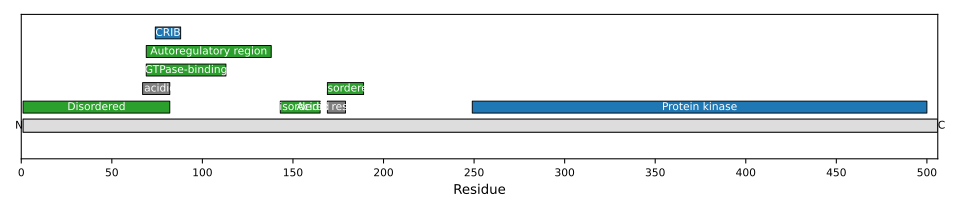
1: Serine/threonine protein kinase that plays a role in a variety of different signaling pathways including cytoskeleton regulation, cell motility, cell cycle progression, apoptosis or proliferation (PubMed:12853446, PubMed:16617111, PubMed:19273597, PubMed:19923322, PubMed:33693784, PubMed:7744004, PubMed:9171063). Acts as a downstream effector of the small GTPases CDC42 and RAC1 (PubMed:7744004). Activation by the binding of active CDC42 and RAC1 results in a conformational change and a subsequent autophosphorylation on several serine and/or threonine residues (PubMed:7744004). Full-length PAK2 stimulates cell survival and cell growth (PubMed:7744004). Phosphorylates MAPK4 and MAPK6 and activates the downstream target MAPKAPK5, a regulator of F-actin polymerization and cell migration (PubMed:21317288). Phosphorylates JUN and plays an important role in EGF-induced cell proliferation (PubMed:21177766). Phosphorylates many other substrates including histone H4 to promote assembly of H3.3 and H4 into nucleosomes, BAD, ribosomal protein S6, or MBP (PubMed:21724829). Phosphorylates CASP7, thereby preventing its activity (PubMed:21555521, PubMed:27889207). Additionally, associates with ARHGEF7 and GIT1 to perform kinase-independent functions such as spindle orientation control during mitosis (PubMed:19273597, PubMed:19923322). On the other hand, apoptotic stimuli such as DNA damage lead to caspase-mediated cleavage of PAK2, generating PAK-2p34, an active p34 fragment that translocates to the nucleus and promotes cellular apoptosis involving the JNK signaling pathway (PubMed:12853446, PubMed:16617111, PubMed:9171063). Caspase-activated PAK2 phosphorylates MKNK1 and reduces cellular translation (PubMed:15234964)