Growth factor receptor-bound protein 10 (GRB10 adapter protein) (Insulin receptor-binding protein Grb-IR)
1_MALAG 6_ CPDSF 11_ LHHPY 16_ YQDKV 21_ EQTPR 26_ SQQDP 31_ AGPGL 36_ PAQSD 41_ RLANH 46_ QEDDV 51_ DLEAL 56_ VNDMN 61_ ASLES 66_ LYSAC 71_ SMQSD 76_ TVPLL 81_ QNGQH 86_ ARSQP 91_ RASGP 96_ PRSIQ 101_ PQVSP 106_ RQRVQ 111_ RSQPV 116_ HILAV 121_ RRLQE 126_ EDQQF 131_ RTSSL 136_ PAIPN 141_ PFPEL 146_ CGPGS 151_ PPVLT 156_ PGSLP 161_ PSQAA 166_ AKQDV 171_ KVFSE 176_ DGTSK 181_ VVEIL 186_ ADMTA 191_ RDLCQ 196_ LLVYK 201_ SHCVD 206_ DNSWT 211_ LVEHH 216_ PHLGL 221_ ERCLE 226_ DHELV 231_ VQVES 236_ TMASE 241_ SKFLF 246_ RKNYA 251_ KYEFF 256_ KNPMN 261_ FFPEQ 266_ MVTWC 271_ QQSNG 276_ SQTQL 281_ LQNFL 286_ NSSSC 291_ PEIQG 296_ FLHVK 301_ ELGKK 306_ SWKKL 311_ YVCLR 316_ RSGLY 321_ CSTKG 326_ TSKEP 331_ RHLQL 336_ LADLE 341_ DSNIF 346_ SLIAG 351_ RKQYN 356_ APTDH 361_ GLCIK 366_ PNKVR 371_ NETKE 376_ LRLLC 381_ AEDEQ 386_ TRTCW 391_ MTAFR 396_ LLKYG 401_ MLLYQ 406_ NYRIP 411_ QQRKA 416_ LLSPF 421_ STPVR 426_ SVSEN 431_ SLVAM 436_ DFSGQ 441_ TGRVI 446_ ENPAE 451_ AQSAA 456_ LEEGH 461_ AWRKR 466_ STRMN 471_ ILGSQ 476_ SPLHP 481_ STLST 486_ VIHRT 491_ QHWFH 496_ GRISR 501_ EESHR 506_ IIKQQ 511_ GLVDG 516_ LFLLR 521_ DSQSN 526_ PKAFV 531_ LTLCH 536_ HQKIK 541_ NFQIL 546_ PCEDD 551_ GQTFF 556_ SLDDG 561_ NTKFS 566_ DLIQL 571_ VDFYQ 576_ LNKGV 581_ LPCKL 586_KHHCI
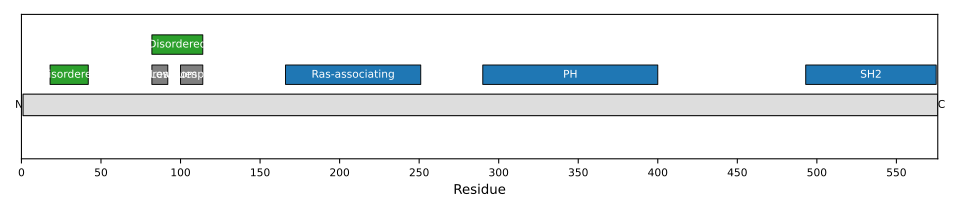
1: Adapter protein which modulates coupling of a number of cell surface receptor kinases with specific signaling pathways. Binds to, and suppress signals from, activated receptors tyrosine kinases, including the insulin (INSR) and insulin-like growth factor (IGF1R) receptors. The inhibitory effect can be achieved by 2 mechanisms: interference with the signaling pathway and increased receptor degradation. Delays and reduces AKT1 phosphorylation in response to insulin stimulation. Blocks association between INSR and IRS1 and IRS2 and prevents insulin-stimulated IRS1 and IRS2 tyrosine phosphorylation. Recruits NEDD4 to IGF1R, leading to IGF1R ubiquitination, increased internalization and degradation by both the proteasomal and lysosomal pathways. May play a role in mediating insulin-stimulated ubiquitination of INSR, leading to proteasomal degradation. Negatively regulates Wnt signaling by interacting with LRP6 intracellular portion and interfering with the binding of AXIN1 to LRP6. Positive regulator of the KDR/VEGFR-2 signaling pathway. May inhibit NEDD4-mediated degradation of KDR/VEGFR-2