Eukaryotic translation initiation factor 3 subunit I (eIF3i) (Eukaryotic translation initiation factor 3 subunit 2) (TGF-beta receptor-interacting protein 1) (TRIP-1) (eIF-3-beta) (eIF3 p36)
1_MKPIL 6_ LQGHE 11_ RSITQ 16_ IKYNR 21_ EGDLL 26_ FTVAK 31_ DPIVN 36_ VWYSV 41_ NGERL 46_ GTYMG 51_ HTGAV 56_ WCVDA 61_ DWDTK 66_ HVLTG 71_ SADNS 76_ CRLWD 81_ CETGK 86_ QLALL 91_ KTNSA 96_ VRTCG 101_ FDFGG 106_ NIIMF 111_ STDKQ 116_ MGYQC 121_ FVSFF 126_ DLRDP 131_ SQIDN 136_ NEPYM 141_ KIPCN 146_ DSKIT 151_ SAVWG 156_ PLGEC 161_ IIAGH 166_ ESGEL 171_ NQYSA 176_ KSGEV 181_ LVNVK 186_ EHSRQ 191_ INDIQ 196_ LSRDM 201_ TMFVT 206_ ASKDN 211_ TAKLF 216_ DSTTL 221_ EHQKT 226_ FRTER 231_ PVNSA 236_ ALSPN 241_ YDHVV 246_ LGGGQ 251_ EAMDV 256_ TTTST 261_ RIGKF 266_ EARFF 271_ HLAFE 276_ EEFGR 281_ VKGHF 286_ GPINS 291_ VAFHP 296_ DGKSY 301_ SSGGE 306_ DGYVR 311_ IHYFD 316_PQYFE
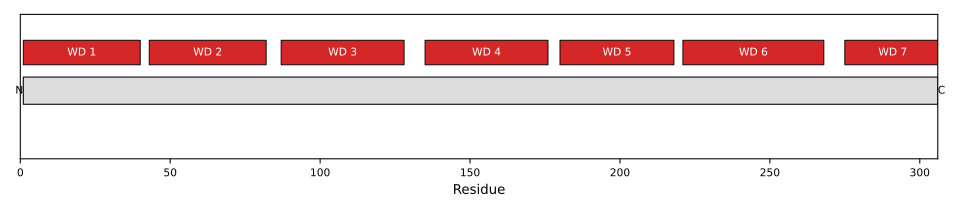
1: Component of the eukaryotic translation initiation factor 3 (eIF-3) complex, which is required for several steps in the initiation of protein synthesis (PubMed:17581632, PubMed:25849773, PubMed:27462815). The eIF-3 complex associates with the 40S ribosome and facilitates the recruitment of eIF-1, eIF-1A, eIF-2:GTP:methionyl-tRNAi and eIF-5 to form the 43S pre-initiation complex (43S PIC). The eIF-3 complex stimulates mRNA recruitment to the 43S PIC and scanning of the mRNA for AUG recognition. The eIF-3 complex is also required for disassembly and recycling of post-termination ribosomal complexes and subsequently prevents premature joining of the 40S and 60S ribosomal subunits prior to initiation (PubMed:17581632). The eIF-3 complex specifically targets and initiates translation of a subset of mRNAs involved in cell proliferation, including cell cycling, differentiation and apoptosis, and uses different modes of RNA stem-loop binding to exert either translational activation or repression (PubMed:25849773)