DNA repair protein XRCC4 (hXRCC4) (X-ray repair cross-complementing protein 4) [Cleaved into: Protein XRCC4, C-terminus (XRCC4/C)]
1_MERKI 6_ SRIHL 11_ VSEPS 16_ ITHFL 21_ QVSWE 26_ KTLES 31_ GFVIT 36_ LTDGH 41_ SAWTG 46_ TVSES 51_ EISQE 56_ ADDMA 61_ MEKGK 66_ YVGEL 71_ RKALL 76_ SGAGP 81_ ADVYT 86_ FNFSK 91_ ESCYF 96_ FFEKN 101_ LKDVS 106_ FRLGS 111_ FNLEK 116_ VENPA 121_ EVIRE 126_ LICYC 131_ LDTIA 136_ ENQAK 141_ NEHLQ 146_ KENER 151_ LLRDW 156_ NDVQG 161_ RFEKC 166_ VSAKE 171_ ALETD 176_ LYKRF 181_ ILVLN 186_ EKKTK 191_ IRSLH 196_ NKLLN 201_ AAQER 206_ EKDIK 211_ QEGET 216_ AICSE 221_ MTADR 226_ DPVYD 231_ ESTDE 236_ ESENQ 241_ TDLSG 246_ LASAA 251_ VSKDD 256_ SIISS 261_ LDVTD 266_ IAPSR 271_ KRRQR 276_ MQRNL 281_ GTEPK 286_ MAPQE 291_ NQLQE 296_ KENSR 301_ PDSSL 306_ PETSK 311_ KEHIS 316_ AENMS 321_ LETLR 326_ NSSPE 331_DLFDE
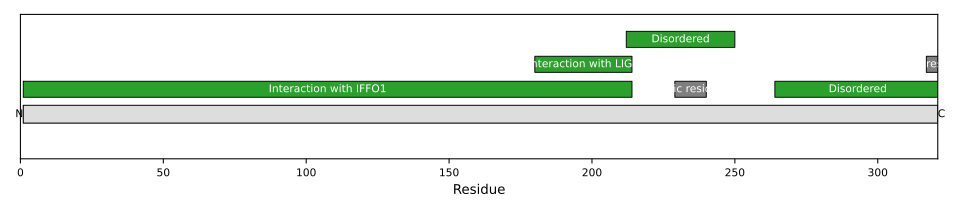
1: DNA non-homologous end joining (NHEJ) core factor, required for double-strand break repair and V(D)J recombination (PubMed:10757784, PubMed:10854421, PubMed:12517771, PubMed:16412978, PubMed:17124166, PubMed:17290226, PubMed:22228831, PubMed:25597996, PubMed:25742519, PubMed:25934149, PubMed:26100018, PubMed:26774286, PubMed:8548796). Acts as a scaffold protein that regulates recruitment of other proteins to DNA double-strand breaks (DSBs) (PubMed:15385968, PubMed:20852255, PubMed:26774286, PubMed:27437582). Associates with NHEJ1/XLF to form alternating helical filaments that bridge DNA and act like a bandage, holding together the broken DNA until it is repaired (PubMed:21768349, PubMed:21775435, PubMed:22287571, PubMed:26100018, PubMed:27437582, PubMed:28500754). The XRCC4-NHEJ1/XLF subcomplex binds to the DNA fragments of a DSB in a highly diffusive manner and robustly bridges two independent DNA molecules, holding the broken DNA fragments in close proximity to one other (PubMed:27437582). The mobility of the bridges ensures that the ends remain accessible for further processing by other repair factors (PubMed:27437582). Plays a key role in the NHEJ ligation step of the broken DNA during DSB repair via direct interaction with DNA ligase IV (LIG4): the LIG4-XRCC4 subcomplex reseals the DNA breaks after the gap filling is completed (PubMed:10757784, PubMed:10854421, PubMed:12517771, PubMed:17290226, PubMed:19837014, PubMed:9242410). XRCC4 stabilizes LIG4, regulates its subcellular localization and enhances LIG4's joining activity (PubMed:10757784, PubMed:10854421, PubMed:12517771, PubMed:17290226, PubMed:21982441, PubMed:22228831, PubMed:9242410). Binding of the LIG4-XRCC4 subcomplex to DNA ends is dependent on the assembly of the DNA-dependent protein kinase complex DNA-PK to these DNA ends (PubMed:10757784, PubMed:10854421). Promotes displacement of PNKP from processed strand break termini (PubMed:20852255, PubMed:28453785)
2: Acts as an activator of the phospholipid scramblase activity of XKR4 (PubMed:33725486). This form, which is generated upon caspase-3 (CASP3) cleavage, translocates into the cytoplasm and interacts with XKR4, thereby promoting phosphatidylserine scramblase activity of XKR4 and leading to phosphatidylserine exposure on apoptotic cell surface (PubMed:33725486)