Mothers against decapentaplegic homolog 4 (MAD homolog 4) (Mothers against DPP homolog 4) (Deletion target in pancreatic carcinoma 4) (SMAD family member 4) (SMAD 4) (Smad4) (hSMAD4)
1_MDNMS 6_ ITNTP 11_ TSNDA 16_ CLSIV 21_ HSLMC 26_ HRQGG 31_ ESETF 36_ AKRAI 41_ ESLVK 46_ KLKEK 51_ KDELD 56_ SLITA 61_ ITTNG 66_ AHPSK 71_ CVTIQ 76_ RTLDG 81_ RLQVA 86_ GRKGF 91_ PHVIY 96_ ARLWR 101_ WPDLH 106_ KNELK 111_ HVKYC 116_ QYAFD 121_ LKCDS 126_ VCVNP 131_ YHYER 136_ VVSPG 141_ IDLSG 146_ LTLQS 151_ NAPSS 156_ MMVKD 161_ EYVHD 166_ FEGQP 171_ SLSTE 176_ GHSIQ 181_ TIQHP 186_ PSNRA 191_ STETY 196_ STPAL 201_ LAPSE 206_ SNATS 211_ TANFP 216_ NIPVA 221_ STSQP 226_ ASILG 231_ GSHSE 236_ GLLQI 241_ ASGPQ 246_ PGQQQ 251_ NGFTG 256_ QPATY 261_ HHNST 266_ TTWTG 271_ SRTAP 276_ YTPNL 281_ PHHQN 286_ GHLQH 291_ HPPMP 296_ PHPGH 301_ YWPVH 306_ NELAF 311_ QPPIS 316_ NHPAP 321_ EYWCS 326_ IAYFE 331_ MDVQV 336_ GETFK 341_ VPSSC 346_ PIVTV 351_ DGYVD 356_ PSGGD 361_ RFCLG 366_ QLSNV 371_ HRTEA 376_ IERAR 381_ LHIGK 386_ GVQLE 391_ CKGEG 396_ DVWVR 401_ CLSDH 406_ AVFVQ 411_ SYYLD 416_ REAGR 421_ APGDA 426_ VHKIY 431_ PSAYI 436_ KVFDL 441_ RQCHR 446_ QMQQQ 451_ AATAQ 456_ AAAAA 461_ QAAAV 466_ AGNIP 471_ GPGSV 476_ GGIAP 481_ AISLS 486_ AAAGI 491_ GVDDL 496_ RRLCI 501_ LRMSF 506_ VKGWG 511_ PDYPR 516_ QSIKE 521_ TPCWI 526_ EIHLH 531_ RALQL 536_ LDEVL 541_ HTMPI 546_ADPQP
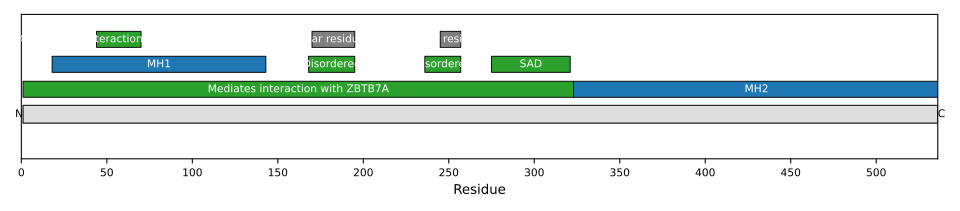
1: In muscle physiology, plays a central role in the balance between atrophy and hypertrophy. When recruited by MSTN, promotes atrophy response via phosphorylated SMAD2/4. MSTN decrease causes SMAD4 release and subsequent recruitment by the BMP pathway to promote hypertrophy via phosphorylated SMAD1/5/8. Acts synergistically with SMAD1 and YY1 in bone morphogenetic protein (BMP)-mediated cardiac-specific gene expression. Binds to SMAD binding elements (SBEs) (5'-GTCT/AGAC-3') within BMP response element (BMPRE) of cardiac activating regions (By similarity). Common SMAD (co-SMAD) is the coactivator and mediator of signal transduction by TGF-beta (transforming growth factor). Component of the heterotrimeric SMAD2/SMAD3-SMAD4 complex that forms in the nucleus and is required for the TGF-mediated signaling (PubMed:25514493). Promotes binding of the SMAD2/SMAD4/FAST-1 complex to DNA and provides an activation function required for SMAD1 or SMAD2 to stimulate transcription. Component of the multimeric SMAD3/SMAD4/JUN/FOS complex which forms at the AP1 promoter site; required for synergistic transcriptional activity in response to TGF-beta. May act as a tumor suppressor. Positively regulates PDPK1 kinase activity by stimulating its dissociation from the 14-3-3 protein YWHAQ which acts as a negative regulator