Receptor-interacting serine/threonine-protein kinase 1 (EC 2.7.11.1) (Cell death protein RIP) (Receptor-interacting protein 1) (RIP-1)
1_MQPDM 6_ SLNVI 11_ KMKSS 16_ DFLES 21_ AELDS 26_ GGFGK 31_ VSLCF 36_ HRTQG 41_ LMIMK 46_ TVYKG 51_ PNCIE 56_ HNEAL 61_ LEEAK 66_ MMNRL 71_ RHSRV 76_ VKLLG 81_ VIIEE 86_ GKYSL 91_ VMEYM 96_ EKGNL 101_ MHVLK 106_ AEMST 111_ PLSVK 116_ GRIIL 121_ EIIEG 126_ MCYLH 131_ GKGVI 136_ HKDLK 141_ PENIL 146_ VDNDF 151_ HIKIA 156_ DLGLA 161_ SFKMW 166_ SKLNN 171_ EEHNE 176_ LREVD 181_ GTAKK 186_ NGGTL 191_ YYMAP 196_ EHLND 201_ VNAKP 206_ TEKSD 211_ VYSFA 216_ VVLWA 221_ IFANK 226_ EPYEN 231_ AICEQ 236_ QLIMC 241_ IKSGN 246_ RPDVD 251_ DITEY 256_ CPREI 261_ ISLMK 266_ LCWEA 271_ NPEAR 276_ PTFPG 281_ IEEKF 286_ RPFYL 291_ SQLEE 296_ SVEED 301_ VKSLK 306_ KEYSN 311_ ENAVV 316_ KRMQS 321_ LQLDC 326_ VAVPS 331_ SRSNS 336_ ATEQP 341_ GSLHS 346_ SQGLG 351_ MGPVE 356_ ESWFA 361_ PSLEH 366_ PQEEN 371_ EPSLQ 376_ SKLQD 381_ EANYH 386_ LYGSR 391_ MDRQT 396_ KQQPR 401_ QNVAY 406_ NREEE 411_ RRRRV 416_ SHDPF 421_ AQQRP 426_ YENFQ 431_ NTEGK 436_ GTAYS 441_ SAASH 446_ GNAVH 451_ QPSGL 456_ TSQPQ 461_ VLYQN 466_ NGLYS 471_ SHGFG 476_ TRPLD 481_ PGTAG 486_ PRVWY 491_ RPIPS 496_ HMPSL 501_ HNIPV 506_ PETNY 511_ LGNTP 516_ TMPFS 521_ SLPPT 526_ DESIK 531_ YTIYN 536_ STGIQ 541_ IGAYN 546_ YMEIG 551_ GTSSS 556_ LLDST 561_ NTNFK 566_ EEPAA 571_ KYQAI 576_ FDNTT 581_ SLTDK 586_ HLDPI 591_ RENLG 596_ KHWKN 601_ CARKL 606_ GFTQS 611_ QIDEI 616_ DHDYE 621_ RDGLK 626_ EKVYQ 631_ MLQKW 636_ VMREG 641_ IKGAT 646_ VGKLA 651_ QALHQ 656_ CSRID 661_ LLSSL 666_IYVSQ
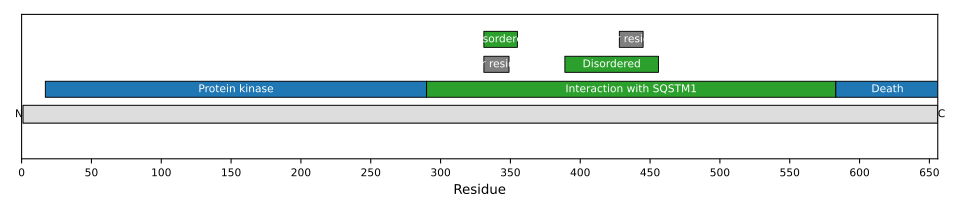
1: Serine-threonine kinase which is a key regulator of TNF-mediated apoptosis, necroptosis and inflammatory pathways (PubMed:17703191, PubMed:24144979, PubMed:31827280, PubMed:31827281, PubMed:32657447, PubMed:35831301). Exhibits kinase activity-dependent functions that regulate cell death and kinase-independent scaffold functions regulating inflammatory signaling and cell survival (PubMed:11101870, PubMed:19524512, PubMed:19524513, PubMed:29440439, PubMed:30988283). Has kinase-independent scaffold functions: upon binding of TNF to TNFR1, RIPK1 is recruited to the TNF-R1 signaling complex (TNF-RSC also known as complex I) where it acts as a scaffold protein promoting cell survival, in part, by activating the canonical NF-kappa-B pathway (By similarity). Kinase activity is essential to regulate necroptosis and apoptosis, two parallel forms of cell death: upon activation of its protein kinase activity, regulates assembly of two death-inducing complexes, namely complex IIa (RIPK1-FADD-CASP8), which drives apoptosis, and the complex IIb (RIPK1-RIPK3-MLKL), which drives necroptosis (By similarity). RIPK1 is required to limit CASP8-dependent TNFR1-induced apoptosis (By similarity). In normal conditions, RIPK1 acts as an inhibitor of RIPK3-dependent necroptosis, a process mediated by RIPK3 component of complex IIb, which catalyzes phosphorylation of MLKL upon induction by ZBP1 (PubMed:19524512, PubMed:19524513, PubMed:29440439, PubMed:30988283). Inhibits RIPK3-mediated necroptosis via FADD-mediated recruitment of CASP8, which cleaves RIPK1 and limits TNF-induced necroptosis (PubMed:19524512, PubMed:19524513, PubMed:29440439, PubMed:30988283). Required to inhibit apoptosis and necroptosis during embryonic development: acts by preventing the interaction of TRADD with FADD thereby limiting aberrant activation of CASP8 (By similarity). In addition to apoptosis and necroptosis, also involved in inflammatory response by promoting transcriptional production of pro-inflammatory cytokines, such as interleukin-6 (IL6) (PubMed:31827280, PubMed:31827281). Phosphorylates RIPK3: RIPK1 and RIPK3 undergo reciprocal auto- and trans-phosphorylation (PubMed:19524513). Phosphorylates DAB2IP at 'Ser-728' in a TNF-alpha-dependent manner, and thereby activates the MAP3K5-JNK apoptotic cascade (PubMed:15310755, PubMed:17389591). Required for ZBP1-induced NF-kappa-B activation in response to DNA damage (By similarity)