Inositol-tetrakisphosphate 1-kinase (EC 2.7.1.134) (Inositol 1,3,4-trisphosphate 5/6-kinase) (Inositol-triphosphate 5/6-kinase) (Ins(1,3,4)P(3) 5/6-kinase) (EC 2.7.1.159)
1_MQTFL 6_ KGKRV 11_ GYWLS 16_ EKKIK 21_ KLNFQ 26_ AFAEL 31_ CRKRG 36_ MEVVQ 41_ LNLSR 46_ PIEEQ 51_ GPLDV 56_ IIHKL 61_ TDVIL 66_ EADQN 71_ DSQSL 76_ ELVHR 81_ FQEYI 86_ DAHPE 91_ TIVLD 96_ PLPAI 101_ RTLLD 106_ RSKSY 111_ ELIRK 116_ IEAYM 121_ EDDRI 126_ CSPPF 131_ MELTS 136_ LCGDD 141_ TMRLL 146_ EKNGL 151_ TFPFI 156_ CKTRV 161_ AHGTN 166_ SHEMA 171_ IVFNQ 176_ EGLNA 181_ IQPPC 186_ VVQNF 191_ INHNA 196_ VLYKV 201_ FVVGE 206_ SYTVV 211_ QRPSL 216_ KNFSA 221_ GTSDR 226_ ESIFF 231_ NSHNV 236_ SKPES 241_ SSVLT 246_ ELDKI 251_ EGVFE 256_ RPSDE 261_ VIREL 266_ SRALR 271_ QALGV 276_ SLFGI 281_ DIIIN 286_ NQTGQ 291_ HAVID 296_ INAFP 301_ GYEGV 306_ SEFFT 311_ DLLNH 316_ IATVL 321_ QGQST 326_ AMAAT 331_ GDVAL 336_ LRHSK 341_ LLAEP 346_ AGGLV 351_ GERTC 356_ SASPG 361_ CCGSM 366_ MGQDA 371_ PWKAE 376_ ADAGG 381_ TAKLP 386_ HQRLG 391_ CNAGV 396_ SPSFQ 401_ QHCVA 406_SLATK
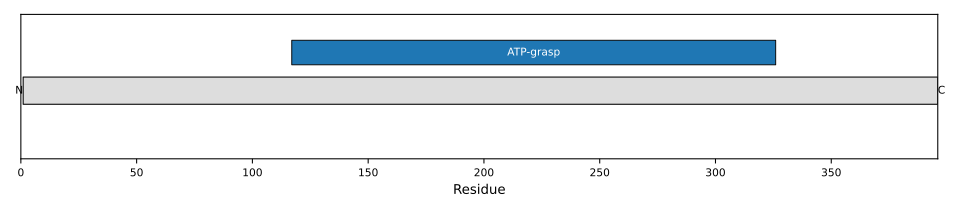
1: Kinase that can phosphorylate various inositol polyphosphate such as Ins(3,4,5,6)P4 or Ins(1,3,4)P3 (PubMed:11042108, PubMed:8662638). Phosphorylates Ins(3,4,5,6)P4 at position 1 to form Ins(1,3,4,5,6)P5 (PubMed:11042108). This reaction is thought to have regulatory importance, since Ins(3,4,5,6)P4 is an inhibitor of plasma membrane Ca(2+)-activated Cl(-) channels, while Ins(1,3,4,5,6)P5 is not. Also phosphorylates Ins(1,3,4)P3 on O-5 and O-6 to form Ins(1,3,4,6)P4, an essential molecule in the hexakisphosphate (InsP6) pathway (PubMed:11042108, PubMed:8662638). Also acts as an inositol polyphosphate phosphatase that dephosphorylates Ins(1,3,4,5)P4 and Ins(1,3,4,6)P4 to Ins(1,3,4)P3, and Ins(1,3,4,5,6)P5 to Ins(3,4,5,6)P4 (PubMed:11909533, PubMed:17616525). May also act as an isomerase that interconverts the inositol tetrakisphosphate isomers Ins(1,3,4,5)P4 and Ins(1,3,4,6)P4 in the presence of ADP and magnesium (PubMed:11909533). Probably acts as the rate-limiting enzyme of the InsP6 pathway. Modifies TNF-alpha-induced apoptosis by interfering with the activation of TNFRSF1A-associated death domain (PubMed:11909533, PubMed:12925536, PubMed:17616525). Plays an important role in MLKL-mediated necroptosis. Produces highly phosphorylated inositol phosphates such as inositolhexakisphosphate (InsP6) which bind to MLKL mediating the release of an N-terminal auto-inhibitory region leading to its activation. Essential for activated phospho-MLKL to oligomerize and localize to the cell membrane during necroptosis (PubMed:17616525)