Cullin-2 (CUL-2)
1_MSLKP 6_ RVVDF 11_ DETWN 16_ KLLTT 21_ IKAVV 26_ MLEYV 31_ ERATW 36_ NDRFS 41_ DIYAL 46_ CVAYP 51_ EPLGE 56_ RLYTE 61_ TKIFL 66_ ENHVR 71_ HLHKR 76_ VLESE 81_ EQVLV 86_ MYHRY 91_ WEEYS 96_ KGADY 101_ MDCLY 106_ RYLNT 111_ QFIKK 116_ NKLTE 121_ ADLQY 126_ GYGGV 131_ DMNEP 136_ LMEIG 141_ ELALD 146_ MWRKL 151_ MVEPL 156_ QAILI 161_ RMLLR 166_ EIKND 171_ RGGED 176_ PNQKV 181_ IHGVI 186_ NSFVH 191_ VEQYK 196_ KKFPL 201_ KFYQE 206_ IFESP 211_ FLTET 216_ GEYYK 221_ QEASN 226_ LLQES 231_ NCSQY 236_ MEKVL 241_ GRLKD 246_ EEIRC 251_ RKYLH 256_ PSSYT 261_ KVIHE 266_ CQQRM 271_ VADHL 276_ QFLHA 281_ ECHNI 286_ IRQEK 291_ KNDMA 296_ NMYVL 301_ LRAVS 306_ TGLPH 311_ MIQEL 316_ QNHIH 321_ DEGLR 326_ ATSNL 331_ TQENM 336_ PTLFV 341_ ESVLE 346_ VHGKF 351_ VQLIN 356_ TVLNG 361_ DQHFM 366_ SALDK 371_ ALTSV 376_ VNYRE 381_ PKSVC 386_ KAPEL 391_ LAKYC 396_ DNLLK 401_ KSAKG 406_ MTENE 411_ VEDRL 416_ TSFIT 421_ VFKYI 426_ DDKDV 431_ FQKFY 436_ ARMLA 441_ KRLIH 446_ GLSMS 451_ MDSEE 456_ AMINK 461_ LKQAC 466_ GYEFT 471_ SKLHR 476_ MYTDM 481_ SVSAD 486_ LNNKF 491_ NNFIK 496_ NQDTV 501_ IDLGI 506_ SFQIY 511_ VLQAG 516_ AWPLT 521_ QAPSS 526_ TFAIP 531_ QELEK 536_ SVQMF 541_ ELFYS 546_ QHFSG 551_ RKLTW 556_ LHYLC 561_ TGEVK 566_ MNYLG 571_ KPYVA 576_ MVTTY 581_ QMAVL 586_ LAFNN 591_ SETVS 596_ YKELQ 601_ DSTQM 606_ NEKEL 611_ TKTIK 616_ SLLDV 621_ KMINH 626_ DSEKE 631_ DIDAE 636_ SSFSL 641_ NMNFS 646_ SKRTK 651_ FKITT 656_ SMQKD 661_ TPQEM 666_ EQTRS 671_ AVDED 676_ RKMYL 681_ QAAIV 686_ RIMKA 691_ RKVLR 696_ HNALI 701_ QEVIS 706_ QSRAR 711_ FNPSI 716_ SMIKK 721_ CIEVL 726_ IDKQY 731_ IERSQ 736_ASADE
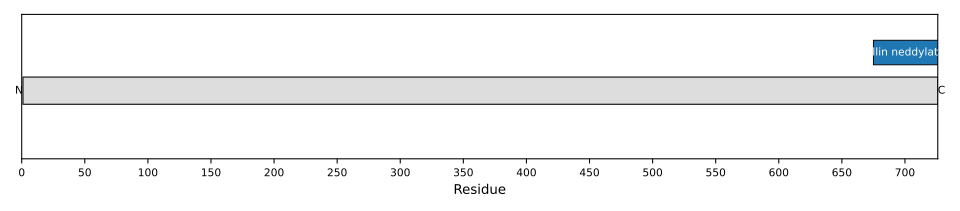
1: Core component of multiple cullin-RING-based ECS (ElonginB/C-CUL2/5-SOCS-box protein) E3 ubiquitin-protein ligase complexes, which mediate the ubiquitination of target proteins (PubMed:11384984, PubMed:26138980, PubMed:29775578, PubMed:29779948, PubMed:38326650). CUL2 serves as a rigid scaffold in the complex and may contribute to catalysis through positioning of the substrate and the E2 ubiquitin-conjugating enzyme (PubMed:10973499, PubMed:11384984, PubMed:12609982, PubMed:24076655, PubMed:9122164, PubMed:38326650). The E3 ubiquitin-protein ligase activity of the complex is dependent on the neddylation of the cullin subunit and is inhibited by the association of the deneddylated cullin subunit with TIP120A/CAND1 (PubMed:12609982, PubMed:24076655, PubMed:27565346, PubMed:38326650). The functional specificity of the ECS complex depends on the substrate recognition component (PubMed:10973499, PubMed:26138980, PubMed:29775578, PubMed:29779948, PubMed:9122164, PubMed:38326650). ECS(VHL) mediates the ubiquitination of hypoxia-inducible factor (HIF) (PubMed:10973499, PubMed:9122164). A number of ECS complexes (containing either KLHDC2, KLHDC3, KLHDC10, APPBP2, FEM1A, FEM1B or FEM1C as substrate-recognition component) are part of the DesCEND (destruction via C-end degrons) pathway, which recognizes a C-degron located at the extreme C terminus of target proteins, leading to their ubiquitination and degradation (PubMed:26138980, PubMed:29775578, PubMed:29779948). ECS complexes and ARIH1 collaborate in tandem to mediate ubiquitination of target proteins (PubMed:27565346). ECS(LRR1) ubiquitinates MCM7 and promotes CMG replisome disassembly by VCP and chromatin extraction during S-phase (By similarity)