Cullin-3 (CUL-3)
1_MSNLS 6_ KGTGS 11_ RKDTK 16_ MRIRA 21_ FPMTM 26_ DEKYV 31_ NSIWD 36_ LLKNA 41_ IQEIQ 46_ RKNNS 51_ GLSFE 56_ ELYRN 61_ AYTMV 66_ LHKHG 71_ EKLYT 76_ GLREV 81_ VTEHL 86_ INKVR 91_ EDVLN 96_ SLNNN 101_ FLQTL 106_ NQAWN 111_ DHQTA 116_ MVMIR 121_ DILMY 126_ MDRVY 131_ VQQNN 136_ VENVY 141_ NLGLI 146_ IFRDQ 151_ VVRYG 156_ CIRDH 161_ LRQTL 166_ LDMIA 171_ RERKG 176_ EVVDR 181_ GAIRN 186_ ACQML 191_ MILGL 196_ EGRSV 201_ YEEDF 206_ EAPFL 211_ EMSAE 216_ FFQME 221_ SQKFL 226_ AENSA 231_ SVYIK 236_ KVEAR 241_ INEEI 246_ ERVMH 251_ CLDKS 256_ TEEPI 261_ VKVVE 266_ RELIS 271_ KHMKT 276_ IVEME 281_ NSGLV 286_ HMLKN 291_ GKTED 296_ LGCMY 301_ KLFSR 306_ VPNGL 311_ KTMCE 316_ CMSSY 321_ LREQG 326_ KALVS 331_ EEGEG 336_ KNPVD 341_ YIQGL 346_ LDLKS 351_ RFDRF 356_ LLESF 361_ NNDRL 366_ FKQTI 371_ AGDFE 376_ YFLNL 381_ NSRSP 386_ EYLSL 391_ FIDDK 396_ LKKGV 401_ KGLTE 406_ QEVET 411_ ILDKA 416_ MVLFR 421_ FMQEK 426_ DVFER 431_ YYKQH 436_ LARRL 441_ LTNKS 446_ VSDDS 451_ EKNMI 456_ SKLKT 461_ ECGCQ 466_ FTSKL 471_ EGMFR 476_ DMSIS 481_ NTTMD 486_ EFRQH 491_ LQATG 496_ VSLGG 501_ VDLTV 506_ RVLTT 511_ GYWPT 516_ QSATP 521_ KCNIP 526_ PAPRH 531_ AFEIF 536_ RRFYL 541_ AKHSG 546_ RQLTL 551_ QHHMG 556_ SADLN 561_ ATFYG 566_ PVKKE 571_ DGSEV 576_ GVGGA 581_ QVTGS 586_ NTRKH 591_ ILQVS 596_ TFQMT 601_ ILMLF 606_ NNREK 611_ YTFEE 616_ IQQET 621_ DIPER 626_ ELVRA 631_ LQSLA 636_ CGKPT 641_ QRVLT 646_ KEPKS 651_ KEIEN 656_ GHIFT 661_ VNDQF 666_ TSKLH 671_ RVKIQ 676_ TVAAK 681_ QGESD 686_ PERKE 691_ TRQKV 696_ DDDRK 701_ HEIEA 706_ AIVRI 711_ MKSRK 716_ KMQHN 721_ VLVAE 726_ VTQQL 731_ KARFL 736_ PSPVV 741_ IKKRI 746_ EGLIE 751_ REYLA 756_ RTPED 761_RKVYT
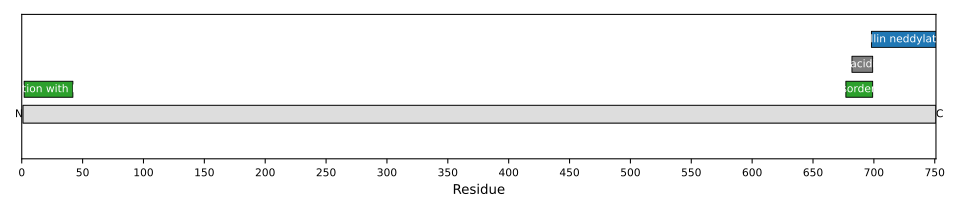
1: Core component of multiple cullin-RING-based BCR (BTB-CUL3-RBX1) E3 ubiquitin-protein ligase complexes which mediate the ubiquitination and subsequent proteasomal degradation of target proteins. BCR complexes and ARIH1 collaborate in tandem to mediate ubiquitination of target proteins (PubMed:27565346). As a scaffold protein may contribute to catalysis through positioning of the substrate and the ubiquitin-conjugating enzyme. The E3 ubiquitin-protein ligase activity of the complex is dependent on the neddylation of the cullin subunit and is inhibited by the association of the deneddylated cullin subunit with TIP120A/CAND1. The functional specificity of the BCR complex depends on the BTB domain-containing protein as the substrate recognition component. BCR(KLHL42) is involved in ubiquitination of KATNA1. BCR(SPOP) is involved in ubiquitination of BMI1/PCGF4, BRMS1, MACROH2A1 and DAXX, GLI2 and GLI3. Can also form a cullin-RING-based BCR (BTB-CUL3-RBX1) E3 ubiquitin-protein ligase complex containing homodimeric SPOPL or the heterodimer formed by SPOP and SPOPL; these complexes have lower ubiquitin ligase activity. BCR(KLHL9-KLHL13) controls the dynamic behavior of AURKB on mitotic chromosomes and thereby coordinates faithful mitotic progression and completion of cytokinesis. BCR(KLHL12) is involved in ER-Golgi transport by regulating the size of COPII coats, thereby playing a key role in collagen export, which is required for embryonic stem (ES) cells division: BCR(KLHL12) acts by mediating monoubiquitination of SEC31 (SEC31A or SEC31B) (PubMed:22358839, PubMed:27716508). BCR(KLHL3) acts as a regulator of ion transport in the distal nephron; by mediating ubiquitination of WNK4 (PubMed:23387299, PubMed:23453970, PubMed:23576762). The BCR(KLHL20) E3 ubiquitin ligase complex is involved in interferon response and anterograde Golgi to endosome transport: it mediates both ubiquitination leading to degradation and 'Lys-33'-linked ubiquitination (PubMed:20389280, PubMed:21670212, PubMed:21840486, PubMed:24768539). The BCR(KLHL21) E3 ubiquitin ligase complex regulates localization of the chromosomal passenger complex (CPC) from chromosomes to the spindle midzone in anaphase and mediates the ubiquitination of AURKB (PubMed:19995937). The BCR(KLHL22) ubiquitin ligase complex mediates monoubiquitination of PLK1, leading to PLK1 dissociation from phosphoreceptor proteins and subsequent removal from kinetochores, allowing silencing of the spindle assembly checkpoint (SAC) and chromosome segregation (PubMed:23455478). The BCR(KLHL22) ubiquitin ligase complex is also responsible for the amino acid-stimulated 'Lys-48' polyubiquitination and proteasomal degradation of DEPDC5. Through the degradation of DEPDC5, releases the GATOR1 complex-mediated inhibition of the TORC1 pathway (PubMed:29769719). The BCR(KLHL25) ubiquitin ligase complex is involved in translational homeostasis by mediating ubiquitination and subsequent degradation of hypophosphorylated EIF4EBP1 (4E-BP1) (PubMed:22578813). The BCR(KLHL25) ubiquitin ligase complex is also involved in lipid synthesis by mediating ubiquitination and degradation of ACLY (PubMed:27664236). The BCR(KBTBD8) complex acts by mediating monoubiquitination of NOLC1 and TCOF1, leading to remodel the translational program of differentiating cells in favor of neural crest specification (PubMed:26399832). Involved in ubiquitination of cyclin E and of cyclin D1 (in vitro) thus involved in regulation of G1/S transition. Involved in the ubiquitination of KEAP1, ENC1 and KLHL41 (PubMed:15983046). In concert with ATF2 and RBX1, promotes degradation of KAT5 thereby attenuating its ability to acetylate and activate ATM. The BCR(KCTD17) E3 ubiquitin ligase complex mediates ubiquitination and degradation of TCHP, a down-regulator of cilium assembly, thereby inducing ciliogenesis (PubMed:25270598). The BCR(KLHL24) E3 ubiquitin ligase complex mediates ubiquitination of KRT14, controls KRT14 levels during keratinocytes differentiation, and is essential for skin integrity (PubMed:27798626). The BCR(KLHL18) E3 ubiquitin ligase complex mediates the ubiquitination of AURKA leading to its activation at the centrosome which is required for initiating mitotic entry (PubMed:23213400). The BCR(KEAP1) E3 ubiquitin ligase complex acts as a key sensor of oxidative and electrophilic stress by mediating ubiquitination and degradation of NFE2L2/NRF2, a transcription factor regulating expression of many cytoprotective genes (PubMed:15601839, PubMed:16006525). As part of the CUL3(KBTBD6/7) E3 ubiquitin ligase complex functions mediates 'Lys-48' ubiquitination and proteasomal degradation of TIAM1 (PubMed:25684205). By controlling the ubiquitination of that RAC1 guanine exchange factors (GEF), regulates RAC1 signal transduction and downstream biological processes including the organization of the cytoskeleton, cell migration and cell proliferation (PubMed:25684205). The BCR(KBTBD4) E3 ubiquitin ligase complex targets CoREST corepressor complex components RCOR1, KDM1A/LSD1 and HDAC2 for proteasomal degradation with RCOR1 likely to be the primary target while degradation of KDM1A and HDAC2 is likely due to their association with RCOR1 (PubMed:33417871). It also targets RCOR3, MIER2 and MIER3 for proteasomal degradation as well as associated proteins ZNF217 and RREB1 with degradation being dependent on the presence of an ELM2 domain in the target proteins (PubMed:36997086). The BCR(ARMC5) complex mediates premature transcription termination of transcripts that are unfavorably configured for transcriptional elongation by mediating ubiquitination of Pol II subunit POLR2A (PubMed:35687106, PubMed:38225631, PubMed:39504960, PubMed:39667934). Required for 'Lys-63'-linked ubiquitination of large ribosomal subunit protein MRPL12 (PubMed:37526061)