Cullin-4A (CUL-4A)
1_MADEA 6_ PRKGS 11_ FSALV 16_ GRTNG 21_ LTKPA 26_ ALAAA 31_ PAKPG 36_ GAGGS 41_ KKLVI 46_ KNFRD 51_ RPRLP 56_ DNYTQ 61_ DTWRK 66_ LHEAV 71_ RAVQS 76_ STSIR 81_ YNLEE 86_ LYQAV 91_ ENLCS 96_ HKVSP 101_ MLYKQ 106_ LRQAC 111_ EDHVQ 116_ AQILP 121_ FREDS 126_ LDSVL 131_ FLKKI 136_ NTCWQ 141_ DHCRQ 146_ MIMIR 151_ SIFLF 156_ LDRTY 161_ VLQNS 166_ TLPSI 171_ WDMGL 176_ ELFRT 181_ HIISD 186_ KMVQS 191_ KTIDG 196_ ILLLI 201_ ERERS 206_ GEAVD 211_ RSLLR 216_ SLLGM 221_ LSDLQ 226_ VYKDS 231_ FELKF 236_ LEETN 241_ CLYAA 246_ EGQRL 251_ MQERE 256_ VPEYL 261_ NHVSK 266_ RLEEE 271_ GDRVI 276_ TYLDH 281_ STQKP 286_ LIACV 291_ EKQLL 296_ GEHLT 301_ AILQK 306_ GLDHL 311_ LDENR 316_ VPDLA 321_ QMYQL 326_ FSRVR 331_ GGQQA 336_ LLQHW 341_ SEYIK 346_ TFGTA 351_ IVINP 356_ EKDKD 361_ MVQDL 366_ LDFKD 371_ KVDHV 376_ IEVCF 381_ QKNER 386_ FVNLM 391_ KESFE 396_ TFINK 401_ RPNKP 406_ AELIA 411_ KHVDS 416_ KLRAG 421_ NKEAT 426_ DEELE 431_ RTLDK 436_ IMILF 441_ RFIHG 446_ KDVFE 451_ AFYKK 456_ DLAKR 461_ LLVGK 466_ SASVD 471_ AEKSM 476_ LSKLK 481_ HECGA 486_ AFTSK 491_ LEGMF 496_ KDMEL 501_ SKDIM 506_ VHFKQ 511_ HMQNQ 516_ SDSGP 521_ IDLTV 526_ NILTM 531_ GYWPT 536_ YTPME 541_ VHLTP 546_ EMIKL 551_ QEVFK 556_ AFYLG 561_ KHSGR 566_ KLQWQ 571_ TTLGH 576_ AVLKA 581_ EFKEG 586_ KKEFQ 591_ VSLFQ 596_ TLVLL 601_ MFNEG 606_ DGFSF 611_ EEIKM 616_ ATGIE 621_ DSELR 626_ RTLQS 631_ LACGK 636_ ARVLI 641_ KSPKG 646_ KEVED 651_ GDKFI 656_ FNGEF 661_ KHKLF 666_ RIKIN 671_ QIQMK 676_ ETVEE 681_ QVSTT 686_ ERVFQ 691_ DRQYQ 696_ IDAAI 701_ VRIMK 706_ MRKTL 711_ GHNLL 716_ VSELY 721_ NQLKF 726_ PVKPG 731_ DLKKR 736_ IESLI 741_ DRDYM 746_ ERDKD 751_NPNQY
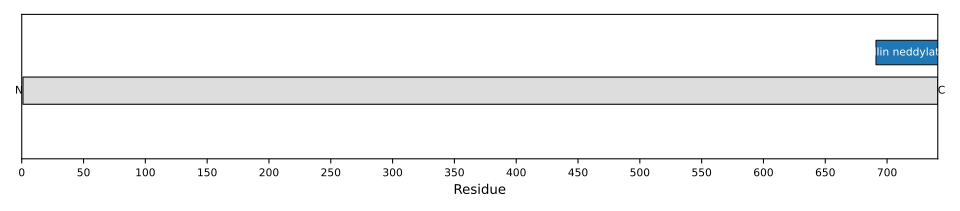
1: Core component of multiple cullin-RING-based E3 ubiquitin-protein ligase complexes which mediate the ubiquitination of target proteins (PubMed:14578910, PubMed:14739464, PubMed:15448697, PubMed:15548678, PubMed:15811626, PubMed:16678110, PubMed:17041588, PubMed:24209620, PubMed:30166453, PubMed:33854232, PubMed:33854239). As a scaffold protein may contribute to catalysis through positioning of the substrate and the ubiquitin-conjugating enzyme (PubMed:14578910, PubMed:14739464, PubMed:15448697, PubMed:15548678, PubMed:15811626, PubMed:16678110, PubMed:17041588, PubMed:24209620). The E3 ubiquitin-protein ligase activity of the complex is dependent on the neddylation of the cullin subunit and is inhibited by the association of the deneddylated cullin subunit with TIP120A/CAND1 (PubMed:14578910, PubMed:14739464, PubMed:15448697, PubMed:15548678, PubMed:15811626, PubMed:16678110, PubMed:17041588, PubMed:24209620). The functional specificity of the E3 ubiquitin-protein ligase complex depends on the variable substrate recognition component (PubMed:14578910, PubMed:14739464, PubMed:15448697, PubMed:15548678, PubMed:15811626, PubMed:16678110, PubMed:17041588, PubMed:24209620). DCX(DET1-COP1) directs ubiquitination of JUN (PubMed:14739464). DCX(DDB2) directs ubiquitination of XPC (PubMed:15811626). DCX(DDB2) ubiquitinates histones H3-H4 and is required for efficient histone deposition during replication-coupled (H3.1) and replication-independent (H3.3) nucleosome assembly, probably by facilitating the transfer of H3 from ASF1A/ASF1B to other chaperones involved in histone deposition (PubMed:16678110, PubMed:17041588, PubMed:24209620). DCX(DTL) plays a role in PCNA-dependent polyubiquitination of CDT1 and MDM2-dependent ubiquitination of p53/TP53 in response to radiation-induced DNA damage and during DNA replication (PubMed:14578910, PubMed:15448697, PubMed:15548678). DCX(DTL) directs autoubiquitination of DTL (PubMed:23478445). In association with DDB1 and SKP2 probably is involved in ubiquitination of CDKN1B/p27kip (PubMed:16537899). Is involved in ubiquitination of HOXA9 (PubMed:14609952). The DDB1-CUL4A-DTL E3 ligase complex regulates the circadian clock function by mediating the ubiquitination and degradation of CRY1 (PubMed:26431207). The DCX(ERCC8) complex (also named CSA complex) plays a role in transcription-coupled repair (TCR) (PubMed:12732143, PubMed:32355176, PubMed:38316879). A number of DCX complexes (containing either TRPC4AP or DCAF12 as substrate-recognition component) are part of the DesCEND (destruction via C-end degrons) pathway, which recognizes a C-degron located at the extreme C terminus of target proteins, leading to their ubiquitination and degradation (PubMed:29779948). The DCX(AMBRA1) complex is a master regulator of the transition from G1 to S cell phase by mediating ubiquitination of phosphorylated cyclin-D (CCND1, CCND2 and CCND3) (PubMed:33854232, PubMed:33854239). The DCX(AMBRA1) complex also acts as a regulator of Cul5-RING (CRL5) E3 ubiquitin-protein ligase complexes by mediating ubiquitination and degradation of Elongin-C (ELOC) component of CRL5 complexes (PubMed:30166453). With CUL4B, contributes to ribosome biogenesis (PubMed:26711351)