Interleukin-10 receptor subunit alpha (IL-10 receptor subunit alpha) (IL-10R subunit alpha) (IL-10RA) (CDw210a) (Interleukin-10 receptor subunit 1) (IL-10R subunit 1) (IL-10R1) (CD antigen CD210)
1_MLPCL 6_ VVLLA 11_ ALLSL 16_ RLGSD 21_ AHGTE 26_ LPSPP 31_ SVWFE 36_ AEFFH 41_ HILHW 46_ TPIPN 51_ QSEST 56_ CYEVA 61_ LLRYG 66_ IESWN 71_ SISNC 76_ SQTLS 81_ YDLTA 86_ VTLDL 91_ YHSNG 96_ YRARV 101_ RAVDG 106_ SRHSN 111_ WTVTN 116_ TRFSV 121_ DEVTL 126_ TVGSV 131_ NLEIH 136_ NGFIL 141_ GKIQL 146_ PRPKM 151_ APAND 156_ TYESI 161_ FSHFR 166_ EYEIA 171_ IRKVP 176_ GNFTF 181_ THKKV 186_ KHENF 191_ SLLTS 196_ GEVGE 201_ FCVQV 206_ KPSVA 211_ SRSNK 216_ GMWSK 221_ EECIS 226_ LTRQY 231_ FTVTN 236_ VIIFF 241_ AFVLL 246_ LSGAL 251_ AYCLA 256_ LQLYV 261_ RRRKK 266_ LPSVL 271_ LFKKP 276_ SPFIF 281_ ISQRP 286_ SPETQ 291_ DTIHP 296_ LDEEA 301_ FLKVS 306_ PELKN 311_ LDLHG 316_ STDSG 321_ FGSTK 326_ PSLQT 331_ EEPQF 336_ LLPDP 341_ HPQAD 346_ RTLGN 351_ REPPV 356_ LGDSC 361_ SSGSS 366_ NSTDS 371_ GICLQ 376_ EPSLS 381_ PSTGP 386_ TWEQQ 391_ VGSNS 396_ RGQDD 401_ SGIDL 406_ VQNSE 411_ GRAGD 416_ TQGGS 421_ ALGHH 426_ SPPEP 431_ EVPGE 436_ EDPAA 441_ VAFQG 446_ YLRQT 451_ RCAEE 456_ KATKT 461_ GCLEE 466_ ESPLT 471_ DGLGP 476_ KFGRC 481_ LVDEA 486_ GLHPP 491_ ALAKG 496_ YLKQD 501_ PLEMT 506_ LASSG 511_ APTGQ 516_ WNQPT 521_ EEWSL 526_ LALSS 531_ CSDLG 536_ ISDWS 541_ FAHDL 546_ APLGC 551_ VAAPG 556_ GLLGS 561_ FNSDL 566_ VTLPL 571_ISSLQ
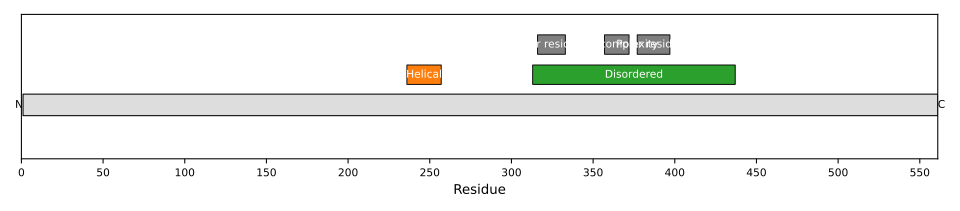
1: Cell surface receptor for the cytokine IL10 that participates in IL10-mediated anti-inflammatory functions, limiting excessive tissue disruption caused by inflammation. Upon binding to IL10, induces a conformational change in IL10RB, allowing IL10RB to bind IL10 as well (PubMed:16982608). In turn, the heterotetrameric assembly complex, composed of two subunits of IL10RA and IL10RB, activates the kinases JAK1 and TYK2 that are constitutively associated with IL10RA and IL10RB respectively (PubMed:12133952). These kinases then phosphorylate specific tyrosine residues in the intracellular domain in IL10RA leading to the recruitment and subsequent phosphorylation of STAT3. Once phosphorylated, STAT3 homodimerizes, translocates to the nucleus and activates the expression of anti-inflammatory genes. In addition, IL10RA-mediated activation of STAT3 inhibits starvation-induced autophagy (PubMed:26962683)