Activin receptor type-2B (EC 2.7.11.30) (Activin receptor type IIB) (ACTR-IIB)
1_MTAPW 6_ VALAL 11_ LWGSL 16_ CAGSG 21_ RGEAE 26_ TRECI 31_ YYNAN 36_ WELER 41_ TNQSG 46_ LERCE 51_ GEQDK 56_ RLHCY 61_ ASWRN 66_ SSGTI 71_ ELVKK 76_ GCWLD 81_ DFNCY 86_ DRQEC 91_ VATEE 96_ NPQVY 101_ FCCCE 106_ GNFCN 111_ ERFTH 116_ LPEAG 121_ GPEVT 126_ YEPPP 131_ TAPTL 136_ LTVLA 141_ YSLLP 146_ IGGLS 151_ LIVLL 156_ AFWMY 161_ RHRKP 166_ PYGHV 171_ DIHED 176_ PGPPP 181_ PSPLV 186_ GLKPL 191_ QLLEI 196_ KARGR 201_ FGCVW 206_ KAQLM 211_ NDFVA 216_ VKIFP 221_ LQDKQ 226_ SWQSE 231_ REIFS 236_ TPGMK 241_ HENLL 246_ QFIAA 251_ EKRGS 256_ NLEVE 261_ LWLIT 266_ AFHDK 271_ GSLTD 276_ YLKGN 281_ IITWN 286_ ELCHV 291_ AETMS 296_ RGLSY 301_ LHEDV 306_ PWCRG 311_ EGHKP 316_ SIAHR 321_ DFKSK 326_ NVLLK 331_ SDLTA 336_ VLADF 341_ GLAVR 346_ FEPGK 351_ PPGDT 356_ HGQVG 361_ TRRYM 366_ APEVL 371_ EGAIN 376_ FQRDA 381_ FLRID 386_ MYAMG 391_ LVLWE 396_ LVSRC 401_ KAADG 406_ PVDEY 411_ MLPFE 416_ EEIGQ 421_ HPSLE 426_ ELQEV 431_ VVHKK 436_ MRPTI 441_ KDHWL 446_ KHPGL 451_ AQLCV 456_ TIEEC 461_ WDHDA 466_ EARLS 471_ AGCVE 476_ ERVSL 481_ IRRSV 486_ NGTTS 491_ DCLVS 496_ LVTSV 501_ TNVDL 506_PPKES
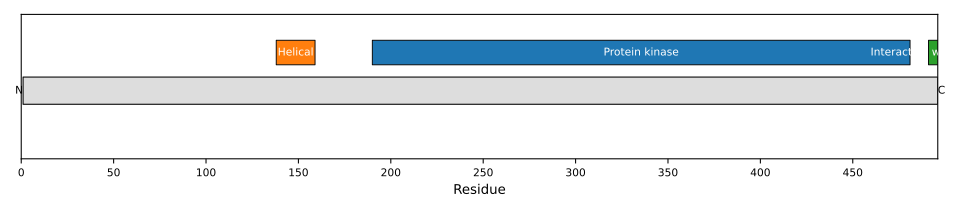
1: Transmembrane serine/threonine kinase activin type-2 receptor forming an activin receptor complex with activin type-1 serine/threonine kinase receptors (ACVR1, ACVR1B or ACVR1c). Transduces the activin signal from the cell surface to the cytoplasm and is thus regulating many physiological and pathological processes including neuronal differentiation and neuronal survival, hair follicle development and cycling, FSH production by the pituitary gland, wound healing, extracellular matrix production, immunosuppression and carcinogenesis. Activin is also thought to have a paracrine or autocrine role in follicular development in the ovary. Within the receptor complex, the type-2 receptors act as a primary activin receptors (binds activin-A/INHBA, activin-B/INHBB as well as inhibin-A/INHA-INHBA). The type-1 receptors like ACVR1B act as downstream transducers of activin signals. Activin binds to type-2 receptor at the plasma membrane and activates its serine-threonine kinase. The activated receptor type-2 then phosphorylates and activates the type-1 receptor. Once activated, the type-1 receptor binds and phosphorylates the SMAD proteins SMAD2 and SMAD3, on serine residues of the C-terminal tail. Soon after their association with the activin receptor and subsequent phosphorylation, SMAD2 and SMAD3 are released into the cytoplasm where they interact with the common partner SMAD4. This SMAD complex translocates into the nucleus where it mediates activin-induced transcription. Inhibitory SMAD7, which is recruited to ACVR1B through FKBP1A, can prevent the association of SMAD2 and SMAD3 with the activin receptor complex, thereby blocking the activin signal. Activin signal transduction is also antagonized by the binding to the receptor of inhibin-B via the IGSF1 inhibin coreceptor