Methylglutaconyl-CoA hydratase, mitochondrial (3-MG-CoA hydratase) (EC 4.2.1.18) (AU-specific RNA-binding enoyl-CoA hydratase) (AU-binding protein/enoyl-CoA hydratase) (Itaconyl-CoA hydratase) (EC 4.2.1.56)
1_MAAAV 6_ AAAPG 11_ ALGSL 16_ HAGGA 21_ RLVAA 26_ CSAWL 31_ CPGLR 36_ LPGSL 41_ AGRRA 46_ GPAIW 51_ AQGWV 56_ PAAGG 61_ PAPKR 66_ GYSSE 71_ MKTED 76_ ELRVR 81_ HLEEE 86_ NRGIV 91_ VLGIN 96_ RAYGK 101_ NSLSK 106_ NLIKM 111_ LSKAV 116_ DALKS 121_ DKKVR 126_ TIIIR 131_ SEVPG 136_ IFCAG 141_ ADLKE 146_ RAKMS 151_ SSEVG 156_ PFVSK 161_ IRAVI 166_ NDIAN 171_ LPVPT 176_ IAAID 181_ GLALG 186_ GGLEL 191_ ALACD 196_ IRVAA 201_ SSAKM 206_ GLVET 211_ KLAII 216_ PGGGG 221_ TQRLP 226_ RAIGM 231_ SLAKE 236_ LIFSA 241_ RVLDG 246_ KEAKA 251_ VGLIS 256_ HVLEQ 261_ NQEGD 266_ AAYRK 271_ ALDLA 276_ REFLP 281_ QGPVA 286_ MRVAK 291_ LAINQ 296_ GMEVD 301_ LVTGL 306_ AIEEA 311_ CYAQT 316_ IPTKD 321_ RLEGL 326_ LAFKE 331_KRPPR
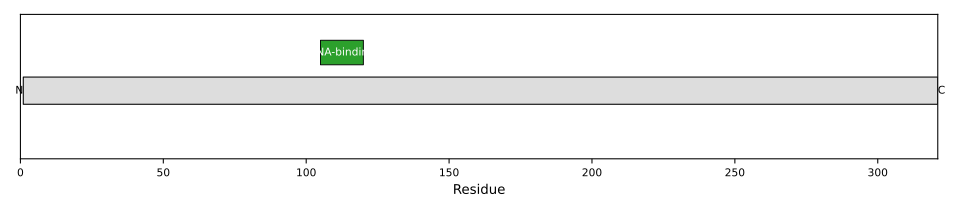
1: Catalyzes the fifth step in the leucine degradation pathway, the reversible hydration of 3-methylglutaconyl-CoA (3-MG-CoA) to 3-hydroxy-3-methylglutaryl-CoA (HMG-CoA) (PubMed:11738050, PubMed:12434311, PubMed:12655555, PubMed:16640564). Can catalyze the reverse reaction but at a much lower rate in vitro (PubMed:16640564). HMG-CoA is then quickly degraded by another enzyme (such as HMG-CoA lyase) to give acetyl-CoA and acetoacetate (PubMed:16640564). Uses other substrates such as (2E)-glutaconyl-CoA efficiently in vitro, and to a lesser extent 3-methylcrotonyl-CoA (3-methyl-(2E)-butenoyl-CoA), crotonyl-CoA ((2E)-butenoyl-CoA) and 3-hydroxybutanoyl-CoA (the missing carboxylate reduces affinity to the active site) (PubMed:16640564). Originally it was identified as an RNA-binding protein as it binds to AU-rich elements (AREs) in vitro (PubMed:7892223). AREs direct rapid RNA degradation and mRNA deadenylation (PubMed:7892223). Might have itaconyl-CoA hydratase activity, converting itaconyl-CoA into citramalyl-CoA in the C5-dicarboxylate catabolism pathway (PubMed:29056341). The C5-dicarboxylate catabolism pathway is required to detoxify itaconate, an antimicrobial metabolite and immunomodulator produced by macrophages during certain infections, that can act as a vitamin B12-poisoning metabolite (PubMed:29056341)