Kelch-like ECH-associated protein 1 (Cytosolic inhibitor of Nrf2) (INrf2) (Kelch-like protein 19)
1_MQPDP 6_ RPSGA 11_ GACCR 16_ FLPLQ 21_ SQCPE 26_ GAGDA 31_ VMYAS 36_ TECKA 41_ EVTPS 46_ QHGNR 51_ TFSYT 56_ LEDHT 61_ KQAFG 66_ IMNEL 71_ RLSQQ 76_ LCDVT 81_ LQVKY 86_ QDAPA 91_ AQFMA 96_ HKVVL 101_ ASSSP 106_ VFKAM 111_ FTNGL 116_ REQGM 121_ EVVSI 126_ EGIHP 131_ KVMER 136_ LIEFA 141_ YTASI 146_ SMGEK 151_ CVLHV 156_ MNGAV 161_ MYQID 166_ SVVRA 171_ CSDFL 176_ VQQLD 181_ PSNAI 186_ GIANF 191_ AEQIG 196_ CVELH 201_ QRARE 206_ YIYMH 211_ FGEVA 216_ KQEEF 221_ FNLSH 226_ CQLVT 231_ LISRD 236_ DLNVR 241_ CESEV 246_ FHACI 251_ NWVKY 256_ DCEQR 261_ RFYVQ 266_ ALLRA 271_ VRCHS 276_ LTPNF 281_ LQMQL 286_ QKCEI 291_ LQSDS 296_ RCKDY 301_ LVKIF 306_ EELTL 311_ HKPTQ 316_ VMPCR 321_ APKVG 326_ RLIYT 331_ AGGYF 336_ RQSLS 341_ YLEAY 346_ NPSDG 351_ TWLRL 356_ ADLQV 361_ PRSGL 366_ AGCVV 371_ GGLLY 376_ AVGGR 381_ NNSPD 386_ GNTDS 391_ SALDC 396_ YNPMT 401_ NQWSP 406_ CAPMS 411_ VPRNR 416_ IGVGV 421_ IDGHI 426_ YAVGG 431_ SHGCI 436_ HHNSV 441_ ERYEP 446_ ERDEW 451_ HLVAP 456_ MLTRR 461_ IGVGV 466_ AVLNR 471_ LLYAV 476_ GGFDG 481_ TNRLN 486_ SAECY 491_ YPERN 496_ EWRMI 501_ TAMNT 506_ IRSGA 511_ GVCVL 516_ HNCIY 521_ AAGGY 526_ DGQDQ 531_ LNSVE 536_ RYDVE 541_ TETWT 546_ FVAPM 551_ KHRRS 556_ ALGIT 561_ VHQGR 566_ IYVLG 571_ GYDGH 576_ TFLDS 581_ VECYD 586_ PDTDT 591_ WSEVT 596_ RMTSG 601_ RSGVG 606_ VAVTM 611_ EPCRK 616_QIDQQ
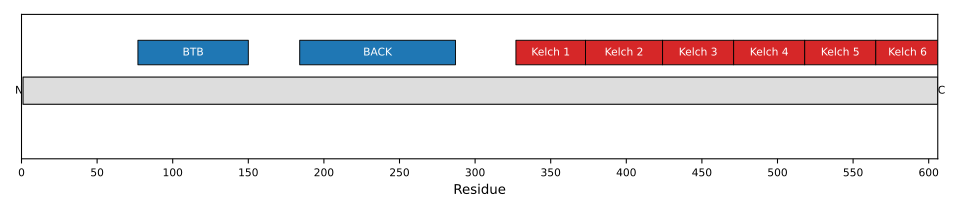
1: Substrate-specific adapter of a BCR (BTB-CUL3-RBX1) E3 ubiquitin ligase complex that regulates the response to oxidative stress by targeting NFE2L2/NRF2 for ubiquitination (PubMed:14585973, PubMed:15379550, PubMed:15572695, PubMed:15601839, PubMed:15983046, PubMed:37339955). KEAP1 acts as a key sensor of oxidative and electrophilic stress: in normal conditions, the BCR(KEAP1) complex mediates ubiquitination and degradation of NFE2L2/NRF2, a transcription factor regulating expression of many cytoprotective genes (PubMed:15601839, PubMed:16006525). In response to oxidative stress, different electrophile metabolites trigger non-enzymatic covalent modifications of highly reactive cysteine residues in KEAP1, leading to inactivate the ubiquitin ligase activity of the BCR(KEAP1) complex, promoting NFE2L2/NRF2 nuclear accumulation and expression of phase II detoxifying enzymes (PubMed:16006525, PubMed:17127771, PubMed:18251510, PubMed:19489739, PubMed:29590092). In response to selective autophagy, KEAP1 is sequestered in inclusion bodies following its interaction with SQSTM1/p62, leading to inactivation of the BCR(KEAP1) complex and activation of NFE2L2/NRF2 (PubMed:20452972). The BCR(KEAP1) complex also mediates ubiquitination of SQSTM1/p62, increasing SQSTM1/p62 sequestering activity and degradation (PubMed:28380357). The BCR(KEAP1) complex also targets BPTF and PGAM5 for ubiquitination and degradation by the proteasome (PubMed:15379550, PubMed:17046835)