Inhibitor of nuclear factor kappa-B kinase subunit epsilon (I-kappa-B kinase epsilon) (IKK-E) (IKK-epsilon) (IkBKE) (EC 2.7.11.10) (Inducible I kappa-B kinase) (IKK-i)
1_MQSTA 6_ NYLWH 11_ TDDLL 16_ GQGAT 21_ ASVYK 26_ ARNKK 31_ SGELV 36_ AVKVF 41_ NTTSY 46_ LRPRE 51_ VQVRE 56_ FEVLR 61_ KLNHQ 66_ NIVKL 71_ FAVEE 76_ TGGSR 81_ QKVLV 86_ MEYCS 91_ SGSLL 96_ SVLES 101_ PENAF 106_ GLPED 111_ EFLVV 116_ LRCVV 121_ AGMNH 126_ LRENG 131_ IVHRD 136_ IKPGN 141_ IMRLV 146_ GEEGQ 151_ SIYKL 156_ TDFGA 161_ ARELD 166_ DDEKF 171_ VSVYG 176_ TEEYL 181_ HPDMY 186_ ERAVL 191_ RKPQQ 196_ KAFGV 201_ TVDLW 206_ SIGVT 211_ LYHAA 216_ TGSLP 221_ FIPFG 226_ GPRRN 231_ KEIMY 236_ RITTE 241_ KPAGA 246_ IAGAQ 251_ RRENG 256_ PLEWS 261_ YTLPI 266_ TCQLS 271_ LGLQS 276_ QLVPI 281_ LANIL 286_ EVEQA 291_ KCWGF 296_ DQFFA 301_ ETSDI 306_ LQRVV 311_ VHVFS 316_ LSQAV 321_ LHHIY 326_ IHAHN 331_ TIAIF 336_ QEAVH 341_ KQTSV 346_ APRHQ 351_ EYLFE 356_ GHLCV 361_ LEPSV 366_ SAQHI 371_ AHTTA 376_ SSPLT 381_ LFSTA 386_ IPKGL 391_ AFRDP 396_ ALDVP 401_ KFVPK 406_ VDLQA 411_ DYNTA 416_ KGVLG 421_ AGYQA 426_ LRLAR 431_ ALLDG 436_ QELMF 441_ RGLHW 446_ VMEVL 451_ QATCR 456_ RTLEV 461_ ARTSL 466_ LYLSS 471_ SLGTE 476_ RFSSV 481_ AGTPE 486_ IQELK 491_ AAAEL 496_ RSRLR 501_ TLAEV 506_ LSRCS 511_ QNITE 516_ TQESL 521_ SSLNR 526_ ELVKS 531_ RDQVH 536_ EDRSI 541_ QQIQC 546_ CLDKM 551_ NFIYK 556_ QFKKS 561_ RMRPG 566_ LGYNE 571_ EQIHK 576_ LDKVN 581_ FSHLA 586_ KRLLQ 591_ VFQEE 596_ CVQKY 601_ QASLV 606_ THGKR 611_ MRVVH 616_ ETRNH 621_ LRLVG 626_ CSVAA 631_ CNTEA 636_ QGVQE 641_ SLSKL 646_ LEELS 651_ HQLLQ 656_ DRAKG 661_ AQASP 666_ PPIAP 671_ YPSPT 676_ RKDLL 681_ LHMQE 686_ LCEGM 691_ KLLAS 696_ DLLDN 701_ NRIIE 706_ RLNRV 711_PAPPD
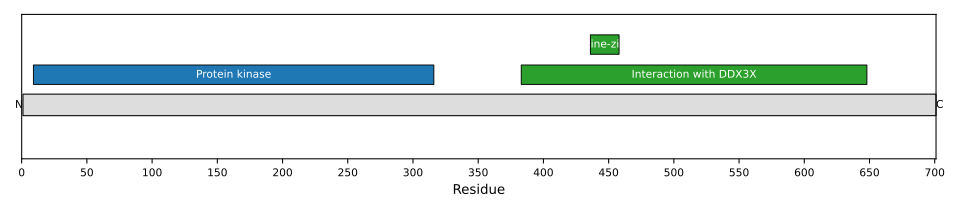
1: Serine/threonine kinase that plays an essential role in regulating inflammatory responses to viral infection, through the activation of the type I IFN, NF-kappa-B and STAT signaling. Also involved in TNFA and inflammatory cytokines, like Interleukin-1, signaling. Following activation of viral RNA sensors, such as RIG-I-like receptors, associates with DDX3X and phosphorylates interferon regulatory factors (IRFs), IRF3 and IRF7, as well as DDX3X. This activity allows subsequent homodimerization and nuclear translocation of the IRF3 leading to transcriptional activation of pro-inflammatory and antiviral genes including IFNB. In order to establish such an antiviral state, IKBKE forms several different complexes whose composition depends on the type of cell and cellular stimuli. Thus, several scaffolding molecules including IPS1/MAVS, TANK, AZI2/NAP1 or TBKBP1/SINTBAD can be recruited to the IKBKE-containing-complexes. Activated by polyubiquitination in response to TNFA and interleukin-1, regulates the NF-kappa-B signaling pathway through, at least, the phosphorylation of CYLD. Phosphorylates inhibitors of NF-kappa-B thus leading to the dissociation of the inhibitor/NF-kappa-B complex and ultimately the degradation of the inhibitor. In addition, is also required for the induction of a subset of ISGs which displays antiviral activity, may be through the phosphorylation of STAT1 at 'Ser-708'. Phosphorylation of STAT1 at 'Ser-708' also seems to promote the assembly and DNA binding of ISGF3 (STAT1:STAT2:IRF9) complexes compared to GAF (STAT1:STAT1) complexes, in this way regulating the balance between type I and type II IFN responses. Protects cells against DNA damage-induced cell death. Also plays an important role in energy balance regulation by sustaining a state of chronic, low-grade inflammation in obesity, wich leads to a negative impact on insulin sensitivity. Phosphorylates AKT1