Endoplasmic reticulum membrane sensor NFE2L1 (Locus control region-factor 1) (LCR-F1) (Nuclear factor erythroid 2-related factor 1) (NF-E2-related factor 1) (NFE2-related factor 1) (Nuclear factor, erythroid derived 2, like 1) (Protein NRF1, p120 form) (Transcription factor 11) (TCF-11) [Cleaved into: Transcription factor NRF1 (Protein NRF1, p110 form)]
1_MLSLK 6_ KYLTE 11_ GLLQF 16_ TILLS 21_ LIGVR 26_ VDVDT 31_ YLTSQ 36_ LPPLR 41_ EIILG 46_ PSSAY 51_ TQTQF 56_ HNLRN 61_ TLDGY 66_ GIHPK 71_ SIDLD 76_ NYFTA 81_ RRLLS 86_ QVRAL 91_ DRFQV 96_ PTTEV 101_ NAWLV 106_ HRDPE 111_ GSVSG 116_ SQPNS 121_ GLALE 126_ SSSGL 131_ QDVTG 136_ PDNGV 141_ RESET 146_ EQGFG 151_ EDLED 156_ LGAVA 161_ PPVSG 166_ DLTKE 171_ DIDLI 176_ DILWR 181_ QDIDL 186_ GAGRE 191_ VFDYS 196_ HRQKE 201_ QDVEK 206_ ELRDG 211_ GEQDT 216_ WAGEG 221_ AEALA 226_ RNLLV 231_ DGETG 236_ ESFPA 241_ QVPSG 246_ EDQTA 251_ LSLEE 256_ CLRLL 261_ EATCP 266_ FGENA 271_ EFPAD 276_ ISSIT 281_ EAVPS 286_ ESEPP 291_ ALQNN 296_ LLSPL 301_ LTGTE 306_ SPFDL 311_ EQQWQ 316_ DLMSI 321_ MEMQA 326_ MEVNT 331_ SASEI 336_ LYSAP 341_ PGDPL 346_ STNYS 351_ LAPNT 356_ PINQN 361_ VSLHQ 366_ ASLGG 371_ CSQDF 376_ LLFSP 381_ EVESL 386_ PVASS 391_ STLLP 396_ LAPSN 401_ STSLN 406_ STFGS 411_ TNLTG 416_ LFFPP 421_ QLNGT 426_ ANDTA 431_ GPELP 436_ DPLGG 441_ LLDEA 446_ MLDEI 451_ SLMDL 456_ AIEEG 461_ FNPVQ 466_ ASQLE 471_ EEFDS 476_ DSGLS 481_ LDSSH 486_ SPSSL 491_ SSSEG 496_ SSSSS 501_ SSSSS 506_ SSSSA 511_ SSSAS 516_ SSFSE 521_ EGAVG 526_ YSSDS 531_ ETLDL 536_ EEAEG 541_ AVGYQ 546_ PEYSK 551_ FCRMS 556_ YQDPA 561_ QLSCL 566_ PYLEH 571_ VGHNH 576_ TYNMA 581_ PSALD 586_ SADLP 591_ PPSAL 596_ KKGSK 601_ EKQAD 606_ FLDKQ 611_ MSRDE 616_ HRARA 621_ MKIPF 626_ TNDKI 631_ INLPV 636_ EEFNE 641_ LLSKY 646_ QLSEA 651_ QLSLI 656_ RDIRR 661_ RGKNK 666_ MAAQN 671_ CRKRK 676_ LDTIL 681_ NLERD 686_ VEDLQ 691_ RDKAR 696_ LLREK 701_ VEFLR 706_ SLRQM 711_ KQKVQ 716_ SLYQE 721_ VFGRL 726_ RDENG 731_ RPYSP 736_ SQYAL 741_ QYAGD 746_ GSVLL 751_ IPRTM 756_ ADQQA 761_ RRQER 766_KPKDR
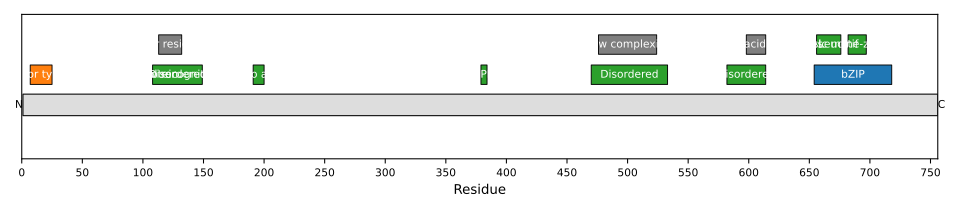
1: Endoplasmic reticulum membrane sensor that translocates into the nucleus in response to various stresses to act as a transcription factor (PubMed:20932482, PubMed:24448410). Constitutes a precursor of the transcription factor NRF1 (By similarity). Able to detect various cellular stresses, such as cholesterol excess, oxidative stress or proteasome inhibition (PubMed:20932482). In response to stress, it is released from the endoplasmic reticulum membrane following cleavage by the protease DDI2 and translocates into the nucleus to form the transcription factor NRF1 (By similarity). Acts as a key sensor of cholesterol excess: in excess cholesterol conditions, the endoplasmic reticulum membrane form of the protein directly binds cholesterol via its CRAC motif, preventing cleavage and release of the transcription factor NRF1, thereby allowing expression of genes promoting cholesterol removal, such as CD36 (By similarity). Involved in proteasome homeostasis: in response to proteasome inhibition, it is released from the endoplasmic reticulum membrane, translocates to the nucleus and activates expression of genes encoding proteasome subunits (PubMed:20932482)
2: CNC-type bZIP family transcription factor that translocates to the nucleus and regulates expression of target genes in response to various stresses (PubMed:8932385, PubMed:9421508). Heterodimerizes with small-Maf proteins (MAFF, MAFG or MAFK) and binds DNA motifs including the antioxidant response elements (AREs), which regulate expression of genes involved in oxidative stress response (PubMed:8932385, PubMed:9421508). Activates or represses expression of target genes, depending on the context (PubMed:8932385, PubMed:9421508). Plays a key role in cholesterol homeostasis by acting as a sensor of cholesterol excess: in low cholesterol conditions, translocates into the nucleus and represses expression of genes involved in defense against cholesterol excess, such as CD36 (By similarity). In excess cholesterol conditions, the endoplasmic reticulum membrane form of the protein directly binds cholesterol via its CRAC motif, preventing cleavage and release of the transcription factor NRF1, thereby allowing expression of genes promoting cholesterol removal (By similarity). Critical for redox balance in response to oxidative stress: acts by binding the AREs motifs on promoters and mediating activation of oxidative stress response genes, such as GCLC, GCLM, GSS, MT1 and MT2 (By similarity). Plays an essential role during fetal liver hematopoiesis: probably has a protective function against oxidative stress and is involved in lipid homeostasis in the liver (By similarity). Involved in proteasome homeostasis: in response to proteasome inhibition, mediates the 'bounce-back' of proteasome subunits by translocating into the nucleus and activating expression of genes encoding proteasome subunits (PubMed:20932482). Also involved in regulating glucose flux (By similarity). Together with CEBPB; represses expression of DSPP during odontoblast differentiation (PubMed:15308669). In response to ascorbic acid induction, activates expression of SP7/Osterix in osteoblasts