Potassium voltage-gated channel subfamily B member 1 (Delayed rectifier potassium channel 1) (DRK1) (h-DRK1) (Voltage-gated potassium channel subunit Kv2.1)
1_MPAGM 6_ TKHGS 11_ RSTSS 16_ LPPEP 21_ MEIVR 26_ SKACS 31_ RRVRL 36_ NVGGL 41_ AHEVL 46_ WRTLD 51_ RLPRT 56_ RLGKL 61_ RDCNT 66_ HDSLL 71_ EVCDD 76_ YSLDD 81_ NEYFF 86_ DRHPG 91_ AFTSI 96_ LNFYR 101_ TGRLH 106_ MMEEM 111_ CALSF 116_ SQELD 121_ YWGID 126_ EIYLE 131_ SCCQA 136_ RYHQK 141_ KEQMN 146_ EELKR 151_ EAETL 156_ REREG 161_ EEFDN 166_ TCCAE 171_ KRKKL 176_ WDLLE 181_ KPNSS 186_ VAAKI 191_ LAIIS 196_ IMFIV 201_ LSTIA 206_ LSLNT 211_ LPELQ 216_ SLDEF 221_ GQSTD 226_ NPQLA 231_ HVEAV 236_ CIAWF 241_ TMEYL 246_ LRFLS 251_ SPKKW 256_ KFFKG 261_ PLNAI 266_ DLLAI 271_ LPYYV 276_ TIFLT 281_ ESNKS 286_ VLQFQ 291_ NVRRV 296_ VQIFR 301_ IMRIL 306_ RILKL 311_ ARHST 316_ GLQSL 321_ GFTLR 326_ RSYNE 331_ LGLLI 336_ LFLAM 341_ GIMIF 346_ SSLVF 351_ FAEKD 356_ EDDTK 361_ FKSIP 366_ ASFWW 371_ ATITM 376_ TTVGY 381_ GDIYP 386_ KTLLG 391_ KIVGG 396_ LCCIA 401_ GVLVI 406_ ALPIP 411_ IIVNN 416_ FSEFY 421_ KEQKR 426_ QEKAI 431_ KRREA 436_ LERAK 441_ RNGSI 446_ VSMNM 451_ KDAFA 456_ RSIEM 461_ MDIVV 466_ EKNGE 471_ NMGKK 476_ DKVQD 481_ NHLSP 486_ NKWKW 491_ TKRTL 496_ SETSS 501_ SKSFE 506_ TKEQG 511_ SPEKA 516_ RSSSS 521_ PQHLN 526_ VQQLE 531_ DMYNK 536_ MAKTQ 541_ SQPIL 546_ NTKES 551_ AAQSK 556_ PKEEL 561_ EMESI 566_ PSPVA 571_ PLPTR 576_ TEGVI 581_ DMRSM 586_ SSIDS 591_ FISCA 596_ TDFPE 601_ ATRFS 606_ HSPLT 611_ SLPSK 616_ TGGST 621_ APEVG 626_ WRGAL 631_ GASGG 636_ RFVEA 641_ NPSPD 646_ ASQHS 651_ SFFIE 656_ SPKSS 661_ MKTNN 666_ PLKLR 671_ ALKVN 676_ FMEGD 681_ PSPLL 686_ PVLGM 691_ YHDPL 696_ RNRGS 701_ AAAAV 706_ AGLEC 711_ ATLLD 716_ KAVLS 721_ PESSI 726_ YTTAS 731_ AKTPP 736_ RSPEK 741_ HTAIA 746_ FNFEA 751_ GVHQY 756_ IDADT 761_ DDEGQ 766_ LLYSV 771_ DSSPP 776_ KSLPG 781_ STSPK 786_ FSTGT 791_ RSEKN 796_ HFESS 801_ PLPTS 806_ PKFLR 811_ QNCIY 816_ STEAL 821_ TGKGP 826_ SGQEK 831_ CKLEN 836_ HISPD 841_ VRVLP 846_ GGGAH 851_GSTRD
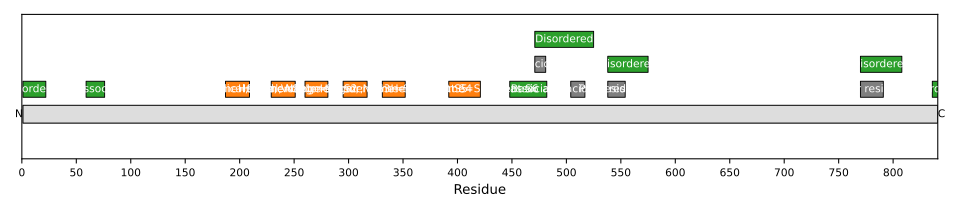
1: Voltage-gated potassium channel that mediates transmembrane potassium transport in excitable membranes, primarily in the brain, but also in the pancreas and cardiovascular system. Contributes to the regulation of the action potential (AP) repolarization, duration and frequency of repetitive AP firing in neurons, muscle cells and endocrine cells and plays a role in homeostatic attenuation of electrical excitability throughout the brain (PubMed:23161216). Plays also a role in the regulation of exocytosis independently of its electrical function (By similarity). Forms tetrameric potassium-selective channels through which potassium ions pass in accordance with their electrochemical gradient. The channel alternates between opened and closed conformations in response to the voltage difference across the membrane. Homotetrameric channels mediate a delayed-rectifier voltage-dependent outward potassium current that display rapid activation and slow inactivation in response to membrane depolarization (PubMed:10484328, PubMed:12560340, PubMed:1283219, PubMed:19074135, PubMed:19717558, PubMed:24901643, PubMed:8081723). Can form functional homotetrameric and heterotetrameric channels that contain variable proportions of KCNB2; channel properties depend on the type of alpha subunits that are part of the channel (By similarity). Can also form functional heterotetrameric channels with other alpha subunits that are non-conducting when expressed alone, such as KCNF1, KCNG1, KCNG3, KCNG4, KCNH1, KCNH2, KCNS1, KCNS2, KCNS3 and KCNV1, creating a functionally diverse range of channel complexes (PubMed:10484328, PubMed:11852086, PubMed:12060745, PubMed:19074135, PubMed:19717558, PubMed:24901643). Heterotetrameric channel activity formed with KCNS3 show increased current amplitude with the threshold for action potential activation shifted towards more negative values in hypoxic-treated pulmonary artery smooth muscle cells (By similarity). Channel properties are also modulated by cytoplasmic ancillary beta subunits such as AMIGO1, KCNE1, KCNE2 and KCNE3, slowing activation and inactivation rate of the delayed rectifier potassium channels (By similarity). In vivo, membranes probably contain a mixture of heteromeric potassium channel complexes, making it difficult to assign currents observed in intact tissues to any particular potassium channel family member. Major contributor to the slowly inactivating delayed-rectifier voltage-gated potassium current in neurons of the central nervous system, sympathetic ganglion neurons, neuroendocrine cells, pancreatic beta cells, cardiomyocytes and smooth muscle cells. Mediates the major part of the somatodendritic delayed-rectifier potassium current in hippocampal and cortical pyramidal neurons and sympathetic superior cervical ganglion (CGC) neurons that acts to slow down periods of firing, especially during high frequency stimulation. Plays a role in the induction of long-term potentiation (LTP) of neuron excitability in the CA3 layer of the hippocampus (By similarity). Contributes to the regulation of glucose-induced action potential amplitude and duration in pancreatic beta cells, hence limiting calcium influx and insulin secretion (PubMed:23161216). Plays a role in the regulation of resting membrane potential and contraction in hypoxia-treated pulmonary artery smooth muscle cells. May contribute to the regulation of the duration of both the action potential of cardiomyocytes and the heart ventricular repolarization QT interval. Contributes to the pronounced pro-apoptotic potassium current surge during neuronal apoptotic cell death in response to oxidative injury. May confer neuroprotection in response to hypoxia/ischemic insults by suppressing pyramidal neurons hyperexcitability in hippocampal and cortical regions (By similarity). Promotes trafficking of KCNG3, KCNH1 and KCNH2 to the cell surface membrane, presumably by forming heterotetrameric channels with these subunits (PubMed:12060745). Plays a role in the calcium-dependent recruitment and release of fusion-competent vesicles from the soma of neurons, neuroendocrine and glucose-induced pancreatic beta cells by binding key components of the fusion machinery in a pore-independent manner (By similarity)