Nuclear receptor subfamily 1 group D member 2 (Orphan nuclear hormone receptor BD73) (Rev-erb alpha-related receptor) (RVR) (Rev-erb-beta) (V-erbA-related protein 1-related) (EAR-1R)
1_MEVNA 6_ GGVIA 11_ YISSS 16_ SSASS 21_ PASCH 26_ SEGSE 31_ NSFQS 36_ SSSSV 41_ PSSPN 46_ SSNSD 51_ TNGNP 56_ KNGDL 61_ ANIEG 66_ ILKND 71_ RIDCS 76_ MKTSK 81_ SSAPG 86_ MTKSH 91_ SGVTK 96_ FSGMV 101_ LLCKV 106_ CGDVA 111_ SGFHY 116_ GVHAC 121_ EGCKG 126_ FFRRS 131_ IQQNI 136_ QYKKC 141_ LKNEN 146_ CSIMR 151_ MNRNR 156_ CQQCR 161_ FKKCL 166_ SVGMS 171_ RDAVR 176_ FGRIP 181_ KREKQ 186_ RMLIE 191_ MQSAM 196_ KTMMN 201_ SQFSG 206_ HLQND 211_ TLVEH 216_ HEQTA 221_ LPAQE 226_ QLRPK 231_ PQLEQ 236_ ENIKS 241_ SSPPS 246_ SDFAK 251_ EEVIG 256_ MVTRA 261_ HKDTF 266_ MYNQE 271_ QQENS 276_ AESMQ 281_ PQRGE 286_ RIPKN 291_ MEQYN 296_ LNHDH 301_ CGNGL 306_ SSHFP 311_ CSESQ 316_ QHLNG 321_ QFKGR 326_ NIMHY 331_ PNGHA 336_ ICIAN 341_ GHCMN 346_ FSNAY 351_ TQRVC 356_ DRVPI 361_ DGFSQ 366_ NENKN 371_ SYLCN 376_ TGGRM 381_ HLVCP 386_ MSKSP 391_ YVDPH 396_ KSGHE 401_ IWEEF 406_ SMSFT 411_ PAVKE 416_ VVEFA 421_ KRIPG 426_ FRDLS 431_ QHDQV 436_ NLLKA 441_ GTFEV 446_ LMVRF 451_ ASLFD 456_ AKERT 461_ VTFLS 466_ GKKYS 471_ VDDLH 476_ SMGAG 481_ DLLNS 486_ MFEFS 491_ EKLNA 496_ LQLSD 501_ EEMSL 506_ FTAVV 511_ LVSAD 516_ RSGIE 521_ NVNSV 526_ EALQE 531_ TLIRA 536_ LRTLI 541_ MKNHP 546_ NEASI 551_ FTKLL 556_ LKLPD 561_ LRSLN 566_ NMHSE 571_ELLAF
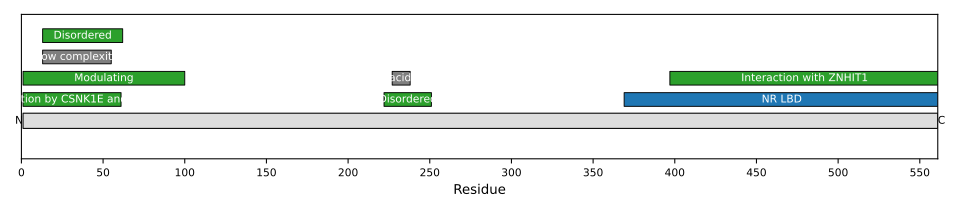
1: Transcriptional repressor which coordinates circadian rhythm and metabolic pathways in a heme-dependent manner. Integral component of the complex transcription machinery that governs circadian rhythmicity and forms a critical negative limb of the circadian clock by directly repressing the expression of core clock components BMAL1 and CLOCK. Also regulates genes involved in metabolic functions, including lipid metabolism and the inflammatory response. Acts as a receptor for heme which stimulates its interaction with the NCOR1/HDAC3 corepressor complex, enhancing transcriptional repression. Recognizes two classes of DNA response elements within the promoter of its target genes and can bind to DNA as either monomers or homodimers, depending on the nature of the response element. Binds as a monomer to a response element composed of the consensus half-site motif 5'-[A/G]GGTCA-3' preceded by an A/T-rich 5' sequence (RevRE), or as a homodimer to a direct repeat of the core motif spaced by two nuclegotides (RevDR-2). Acts as a potent competitive repressor of ROR alpha (RORA) function and also negatively regulates the expression of NR1D1. Regulates lipid and energy homeostasis in the skeletal muscle via repression of genes involved in lipid metabolism and myogenesis including: CD36, FABP3, FABP4, UCP3, SCD1 and MSTN. Regulates hepatic lipid metabolism via the repression of APOC3. Represses gene expression at a distance in macrophages by inhibiting the transcription of enhancer-derived RNAs (eRNAs). In addition to its activity as a repressor, can also act as a transcriptional activator. Acts as a transcriptional activator of the sterol regulatory element-binding protein 1 (SREBF1) and the inflammatory mediator interleukin-6 (IL6) in the skeletal muscle (By similarity). Plays a role in the regulation of circadian sleep/wake cycle; essential for maintaining wakefulness during the dark phase or active period (By similarity). Key regulator of skeletal muscle mitochondrial function; negatively regulates the skeletal muscle expression of core clock genes and genes involved in mitochondrial biogenesis, fatty acid beta-oxidation and lipid metabolism (By similarity). May play a role in the circadian control of neutrophilic inflammation in the lung (By similarity)