ER membrane protein complex subunit 2 (Tetratricopeptide repeat protein 35) (TPR repeat protein 35)
1_MAKVS 6_ ELYDV 11_ TWEEM 16_ RDKMR 21_ KWREE 26_ NSRNS 31_ EQIVE 36_ VGEEL 41_ INEYA 46_ SKLGD 51_ DIWII 56_ YEQVM 61_ IAALD 66_ YGRDD 71_ LALFC 76_ LQELR 81_ RQFPG 86_ SHRVK 91_ RLTGM 96_ RFEAM 101_ ERYDD 106_ AIQLY 111_ DRILQ 116_ EDPTN 121_ TAARK 126_ RKIAI 131_ RKAQG 136_ KNVEA 141_ IRELN 146_ EYLEQ 151_ FVGDQ 156_ EAWHE 161_ LAELY 166_ INEHD 171_ YAKAA 176_ FCLEE 181_ LMMTN 186_ PHNHL 191_ YCQQY 196_ AEVKY 201_ TQGGL 206_ ENLEL 211_ SRKYF 216_ AQALK 221_ LNNRN 226_ MRALF 231_ GLYMS 236_ ASHIA 241_ SNPKA 246_ SAKTK 251_ KDNMK 256_ YASWA 261_ ASQIN 266_ RAYQF 271_ AGRSK 276_ KETKY 281_ SLKAV 286_ EDMLE 291_TLQIT
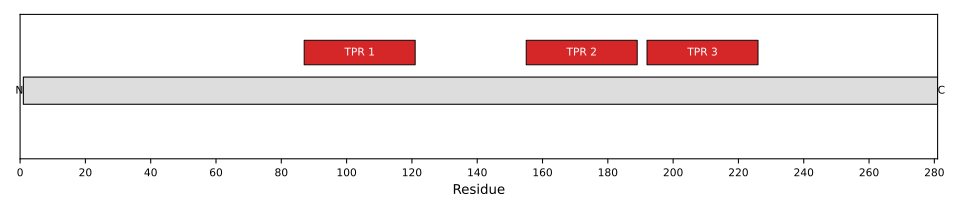
1: Part of the endoplasmic reticulum membrane protein complex (EMC) that enables the energy-independent insertion into endoplasmic reticulum membranes of newly synthesized membrane proteins (PubMed:29242231, PubMed:29809151, PubMed:30415835, PubMed:32439656, PubMed:32459176, PubMed:33964204). Preferentially accommodates proteins with transmembrane domains that are weakly hydrophobic or contain destabilizing features such as charged and aromatic residues (PubMed:29242231, PubMed:29809151, PubMed:30415835). Involved in the cotranslational insertion of multi-pass membrane proteins in which stop-transfer membrane-anchor sequences become ER membrane spanning helices (PubMed:29809151, PubMed:30415835). It is also required for the post-translational insertion of tail-anchored/TA proteins in endoplasmic reticulum membranes (PubMed:29242231, PubMed:29809151). By mediating the proper cotranslational insertion of N-terminal transmembrane domains in an N-exo topology, with translocated N-terminus in the lumen of the ER, controls the topology of multi-pass membrane proteins like the G protein-coupled receptors (PubMed:30415835). By regulating the insertion of various proteins in membranes, it is indirectly involved in many cellular processes (Probable)