DNA polymerase delta subunit 3 (DNA polymerase delta subunit C) (DNA polymerase delta subunit p66) (DNA polymerase delta subunit p68)
1_MADQL 6_ YLENI 11_ DEFVT 16_ DQNKI 21_ VTYKW 26_ LSYTL 31_ GVHVN 36_ QAKQM 41_ LYDYV 46_ ERKRK 51_ ENSGA 56_ QLHVT 61_ YLVSG 66_ SLIQN 71_ GHSCH 76_ KVAVV 81_ REDKL 86_ EAVKS 91_ KLAVT 96_ ASIHV 101_ YSIQK 106_ AMLKD 111_ SGPLF 116_ NTDYD 121_ ILKSN 126_ LQNCS 131_ KFSAI 136_ QCAAA 141_ VPRAP 146_ AESSS 151_ SSKKF 156_ EQSHL 161_ HMSSE 166_ TQANN 171_ ELTTN 176_ GHGPP 181_ ASKQV 186_ SQQPK 191_ GIMGM 196_ FASKA 201_ AAKTQ 206_ ETNKE 211_ TKTEA 216_ KEVTN 221_ ASAAG 226_ NKAPG 231_ KGNMM 236_ SNFFG 241_ KAAMN 246_ KFKVN 251_ LDSEQ 256_ AVKEE 261_ KIVEQ 266_ PTVSV 271_ TEPKL 276_ ATPAG 281_ LKKSS 286_ KKAEP 291_ VKVLQ 296_ KEKKR 301_ GKRVA 306_ LSDDE 311_ TKETE 316_ NMRKK 321_ RRRIK 326_ LPESD 331_ SSEDE 336_ VFPDS 341_ PGAYE 346_ AESPS 351_ PPPPP 356_ SPPLE 361_ PVPKT 366_ EPEPP 371_ SVKSS 376_ SGENK 381_ RKRKR 386_ VLKSK 391_ TYLDG 396_ EGCIV 401_ TEKVY 406_ ESESC 411_ TDSEE 416_ ELNMK 421_ TSSVH 426_ RPPAM 431_ TVKKE 436_ PREER 441_ KGPKK 446_ GTAAL 451_ GKANR 456_ QVSIT 461_GFFQR
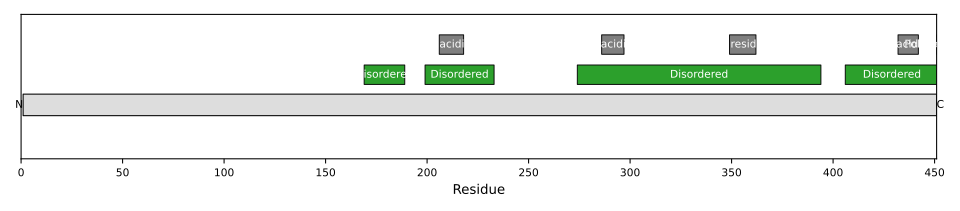
1: Accessory component of both the DNA polymerase delta complex and the DNA polymerase zeta complex (PubMed:17317665, PubMed:22801543, PubMed:24449906). As a component of the trimeric and tetrameric DNA polymerase delta complexes (Pol-delta3 and Pol-delta4, respectively), plays a role in high fidelity genome replication, including in lagging strand synthesis, and repair. Required for optimal Pol-delta activity. Stabilizes the Pol-delta complex and plays a major role in Pol-delta stimulation by PCNA (PubMed:10219083, PubMed:10852724, PubMed:11595739, PubMed:16510448, PubMed:24035200). Pol-delta3 and Pol-delta4 are characterized by the absence or the presence of POLD4. They exhibit differences in catalytic activity. Most notably, Pol-delta3 shows higher proofreading activity than Pol-delta4 (PubMed:19074196, PubMed:20334433). Although both Pol-delta3 and Pol-delta4 process Okazaki fragments in vitro, Pol-delta3 may also be better suited to fulfill this task, exhibiting near-absence of strand displacement activity compared to Pol-delta4 and stalling on encounter with the 5'-blocking oligonucleotides. Pol-delta3 idling process may avoid the formation of a gap, while maintaining a nick that can be readily ligated (PubMed:24035200). Along with DNA polymerase kappa, DNA polymerase delta carries out approximately half of nucleotide excision repair (NER) synthesis following UV irradiation. In this context, POLD3, along with PCNA and RFC1-replication factor C complex, is required to recruit POLD1, the catalytic subunit of the polymerase delta complex, to DNA damage sites (PubMed:20227374). Under conditions of DNA replication stress, required for the repair of broken replication forks through break-induced replication (BIR) (PubMed:24310611). Involved in the translesion synthesis (TLS) of templates carrying O6-methylguanine or abasic sites performed by Pol-delta4, independently of DNA polymerase zeta (REV3L) or eta (POLH). Facilitates abasic site bypass by DNA polymerase delta by promoting extension from the nucleotide inserted opposite the lesion (PubMed:19074196, PubMed:25628356, PubMed:27185888). Also involved in TLS, as a component of the tetrameric DNA polymerase zeta complex. Along with POLD2, dramatically increases the efficiency and processivity of DNA synthesis of the DNA polymerase zeta complex compared to the minimal zeta complex, consisting of only REV3L and REV7 (PubMed:24449906)