Non-POU domain-containing octamer-binding protein (NonO protein) (54 kDa nuclear RNA- and DNA-binding protein) (p54(nrb)) (p54nrb) (55 kDa nuclear protein) (NMT55) (DNA-binding p52/p100 complex, 52 kDa subunit)
1_MQSNK 6_ TFNLE 11_ KQNHT 16_ PRKHH 21_ QHHHQ 26_ QQHHQ 31_ QQQQQ 36_ PPPPP 41_ IPANG 46_ QQASS 51_ QNEGL 56_ TIDLK 61_ NFRKP 66_ GEKTF 71_ TQRSR 76_ LFVGN 81_ LPPDI 86_ TEEEM 91_ RKLFE 96_ KYGKA 101_ GEVFI 106_ HKDKG 111_ FGFIR 116_ LETRT 121_ LAEIA 126_ KVELD 131_ NMPLR 136_ GKQLR 141_ VRFAC 146_ HSASL 151_ TVRNL 156_ PQYVS 161_ NELLE 166_ EAFSV 171_ FGQVE 176_ RAVVI 181_ VDDRG 186_ RPSGK 191_ GIVEF 196_ SGKPA 201_ ARKAL 206_ DRCSE 211_ GSFLL 216_ TTFPR 221_ PVTVE 226_ PMDQL 231_ DDEEG 236_ LPEKL 241_ VIKNQ 246_ QFHKE 251_ REQPP 256_ RFAQP 261_ GSFEY 266_ EYAMR 271_ WKALI 276_ EMEKQ 281_ QQDQV 286_ DRNIK 291_ EAREK 296_ LEMEM 301_ EAARH 306_ EHQVM 311_ LMRQD 316_ LMRRQ 321_ EELRR 326_ MEELH 331_ NQEVQ 336_ KRKQL 341_ ELRQE 346_ EERRR 351_ REEEM 356_ RRQQE 361_ EMMRR 366_ QQEGF 371_ KGTFP 376_ DAREQ 381_ EIRMG 386_ QMAMG 391_ GAMGI 396_ NNRGA 401_ MPPAP 406_ VPAGT 411_ PAPPG 416_ PATMM 421_ PDGTL 426_ GLTPP 431_ TTERF 436_ GQAAT 441_ MEGIG 446_ AIGGT 451_ PPAFN 456_ RAAPG 461_ AEFAP 466_NKRRR
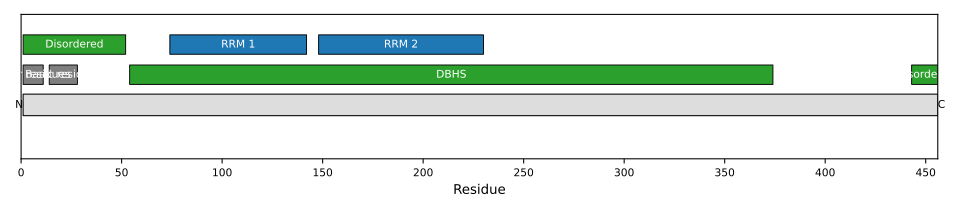
1: DNA- and RNA binding protein, involved in several nuclear processes (PubMed:11525732, PubMed:12403470, PubMed:26571461). Binds the conventional octamer sequence in double-stranded DNA (PubMed:11525732, PubMed:12403470, PubMed:26571461). Also binds single-stranded DNA and RNA at a site independent of the duplex site (PubMed:11525732, PubMed:12403470, PubMed:26571461). Involved in pre-mRNA splicing, probably as a heterodimer with SFPQ (PubMed:11525732, PubMed:12403470, PubMed:26571461). Interacts with U5 snRNA, probably by binding to a purine-rich sequence located on the 3' side of U5 snRNA stem 1b (PubMed:12403470). Together with PSPC1, required for the formation of nuclear paraspeckles (PubMed:22416126). The SFPQ-NONO heteromer associated with MATR3 may play a role in nuclear retention of defective RNAs (PubMed:11525732). The SFPQ-NONO heteromer may be involved in DNA unwinding by modulating the function of topoisomerase I/TOP1 (PubMed:10858305). The SFPQ-NONO heteromer may be involved in DNA non-homologous end joining (NHEJ) required for double-strand break repair and V(D)J recombination and may stabilize paired DNA ends (PubMed:15590677). In vitro, the complex strongly stimulates DNA end joining, binds directly to the DNA substrates and cooperates with the Ku70/G22P1-Ku80/XRCC5 (Ku) dimer to establish a functional preligation complex (PubMed:15590677). NONO is involved in transcriptional regulation. The SFPQ-NONO-NR5A1 complex binds to the CYP17 promoter and regulates basal and cAMP-dependent transcriptional activity (PubMed:11897684). NONO binds to an enhancer element in long terminal repeats of endogenous intracisternal A particles (IAPs) and activates transcription (By similarity). Regulates the circadian clock by repressing the transcriptional activator activity of the CLOCK-BMAL1 heterodimer (By similarity). Important for the functional organization of GABAergic synapses (By similarity). Plays a specific and important role in the regulation of synaptic RNAs and GPHN/gephyrin scaffold structure, through the regulation of GABRA2 transcript (By similarity). Plays a key role during neuronal differentiation by recruiting TET1 to genomic loci and thereby regulating 5-hydroxymethylcytosine levels (By similarity). Plays a role in the regulation of DNA virus-mediated innate immune response by assembling into the HDP-RNP complex, a complex that serves as a platform for IRF3 phosphorylation and subsequent innate immune response activation through the cGAS-STING pathway (PubMed:28712728, PubMed:30270045). Promotes activation of the cGAS-STING pathway in response to HIV-2 infection: acts by interacting with HIV-2 Capsid protein p24, thereby promoting detection of viral DNA by CGAS, leading to CGAS-mediated inmmune activation (PubMed:30270045). In contrast, the weak interaction with HIV-1 Capsid protein p24 does not allow activation of the cGAS-STING pathway (PubMed:30270045)